 Zhengchao An
3ed682be42
Zhengchao An
3ed682be42
* feat(log-analyzer): add crate skeleton and unified event model

Implements LA-1 (rustfs/backlog#1282) of the log fault-analysis system
(rustfs/backlog#1281): new synchronous rustfs-log-analyzer crate with the
LogEvent/LogLevel/SourceRef/EventKind/ParseStats model shared by all
later stages. No tokio, no rustfs-* internal deps by design.

Note: thiserror listed in the issue is deferred until a stage actually
defines error types (LA-3/LA-4) to avoid an unused dependency.

* feat(log-analyzer): add line parsing layer

Implements LA-2 (rustfs/backlog#1283): four parse channels tried in order
per line — native tracing JSON, container-prefix stripping (K8s CRI /
docker compose / journald) with JSON retry, multi-line Rust panic block
folding (both pre- and post-1.65 formats, stderr has no JSON logger), and
a plain-text fallback that never fails. Parse accounting feeds the report
parse-ratio disclosure.

* feat(log-analyzer): add ingest layer for directories and archives

Implements LA-3 (rustfs/backlog#1284): expands customer inputs (files,
directories, zip/tar/tar.gz/.zst/.gz, stdin-like readers) into parsed
events. Magic-byte detection with extension fallback, recursive archive
walking with depth/entry/byte/memory caps (every capped input disclosed
in IngestReport.skipped), first-level directory names become node labels,
and nothing is ever extracted to disk so hostile entry paths are inert.

Adds tar 0.4 to workspace deps (sync; the async astral-tokio-tar used by
rustfs-zip does not fit this crate's no-tokio contract).

* feat(log-analyzer): add rule model, matching engine, and finding aggregation

Implements LA-4 (rustfs/backlog#1285): owned serde-round-trippable Rule/
Matcher/Severity types (external JSON rules deserialize into the same
types later), fail-fast RuleSet validation that reports every problem at
once, a linear-scan engine with regexes compiled once, and an
order-independent FindingsCollector (commutative aggregates only; the
test asserts byte-identical output across shuffled input orders).

* feat(log-analyzer): add built-in seed rule library (68 rules, 12 categories)

Implements LA-5 (rustfs/backlog#1286): the 2026-07 repository-wide
failure-log survey distilled into rules across disk health, erasure/
bitrot, quorum, network/RPC, distributed locks, heal, scanner, IAM,
startup/config/TLS, capacity, decommission/rebalance, and process panics.

Every anchor was verified verbatim against the source tree (94/94 hits,
zero corrections needed). Quorum rules pre-fill implies_root_cause for
the Phase-2 folding (rustfs/backlog#1290); client-side rules carry burst
thresholds (min_count) so isolated client mistakes don't clutter reports.
Tests: one realistic positive sample per rule (table-driven), exact-set
smoke samples including the intentional internode/client signature
double-hit, and negative cases.

* feat(log-analyzer): add analysis orchestration, report rendering, and redaction

Implements LA-6 (rustfs/backlog#1287): a single-pass Analyzer that does
rule matching, minute-bucket timelines (gap-filled, merged to <=60
buckets), unmatched WARN/ERROR template clustering (placeholders for
numbers/uuids/paths/addresses/quotes, 5000-template cap disclosed as
<overflow>), mixed-UTC-offset detection, and below-min_count demotion to
a low-confidence section. Renderers: pipe-friendly terminal text, stable
JSON (schema_version=1), and ticket-pasteable Markdown. --redact hashes
customer identifiers (stable h:sha256[..8]) in samples/evidence/messages
while keeping rule ids, targets, and panic locations intact.

* feat(rustfs): add 'rustfs diagnose' subcommand for offline log fault analysis

Implements LA-7 (rustfs/backlog#1288): wires rustfs-log-analyzer into the
main binary as a diagnose subcommand that short-circuits before
observability/storage init (same pattern as 'info' / 'tls inspect') so
the report on stdout is never wrapped by the JSON logger.

rustfs diagnose <paths>... [--format text|json|md] [--since 24h]
  [--until ...] [--min-level warn] [--redact] [--top N] [--samples N]
Accepts files, directories, archives (.zip/.tar/.tar.gz/.zst/.gz) and '-'
for stdin. Exit codes: 0 = diagnosis completed (findings never fail the
process), 2 = bad arguments / no readable input.

diagnose_e2e covers the six MVP acceptance scenarios from
rustfs/backlog#1281 (directory+zst archive, multi-node zip attribution,
CRI-prefixed kubectl logs, panic folding, stable JSON schema, CLI parsing
incl. the legacy 'rustfs <volume>' preprocessor regression); the
full-binary smoke test is #[ignore]d (run with -- --ignored).
Usage doc: docs/operations/log-diagnose.md.

* ci(log-analyzer): guard rule anchors against log-message drift

Implements LA-8 (rustfs/backlog#1289): every seed-rule anchor must exist
verbatim in the rustfs source tree, so changing a log message without
updating its rule fails the gate instead of silently killing the rule.

- la-dump-anchors bin emits 'rule_id<TAB>anchor' TSV;
- scripts/check_log_analyzer_rules.sh greps each anchor (fixed-string,
  *.rs only, excluding crates/log-analyzer itself to avoid self-matches);
- RuleSet::new now rejects anchors that are blank, contain tab/newline,
  or are shorter than 8 bytes (no discriminating power); the '[FATAL]'
  anchor gained its trailing space to meet the floor while still matching
  the emit_fatal_stderr format string;
- wired as log-analyzer-rules-check into the pre-pr gate (it compiles the
  crate, so it stays out of the fast pre-commit set).

Negative self-test: breaking an anchor makes the script exit 1 naming the
rule ('MISSING anchor for rule inconsistent-drive: zzz-not-exist-anchor').

* refactor(log-analyzer): use root-relative provenance for directory inputs

Binary smoke run showed report samples citing full absolute paths, which
drowns the useful part. Directory inputs now label sources as
"<root-name>/<relative-path>" (e.g. "smoke-logs/node1/rustfs.log");
archives and single files keep their existing provenance.

* chore(log-analyzer): reword comment to satisfy the typos gate

* fix(log-analyzer): declare chrono serde feature locally after workspace feature localization

* fix(log-analyzer): bound line reads so a newline-less input cannot bypass the byte cap

read_until grew the line buffer with the entire remaining stream before the
max_total_bytes check ran, so a single multi-GB line (decompression bomb or
corrupt file) could allocate unboundedly. Replace it with a capped reader that
enforces the remaining global budget chunk-by-chunk and adds a per-line cap
(IngestOptions::max_line_bytes, default 1 MiB); over-cap tails are discarded
but still charged, and truncation is disclosed once per file as the new
line_too_long skip reason. Flagged by Codex review on #4876.

* fix(log-analyzer): redact field-shaped identifiers inside message text and widen the hash to 64 bits

--redact only hashed IPv4 literals in unstructured message text, so
bucket/object/access-key values embedded in messages (access_key=AK123,
'bucket: media, object: private/a.bin') leaked into reports documented as
safe to forward. Apply the SENSITIVE_FIELDS list to key=value / key: value
shapes in message text with the same hash as structured fields, and extend
the hash from 8 to 16 hex chars so cross-identifier collisions stay
negligible. Flagged by Codex and Copilot review on #4876.

* fix(log-analyzer): strip collector prefixes before panic-block absorption

An open panic block tested continuation lines against absorbs() before their
CRI/compose/journald prefix was stripped, so containerized panics stored the
prefix in the payload and split into a truncated panic plus text noise as soon
as the note/backtrace lines arrived. Stripping now happens once at the top of
feed() and every channel judges the payload. Flagged by Codex review on #4876.

* fix(log-analyzer): remove two input-order dependencies in representative selection

The unmatched-cluster target stayed pinned to the first-seen event while the
representative sample could be replaced, so sample and target could come from
different events and vary with input order; the pair now updates together by
lexicographic (sample, target) min. Sample selection tie-broke on line number
alone, which is only unique within one file; the key now includes the source
file. Flagged by Copilot review on #4876.

* fix(rustfs): reject negative relative times in diagnose --since/--until

parse_time_arg accepted "-24h" and produced a future timestamp, contradicting
the documented 'counted back from now' semantics. The amount now parses as
unsigned, so a leading '-' fails with the usual invalid-time error. Flagged by
Copilot review on #4876.

* feat(log-analyzer): Phase 2 — causal folding, timeline anomalies, external rules (LA-9) (#4942)

* feat(log-analyzer): collapse cascade symptoms under their root-cause finding

Phase-2 sub-item A (rustfs/backlog#1290): a finding whose rule declares
implies_root_cause edges folds under a qualifying root — root.first_seen <=
symptom.first_seen + 5min and root.last_seen >= symptom.first_seen - 30min,
existence-based when either side has no timestamps (pure stderr panics).
Findings gain collapsed_into/caused; text/markdown render the root block with
an indented cascade line and stop listing collapsed symptoms flat, while JSON
keeps every finding. Roots are promoted to the most severe position among
their block so the report top still answers 'the most likely cause'.

* feat(log-analyzer): detect timeline/clock anomalies (schema v2)

Phase-2 sub-item B (rustfs/backlog#1290): three deterministic hints rendered
between the summary and findings — mixed UTC offsets (with a clock-skew note
when signature-mismatch findings coexist), per-node time ranges that do not
overlap at all (both nodes >100 timestamped events), and log gaps of at least
max(15min, 3x bucket width) after >=3 consecutive active minutes, upgraded to
restart evidence when a startup-class finding begins within 5min after the
gap. JSON gains timeline_anomalies and schema_version bumps to 2.

* feat(diagnose): load external rules with --rules <file.json>

Phase-2 sub-item C (rustfs/backlog#1290): an external JSON rule file
({schema_version: 1, rules: [Rule...]}, the exact serde shape of the built-in
rules) merges over the seed library, with same-id rules replacing built-ins so
the support team can hotfix a misfiring rule without a release. The merged set
validates as a whole and any problem (bad regex, duplicate id, empty matcher
group, wrong schema version) prints every error and exits 2 — analysis never
runs on a half-broken set. External anchors are exempt from the CI anchor
guard, documented as author-owned quality. Adds the custom-rules section to
docs/operations/log-diagnose.md.

* fix(log-analyzer): address PR #4876 review (redaction coverage, order-independence, guards)

Redaction (--redact) now honours its "forwardable" intent across every report surface instead of a 15-name field whitelist applied over a subset:
- redact_event scrubs the full fields map (sensitive names hashed whole, every other value run through redact_text) plus provenance, so the JSON/Markdown full-sample dump no longer leaks non-whitelisted fields (client_ip, url, user, ...).
- node labels are hashed once at ingestion, so summary.nodes, per-node timeline ranges, samples and timeline anomalies stay consistent and correlatable under one stable hash.
- evidence values, unmatched-cluster templates and skipped-input paths are now redacted; peer/disk/drive/volume/node/user added to the sensitive set; IPv6 literals are hashed (without touching `rust::paths` or HH:MM:SS clocks); provenance keeps the leaf filename and hashes the customer directory/archive prefix.
- redact.rs and docs/operations/log-diagnose.md reworded to "best-effort identifier scrubbing", not an anonymization guarantee.

Order-independence (the crate's headline contract):
- the evidence value cap keeps the lexicographically smallest N distinct values instead of the first-N-by-arrival (previously order-dependent).
- first_seen/last_seen break equal-instant ties on the offset, so the serialized RFC3339 offset no longer depends on input order.

Parsing:
- a new-format panic header no longer swallows the line immediately after it when that line is itself a JSON event or a second panic header (previously dropped an interleaved ERROR in merged stdout/stderr, or merged a panic-during-panic); trailing "note: ..." backtrace lines now fold into the block.

CLI:
- diagnose --since/--until reject absurd relative amounts via checked_sub_signed instead of panicking; the exit-code doc now matches actual behaviour.

CI:
- check_log_analyzer_rules.sh is wired into the ci.yml test-and-lint job (it was only in make pre-pr, so anchor drift from other PRs could merge green).

Markdown table cells escape '|' so customer log text cannot break the table structure.

---------

Co-authored-by: houseme <housemecn@gmail.com>
RustFS is a high-performance, distributed object storage system built in Rust.





Getting Started · Docs · Bug reports · Discussions
English | 简体中文 | Deutsch | Español | français | 日本語 | 한국어 | Portuguese | Русский
RustFS is a high-performance, distributed object storage system built in Rust—one of the most loved programming languages worldwide. RustFS combines the simplicity of MinIO with the memory safety and raw performance of Rust. It offers broad S3 API compatibility for supported features, is completely open-source, and is optimized for data lakes, AI, and big data workloads.
Unlike other storage systems, RustFS is released under the permissible Apache 2.0 license, avoiding the restrictions of AGPL. With Rust as its foundation, RustFS delivers superior speed and secure distributed features for next-generation object storage.
Feature & Status
- High Performance: Built with Rust to ensure maximum speed and resource efficiency.
- Distributed Architecture: Scalable and fault-tolerant design suitable for large-scale deployments.
- S3 Compatibility: Seamless integration with common S3-compatible applications and tools; current coverage is tracked in the S3 compatibility matrix.
- OpenStack Swift API: Native support for Swift protocol with Keystone authentication.
- OpenStack Keystone Integration: Native support for OpenStack Keystone authentication with X-Auth-Token headers.
- Data Lake Support: Optimized for high-throughput big data and AI workloads.
- Open Source: Licensed under Apache 2.0, encouraging unrestricted community contributions and commercial usage.
- User-Friendly: Designed with simplicity in mind for easy deployment and management.
| Feature | Status | Feature | Status |
|---|---|---|---|
| S3 Core Features | ✅ Available | Bitrot Protection | ✅ Available |
| Upload / Download | ✅ Available | Single Node Mode | ✅ Available |
| Versioning | ✅ Available | Bucket Replication | ✅ Available |
| Logging | ✅ Available | Lifecycle Management | 🚧 Under Testing |
| Event Notifications | ✅ Available | Distributed Mode | 🚧 Under Testing |
| K8s Helm Charts | ✅ Available | RustFS KMS | 🚧 Under Testing |
| Keystone Auth | ✅ Available | Multi-Tenancy | ✅ Available |
| Swift API | ✅ Available | Swift Metadata Ops | 🚧 Partial |
RustFS vs MinIO Performance
Stress Test Environment:
| Type | Parameter | Remark |
|---|---|---|
| CPU | 2 Core | Intel Xeon (Sapphire Rapids) Platinum 8475B, 2.7/3.2 GHz |
| Memory | 4GB | |
| Network | 15Gbps | |
| Drive | 40GB x 4 | IOPS 3800 / Drive |
https://github.com/user-attachments/assets/2e4979b5-260c-4f2c-ac12-c87fd558072a
RustFS vs Other Object Storage
| Feature | RustFS | Other Object Storage |
|---|---|---|
| Console Experience | Powerful Console Comprehensive management interface. |
Basic / Limited Console Often overly simple or lacking critical features. |
| Language & Safety | Rust-based Memory safety by design. |
Go or C-based Potential for memory GC pauses or leaks. |
| Data Sovereignty | No Telemetry / Full Compliance Guards against unauthorized cross-border data egress. Compliant with GDPR (EU/UK), CCPA (US), and APPI (Japan). |
Potential Risk Possible legal exposure and unwanted data telemetry. |
| Licensing | Permissive Apache 2.0 Business-friendly, no "poison pill" clauses. |
Restrictive AGPL v3 Risk of license traps and intellectual property pollution. |
| Compatibility | S3-Compatible Core Works with common S3-compatible clients, with coverage tracked in the compatibility matrix. |
Variable Compatibility May lack support for local cloud vendors or specific APIs. |
| Edge & IoT | Strong Edge Support Ideal for secure, innovative edge devices. |
Weak Edge Support Often too heavy for edge gateways. |
| Risk Profile | Enterprise Risk Mitigation Clear IP rights and safe for commercial use. |
Legal Risks Intellectual property ambiguity and usage restrictions. |
Staying ahead
Star RustFS on GitHub and be instantly notified of new releases.
Quickstart
To get started with RustFS, follow these steps:
1. One-click Installation (Option 1)
curl -O https://rustfs.com/install_rustfs.sh && bash install_rustfs.sh
2. Docker Quick Start (Option 2)
The RustFS container runs as a non-root user rustfs (UID/GID 10001:10001). If you bind-mount host directories with Docker or Compose, every mounted path must be writable by that user, otherwise startup may fail with permission denied errors. This applies to data directories, log directories, and TLS certificate directories when RUSTFS_TLS_PATH is enabled.
# Create data and logs directories
mkdir -p data logs

# Change the owner of these directories
chown -R 10001:10001 data logs

# Using latest version
docker run -d -p 9000:9000 -p 9001:9001 -v $(pwd)/data:/data -v $(pwd)/logs:/logs rustfs/rustfs:latest

# Using specific version
docker run -d -p 9000:9000 -p 9001:9001 -v $(pwd)/data:/data -v $(pwd)/logs:/logs rustfs/rustfs:1.0.0-beta.10
If you use podman instead of docker, you can install the RustFS with the below command
# Create data and logs directories
mkdir -p data logs

# Run the container (podman will automatically set the folders ownership)
podman run -d -p 9000:9000 -p 9001:9001 -v $(pwd)/data:/data:Z,U -v $(pwd)/logs:/logs:Z,U rustfs/rustfs:latest
If you enable TLS with a bind-mounted certificate directory, prepare that mount the same way:
mkdir -p certs
chown -R 10001:10001 certs
You can also use Docker Compose. Using the docker-compose-simple.yml file in the root directory:
docker compose -f docker-compose-simple.yml up -d
Before running Compose with host bind mounts:
- Ensure every mounted host path is writable by
10001:10001. - If you enable TLS, ensure the certificate mount for
/opt/tlsis also readable by10001:10001. - If matching host ownership is not practical, run the
rustfsservice withuser: "<host-uid>:<host-gid>"instead. docker-compose-simple.ymlincludes avolume-permission-helperservice for named volumes.docker-compose-simple.ymlrelies on you to prepare bind-mounted host paths in advance.
Similarly, you can run the command with podman
podman compose -f docker-compose-simple.yml up -d
Webhook notification quick start (Docker):
docker run -d --name rustfs -p 9000:9000 \
  -e RUSTFS_NOTIFY_ENABLE=true \
  -e RUSTFS_NOTIFY_WEBHOOK_ENABLE_PRIMARY=on \
  -e RUSTFS_NOTIFY_WEBHOOK_ENDPOINT_PRIMARY=http://<host-ip>:3020/webhook \
  -e RUSTFS_NOTIFY_WEBHOOK_QUEUE_DIR_PRIMARY=/tmp/rustfs-events \
  rustfs/rustfs:latest
Notes:
RUSTFS_NOTIFY_ENABLE=trueenables the global notify module switch.- For ARN
arn:rustfs:sqs::primary:webhook, use instance-scoped env vars with_PRIMARY. - If queue dir is omitted, default is
/opt/rustfs/events; ensure it is writable by the container runtime user. RUSTFS_NOTIFY_WEBHOOK_SKIP_TLS_VERIFY_PRIMARYdefaults tofalse; enabling it skips webhook TLS certificate verification, allows MITM attacks, and emits a startup warning. PreferRUSTFS_NOTIFY_WEBHOOK_CLIENT_CA_PRIMARYfor private CAs.
NOTE: We recommend reviewing the docker-compose.yml file before running. It defines several services including Grafana, Prometheus, and Jaeger, which are helpful for RustFS observability. If you wish to start Redis or Nginx containers, you can specify the corresponding profiles.
3. Build from Source (Option 3) - Advanced Users
For developers who want to build RustFS Docker images from source with multi-architecture support:
# Build multi-architecture images locally
./docker-buildx.sh --build-arg RELEASE=latest

# Build and push to registry
./docker-buildx.sh --push

# Build specific version
./docker-buildx.sh --release v1.0.0 --push

# Build for custom registry
./docker-buildx.sh --registry your-registry.com --namespace yourname --push
The docker-buildx.sh script supports:
- Multi-architecture builds:
linux/amd64,linux/arm64 - Automatic version detection: Uses git tags or commit hashes
- Registry flexibility: Supports Docker Hub, GitHub Container Registry, etc.
- Build optimization: Includes caching and parallel builds
You can also use Make targets for convenience:
make docker-buildx                    # Build locally
make docker-buildx-push               # Build and push
make docker-buildx-version VERSION=v1.0.0  # Build specific version
make help-docker                      # Show all Docker-related commands
Heads-up (macOS cross-compilation): macOS keeps the default
ulimit -nat 256, socargo zigbuildor./build-rustfs.sh --platform ...may fail withProcessFdQuotaExceededwhen targeting Linux. The build script attempts to raise the limit automatically, but if you still see the warning, runulimit -n 4096(or higher) in your shell before building.
4. Build with Helm Chart (Option 4) - Cloud Native
Follow the instructions in the Helm Chart README to install RustFS on a Kubernetes cluster.
For scanner pacing, cycle budgets, bitrot cadence, lifecycle transition status,
and single-node single-disk idle CPU tuning, see
Scanner Runtime Controls. For
repeatable scanner-pressure validation, see
Scanner Benchmark Runbook. For
drive timeout knobs on slow storage — including the walk stall budget that
governs ListObjects on large prefixes — see
Drive Timeout Tuning.
5. Nix Flake (Option 5)
If you have Nix with flakes enabled:
# Run directly without installing
nix run github:rustfs/rustfs

# Build the binary
nix build github:rustfs/rustfs
./result/bin/rustfs --help

# Or from a local checkout
nix build
nix run
6. X-CMD (Option 6)
If you are an x-cmd user:
# Run directly without installing
x rustfs

# Download the binary and install it to the global environment
x env use rustfs
rustfs --help
Accessing RustFS
- Access the Console: Open your web browser and navigate to
http://localhost:9001to access the RustFS console.- Default credentials:
rustfsadmin/rustfsadmin
- Default credentials:
- Create a Bucket: Use the console to create a new bucket for your objects.
- Upload Objects: You can upload files directly through the console or use S3-compatible APIs/clients to interact with your RustFS instance.
NOTE: To access the RustFS instance via https, please refer to the TLS Configuration Docs.
OIDC Roles Claim (Microsoft Entra ID)
RustFS supports mapping an OIDC claim containing role values into the existing
authorization pipeline. The roles_claim setting is optional: when unset or
empty, only the groups claim contributes to authorization (same as older
RustFS releases). For Microsoft Entra ID app roles, set roles_claim=roles so
both console admin checks and bucket IAM policies can evaluate those roles.
Example environment configuration (opt-in roles claim):
RUSTFS_IDENTITY_OPENID_ENABLE=on
RUSTFS_IDENTITY_OPENID_CONFIG_URL="https://login.microsoftonline.com/<tenant-id>/v2.0/.well-known/openid-configuration"
RUSTFS_IDENTITY_OPENID_CLIENT_ID="<client-id>"
RUSTFS_IDENTITY_OPENID_CLIENT_SECRET="<client-secret>"
RUSTFS_IDENTITY_OPENID_SCOPES="openid,profile,email"
RUSTFS_IDENTITY_OPENID_GROUPS_CLAIM="groups"
RUSTFS_IDENTITY_OPENID_ROLES_CLAIM="roles"
Policy condition example (evaluate app roles directly with jwt:roles; when
roles_claim is configured, RustFS also merges those values into jwt:groups
for backward compatibility with older policies):
{
  "Version": "2012-10-17",
  "Statement": [
    {
      "Effect": "Allow",
      "Action": ["admin:*"],
      "Resource": ["arn:aws:s3:::*"],
      "Condition": {
        "ForAnyValue:StringEquals": {
          "jwt:roles": ["RustFS.ConsoleAdmin"]
        }
      }
    }
  ]
}
Documentation
For detailed documentation, including configuration options, API references, and advanced usage, please visit our Documentation.
Getting Help
If you have any questions or need assistance:
- Check the FAQ for common issues and solutions.
- Join our GitHub Discussions to ask questions and share your experiences.
- Open an issue on our GitHub Issues page for bug reports or feature requests.
Links
- Documentation - The manual you should read
- Changelog - What we broke and fixed
- GitHub Discussions - Where the community lives
- Discord - Chat with the RustFS community
Contact
- Bugs: GitHub Issues
- Business: hello@rustfs.com
- Jobs: jobs@rustfs.com
- General Discussion: GitHub Discussions
- Contributing: CONTRIBUTING.md
Contributors
RustFS is a community-driven project, and we appreciate all contributions. Check out the Contributors page to see the amazing people who have helped make RustFS better.

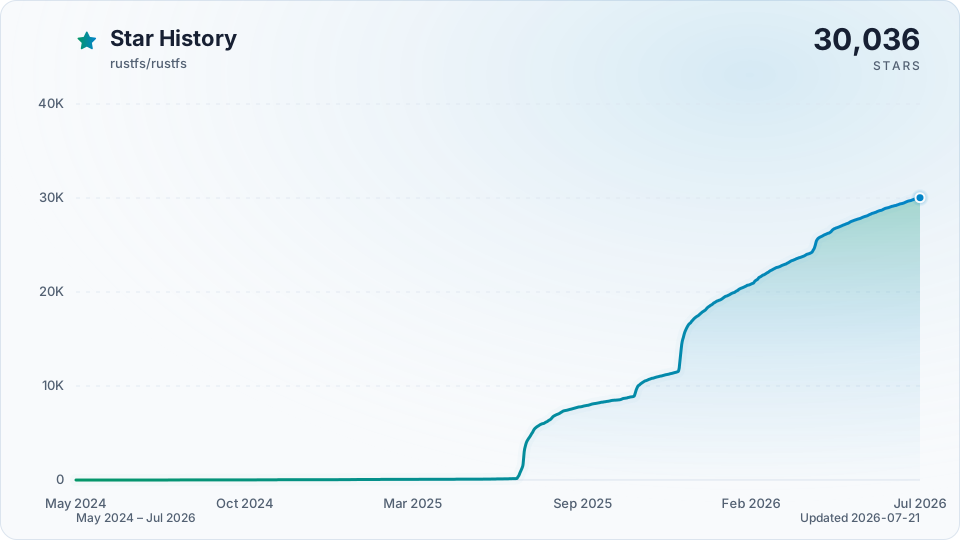
Star History
License
RustFS is a trademark of RustFS, Inc. All other trademarks are the property of their respective owners.