 Chris An
d6210ac17b
* fix(ecstore,heal,select): bound storage-layer work driven by client input

Scan findings in the erasure store, heal, file metadata and S3 Select
layers, grouped because they share the disk walk, the multipart staging
area, delete recovery and the select snapshot lease:

- Multipart: upload ids are canonicalized before they name a staging path
  or a lock key (backlog#3027); trailing-slash keys are encoded like every
  other handler (backlog#3055); unlisted parts are removed at completion
  (backlog#3106); per-bucket uploads are found through a signed per-disk
  index instead of a scan of the shared staging area (backlog#3121);
  encrypted part ETags carry a per-upload secret so a write-only user
  cannot confirm plaintext guesses (backlog#3044).
- Delete and recovery: recovery walks are bounded per request
  (backlog#3038); a delete marker on a key whose xl.meta path is a
  directory, and sidecar names used as child keys, no longer wedge the
  journal (backlog#3035, backlog#3105); over-quota PUTs no longer list the
  bucket under the ledger lock (backlog#3128).
- Listing: scan_dir sends metadata without inline data (backlog#3052),
  counts delete markers against max-keys (backlog#3108), and rejects a
  marker that carries the cursor tag (backlog#3059).
- Heal: bucket metadata and heal records live in separate namespaces so
  DeleteBucket cannot erase a drive rebuild (backlog#3039), a deleted
  bucket is skipped instead of failing the rebuild (backlog#3040), and
  directory objects are encoded on readback (backlog#3061).
- Restore and tiering: RestoreObject preserves tags and the version's
  modification time (backlog#3073, backlog#3074); Snowball transport
  headers are not forwarded to the tier (backlog#3090); an epoch
  modification time round-trips through xl.meta (backlog#3063).
- Locks: PutObject takes its bucket locks after the body is staged
  (backlog#3131); SelectObjectContent releases its namespace locks once
  the snapshot is taken (backlog#3132).
- RPC and peers: the v3 signature check consumes the v2 nonce
  (backlog#3129); a bucket-metadata reload timeout no longer marks the
  peer offline (backlog#3124); replication target requests carry an
  operation deadline (backlog#3102); the scanner resumes its interrupted
  wait after a lifecycle write (backlog#3118).
- S3 Select: bounded schema inference, column cap and budgeted CSV
  batches, Parquet dictionary bounds and pre-planner projection checks
  (backlog#3075, backlog#3076, backlog#3077, backlog#3078).

* test(e2e): seed legacy duplicate bucket tags offline for the OPA contract

* fix(s3): authorize what handlers store and bound request-driven work

Scan findings in the S3 request layer (access hooks, object use cases,
HTTP server layers), grouped because they share the authorization
condition builder, the PutObject admission path and the response
layers. Builds on the storage-layer batch for the bounded recovery and
multipart APIs it calls.

Authorization and policy conditions:
- copy source is percent-decoded and version-canonical before the
  s3:x-amz-copy-source condition (backlog#3135); CopyObject authorizes
  the tag set it copies (backlog#3034); HeadObject with the replication
  check header still authorizes s3:GetObject (backlog#3047); the
  x-rustfs-source-version-id header feeds s3:versionid (backlog#3072);
  recursive force-delete with a REPLICA header authorizes every
  descendant as a delete (backlog#3070); include-deleted listings require
  s3:ListBucketVersions (backlog#3099); the metadata listing route keeps
  table isolation and uses the same prefix it authorizes (backlog#3053,
  backlog#3054); If-Match probing needs read permission (backlog#3097);
  Object Lambda checks s3:GetObjectVersion (backlog#3058); replication
  proxy fallback keeps ExistingObjectTag denies (backlog#3089); HeadObject
  returns lock and tag headers only with permission (backlog#3113);
  IPv4 clients on the dual-stack listener match IPv4 SourceIp conditions
  (backlog#3049); bucket policies are parsed once and cached
  (backlog#3032); keystone: access keys no longer verify with an empty
  secret (backlog#3043).
Admission and resource bounds:
- GetObject releases disk-read permits when the client stops reading
  (backlog#3023); PutObject takes buffer and foreground admission only
  after body bytes arrive and bounds the wait (backlog#3031,
  backlog#3084); xl.meta size is bounded on the write path
  (backlog#3100); XML compat layers stream instead of buffering whole
  bodies (backlog#3094); tier GETs stream the remote body (backlog#3046); on-demand migration pulls release permits on
  unread GETs (backlog#3110); SSE-KMS key policy covers UploadPart and
  completion (backlog#3130); MinIO admin decryption runs Argon2id off the
  async worker (backlog#3024).
Input validation and leaks:
- replication headers are validated (source ETag shape, original size)
  (backlog#3092, backlog#3093); control characters in keys and lifecycle
  rule IDs are rejected (backlog#3101, backlog#3117); Snowball member
  mtime needs s3:ReplicateObject (backlog#3083); DeleteObjects checks
  Content-MD5 and admin/STS reject SigV2 replays with altered query or
  body (backlog#3037, backlog#3026); request logs redact presigned
  queries and handler spans skip credentials (backlog#3068,
  backlog#3107); SSE-C listings and completions withhold plaintext
  metadata and checksums (backlog#3120, backlog#3050); CORS resolves the
  bucket like s3s does (backlog#3104); PutBucketTagging rejects duplicate
  keys (backlog#3126); notifications fire after a client disconnect
  (backlog#3127); ListenNotification streams re-check access
  (backlog#3119).

* fix(api): drop imports left unused by the base merge

* test(s3): move the KMS multipart denial test to the app layer

The test drives app-layer multipart use cases, so it belongs with them;
living in the SSE module it imported app code from the infra layer and
failed the layer dependency guard. The SSE test helpers it borrows are
exposed through the storage and app facades.

* fix(s3): keep the SSE-C key fingerprint on keyless multipart completion

The backlog#3050 fix withheld both the plaintext checksums and the
customer-key MD5 header from a CompleteMultipartUpload that did not
present the key. The checksums are a digest of the plaintext and stay
hidden; the key MD5 identifies the key only, and the S3 conformance suite
(test_copy_part_enc) expects it on a keyless completion, so it is echoed
again.

* fix(tier): stream GET bodies and document replication budgets

* fix(ecstore,s3): keep the multipart index and cold fill off disk lifetimes

Two lifecycle regressions surfaced once the storage and request batches
ran together against main:

- The multipart index owner cloned the disk's pinned publication root and
  bootstrapped on a task of its own. That kept the mount alive past the
  last LocalDisk owner (the disk lifecycle allows exactly three holders of
  the root FD) and left a stray task behind, which the local-disk and
  read-repair tests detect. The owner now keeps only the root path and
  reopens it for identity checks, and the bootstrap scan rides the disk's
  existing cleanup task, where stopping the disk abandons it and a
  reconnect resumes it.
- The disk-read admission wrapper defers releasing its permit until an
  in-flight read completes, so a cancelled client cannot widen disk
  concurrency. The cold-fill producer, however, drops a read it has
  already classified as stalled when its deadline fires, and that permit
  stayed pinned for the lifetime of the stuck read. The producer now
  abandons the admission explicitly on timeout.

* test(ecstore): pass the index owner to the Linux cleanup-loop test

* fix(s3): release cold-fill admission after watchdog handoff

* fix(s3,ecstore): close the round-1 adversarial review findings

Adversarial review of the combined request- and storage-layer batch found
fixes that fell short of their issues, two behaviour regressions for
legitimate clients and several unrequested costs:

- backlog#3038: a bulk DeleteObjects reserved the whole per-disk
  inspection allowance up front for every key in flight and exhausted the
  16 Mi request budget on any set wider than eight drives, failing healthy
  keys with SlowDown. Calls are now admitted while budget remains and
  charged for the entries they actually visited. Object-scoped discovery
  charges plain child keys at one entry per 64 names instead of one each,
  so deleting a missing key that names a folder prefix completes instead
  of answering 503 forever while a hostile prefix stays bounded. A peer
  still on the previous binary is reported
  as an unsupported participant, the repository's rolling-upgrade
  contract, instead of as a budget verdict.
- backlog#3037/#3026: a SigV2 configuration PUT without Content-MD5 was
  still replayable with another body; it is refused with MissingContentMD5
  while SigV4 keeps the optional-MD5 contract.
- backlog#3072: DeleteObject now resolves x-rustfs-source-version-id before
  authorization like PUT and COPY, so a replica delete cannot remove a
  version the policy never saw.
- backlog#3121: the multipart index no longer fsyncs a marker and four
  directories per multipart metadata write (it is rebuilt on every start),
  and ListMultipartUploads discovers roots concurrently.
- backlog#3077: Parquet SelectObjectContent decodes budget-sized batches
  instead of one row per batch.
- backlog#3031: a full upload buffer pool hands out an unpooled buffer
  instead of refusing the upload; the progress floor already bounds stalls.
- backlog#3023: the GET disk-read idle cut-off is configurable
  (RUSTFS_GET_DISK_READ_IDLE_TIMEOUT_SECS, default 120 s) so a paused
  client is not truncated after 30 s.
- backlog#3075: JSON Lines schema inference keeps the sample collected at
  the 4 MiB bound instead of failing the query.
- backlog#3024: compat admin decryption queues briefly for a slot instead
  of refusing the third concurrent request.
- backlog#3113: HEAD skips its permission probes for the bucket owner.
- backlog#3117: control characters in a lifecycle rule ID are rejected on
  PutBucketLifecycle as well.

The lock-crate publication FIFO serves backlog#3111 and moves to the
table-catalog PR. Also fixed: a lossy admin error message, an unused
s3-client function, two unused test-util features, a duplicated key
validation, the s3s footprint baseline, and a stale log event name in the
reverse-proxy runbook. The ODM multipart write-back test runs on the large
test stack like its sibling.

* fix(table-catalog): bound maintenance work and isolate table namespaces (#9174)

* fix(table-catalog): bound maintenance work and isolate table namespaces

Scan findings in the Iceberg table catalog:

- Metadata maintenance deleted every unreferenced *.metadata.json in a
  table's directory without checking whether a renamed table in another
  namespace still owned those files (backlog#3060); it now resolves the
  owning table through the directory index before deleting.
- Manifest lists and manifests were decoded with the embedded Avro
  writer schema and no recursion depth limit; a self-referencing record
  schema overflowed the stack (backlog#3080). Schemas are validated for
  depth before decoding.
- Compaction decoded every input Parquet file into Arrow batches held in
  memory; a decompression bomb OOM-killed the server (backlog#3085). Row
  groups are streamed through a byte budget and oversized inputs are
  refused.
- An S3 request for a key outside an indexed table prefix listed the
  bucket's whole namespaces/ catalog prefix and failed once it held more
  than 4096 objects (backlog#3086); a per-bucket directory index answers
  index misses without the listing.
- The maintenance planner read whole orphan files to obtain their
  modification time (backlog#3087); it reads metadata only.
- A client disconnect between persisting active_rename_id and clearing it
  left the bucket's catalog entry locked at 503 (backlog#3088); the rename
  runs detached from the request future and clears the flag on every exit.
- Table commits held the bucket publication fence until publication,
  starving every object write (backlog#3111); commits now hold it under a
  deadline and object writes are admitted between commits.

The directory index is managed through three new admin routes under
{warehouse}/catalog/directory, registered in the admin route policy.

The durable-strong store is left as is (its snapshot partitioning for
backlog#3109 and the strong-path deadline are not ported): that backing
is being retired separately, so the new tests cover the object backing.

* fix(table-catalog): close the review gaps in the scan-fix batch

Adversarial review of the table-catalog batch found the fixes narrower
than the issues they close and two cost regressions:

- backlog#3085: the compaction footer check bounded nothing a page header
  could not override; parquet sizes its page buffers from the header.
  Walk every column chunk's page headers (Thrift compact, no decompression)
  and hold each page and the chunk total to the budget before decoding.
  The stored-input budget is per rewrite group, so a multi-group job no
  longer fails after writing earlier outputs.
- backlog#3086: the default index-miss scan still counted maintenance
  reports toward its 4096-object limit; only table entries count now, and
  the listing itself is bounded to 64 pages. The directory index remains
  an optional accelerator.
- backlog#3111: a create wrote its metadata file under the fence as the
  first durable mutation, which disarmed the deadline before the unbounded
  registration inventory. The write precedes publication now. The deadline
  gets its own knob (RUSTFS_TABLE_CATALOG_PUBLICATION_PREPARATION_TIMEOUT_SECS,
  default 30 s, never below the lock-acquire timeout) instead of reusing
  the 5 s lock timeout, and the ownership inventory reads entries
  concurrently.
- Directory candidates are written only while a directory exists; the
  backfill covers earlier entries. A directory on the migration-fence
  path is reported as a conflict instead of a parse error.
- Dead test hooks, a stale comment and the support-matrix text that did
  not match the code are removed or corrected.

* fix(select): preserve complete samples and Parquet batch limits

* fix(s3,ecstore): close the round-2 adversarial review findings

DeleteObject resolved x-rustfs-source-version-id for authorization on
every request while storage consumes it only for a REPLICA request, so a
non-replica caller with s3:DeleteObjectVersion could trigger a plain
delete of the current version. The hook now resolves the header under
the same predicate as storage, and the regression test covers the
non-replica case.

HEAD no longer skips its permission probes for the bucket owner; an
explicit bucket-policy Deny on the metadata actions binds the owner too.

Multipart index pages verify each root against the staging area and
prune markers whose staging root is gone, under the marker's own lease
with a re-check, so the per-drive index stays proportional to live
uploads instead of every key ever multipart-initiated on the drive.

SigV2 configuration PUTs that declare an empty body need no Content-MD5:
there is no body to replay. The minimum-progress floor stays independent
of RUSTFS_HTTP_REQUEST_BODY_READ_TIMEOUT; the knob's documentation now
says so instead of claiming 0 disables it. The quota bootstrap window
(503 until the background scan publishes the ledger) is kept, because
ledger admission must not come from scanner reporting; the compatibility
matrix now documents it.

The S3 compatibility matrix gains a section for the client-visible
validation bounds, and the drive-timeout tuning guide tabulates
RUSTFS_GET_DISK_READ_IDLE_TIMEOUT_SECS.

* fix(lock): queue table-bucket publication writers fairly

Table commits take the bucket publication fence as a write lock; under a
stream of commits the lock's try-and-retry acquisition let a new commit
jump ahead of object writers that had been waiting longer, which is part
of what starved them (backlog#3111). Requests for the publication lock
path now take a FIFO ticket per shard: a waiter is admitted only when it
is at the head of the queue, cancelled waiters release their turn, and
batch acquisitions join the same queue. Other lock paths are unchanged.

This moved here from the request-layer batch, where no cited issue
covered it; it serves the table-catalog issue this PR closes.

* fix(table-catalog): close the round-2 adversarial review findings

Parquet page-header walker: read the size fields by field id as parquet
does, accepting I16/I32/I64 wire kinds and rejecting any other kind, so
a header encoding uncompressed_page_size as I64 can no longer bypass the
budget while parquet allocates it. Bound every list, set and map count by
the bytes remaining in the chunk, and reject bool collection elements
(parquet skips them with zero width, so either width would desynchronize
the two parsers); this removes the 2^63-iteration spin on LIST<BOOL>.
Start each column-chunk walk at the dictionary page offset whenever the
footer declares one, exactly as parquet's byte_range does, instead of
min(dictionary, data).

Footer pre-walk: before parquet decodes a footer, walk FileMetaData with
the hardened cursor and charge the declared row_groups count times the
RowGroupMetaData size to the decode budget, because parquet 59 reserves
that Vec before reading one element.

Preparation deadline: clamp the
RUSTFS_TABLE_CATALOG_PUBLICATION_PREPARATION_TIMEOUT_SECS knob to 86,400
seconds so Instant + Duration cannot overflow.

Index-miss scan: after each listing page, jump the cursor past the
maintenance subtree the page ended in, and allow one extra page per table
entry already listed, so job-report history scales with the catalog while
a report flood under one table stays bounded.

Migration fence: read the fence-path object once and decide from its
stored kind whether it is directory state or a fence.

Expired or failed create: remove the initial metadata file when the
registration fails before any catalog write may have begun; nothing else
references it. Correct the comment and support matrix that claimed
maintenance reclaims it.

Tests cover each walker divergence, the footer row-group reservation, the
deadline ceiling, the paging budget for honest catalogs and for a report
flood, and the removal of the unpublished metadata file.

* test(admin): register the catalog directory routes in the route matrix

The table-catalog batch added GET, POST and DELETE
{warehouse}/catalog/directory on both the Iceberg and the compat admin
prefixes without listing them in the admin route matrix, so
test_admin_route_matrix_matches_registered_routes failed on CI.

* fix(s3,ecstore): close the round-3 adversarial review findings

Multipart index pages now treat the cursor as the last examined marker
rather than the last root, so a page that pruned a stale marker still
validates and ListMultipartUploads keeps using the index. A marker is
written before its staging root is published, so pruning spares markers
younger than a five-minute grace period and an existing marker is
touched on every new upload; the prune re-checks both under the marker
lease. Bounded delete-recovery inspection rides the durable-mutation
lane like the unbounded path instead of the one-worker foreground lane.
The on-demand-migration inline body budget scales with the object size
(at least 64 KiB/s) instead of a flat 120 s. The control-body digest
service honors RUSTFS_HTTP_REQUEST_BODY_READ_TIMEOUT=0 as "no
inactivity timeout" like every other reader of that knob.

Quota reconciliation throttle objects are deleted together with a
retired generation's ledger, so bucket turnover leaves no residue. The PUT guard
test shim is gone; tests call the shared guard. Bounded DiskAPI defaults
answer MethodNotAllowed like their siblings. Stale
budget docs, an unreachable CSV arm, an always-Some limit parameter,
commented-out constants and a misplaced doc comment are cleaned up;
weak test assertions name the expected error; lifecycle rule-ID control
characters gain a test. The compatibility matrix records the CopyObject
tag-copy permission, the exact SigV2 empty-body predicate, replica and
migration writes of control-character keys, and the SigV2 DeleteObjects
digest rule.

* fix(table-catalog,heal): close the round-3 review findings

A. Pack compaction rewrite groups to min(max-rewrite-bytes-per-job,
   TABLE_COMPACTION_MAX_STORED_BYTES), reject an over-ceiling group before
   any output is written, and name the ceiling in the commit-path errors;
   document the effective cap in the support matrix and scheduler runbook.
B. Keep TaskCancelled/TaskTimeout classification on replacement passes:
   the namespace verification runs only for completed or storage-failed
   passes, in the erasure healer and the task bucket prepass.
C. Compare the replacement bucket pass per bucket: a recorded identity
   that is gone or replaced still errors or restarts the pass, buckets
   created mid-pass are appended to the identities, pending_buckets and a
   persisted positional order without rewinding progress or the
   checkpoint; verification ignores additions.
D. Read the migration-fence object once in the object-backed write permit
   and dispatch on its kind.
E. Drop the strong store's copy of maintenance_cleanup_roots.
F. Remove the unused test hooks fail_put_prefix, corrupt_put_prefix and
   pause_after_metadata; make compact_parquet_data_files and
   PublicationTicket.state private.
G. Document the body-revision identity, the legacy revalidation budget
   and its HTTP 503 in the support matrix.
H. Define HEAL_REPLACEMENT_RECOVERY_DIR once in ecstore and consume it
   from heal through the storage_api facade.

* fix(ecstore): cap the index pages one disk may answer

Pruned multipart index pages may carry few roots, so the page cursor no
longer bounds how many pages a peer can make a listing fetch. Cut a disk
off after 4096 pages (about one million examined markers) so it
contributes no coverage and the listing falls back to the staging scan.

* fix(ecstore,table-catalog): close the round-4 adversarial review findings

Multipart index markers dated in the future (a backwards clock step
between recording a marker and publishing its staging root) were judged
old and could be pruned while their upload was in flight; a future-dated
marker is now kept. The marker touch on EEXIST is best effort, so a
filesystem that refuses to set times no longer fails the upload commit.
Pruning runs on the durable-mutation lane instead of the one-worker
foreground lane.

Quota reconciliation keeps one throttle object per bucket incarnation (a
quota revision change replaces it instead of orphaning the previous
revision's object), the retirement cleanup deletes it ahead of the ledger
and also when the ledger is already gone, and a scan the retirement
already refused writes nothing back. Bounded DiskAPI defaults answer
UnsupportedDisk, the verdict the aggregate gives a peer without the
protocol. The compaction ceiling pre-check runs over every rewrite group
before any output is written, and the worker's ceiling error no longer
names a placeholder group.

Docs: the inline on-demand-migration client budget, the protocol-2
downgrade conflict of replacement passes, the exact footprint numbers.
RustFS is a high-performance, distributed object storage system built in Rust.




Getting Started · Docs · Bug reports · Discussions
English | 简体中文 | Deutsch | Español | français | 日本語 | 한국어 | Portuguese | Русский
RustFS is a high-performance, distributed object storage system built in Rust—one of the most loved programming languages worldwide. RustFS combines the simplicity of MinIO with the memory safety and raw performance of Rust. It offers broad S3 API compatibility for supported features, is completely open-source, and is optimized for data lakes, AI, and big data workloads.
Unlike other storage systems, RustFS is released under the permissible Apache 2.0 license, avoiding the restrictions of AGPL. With Rust as its foundation, RustFS delivers superior speed and secure distributed features for next-generation object storage.
Feature & Status
- High Performance: Built with Rust to ensure maximum speed and resource efficiency.
- Distributed Architecture: Scalable and fault-tolerant design suitable for large-scale deployments.
- S3 Compatibility: Seamless integration with common S3-compatible applications and tools; current coverage is tracked in the S3 compatibility matrix.
- OpenStack Swift API: Native support for Swift protocol with Keystone authentication.
- OpenStack Keystone Integration: Native support for OpenStack Keystone authentication with X-Auth-Token headers.
- Data Lake Support: Optimized for high-throughput big data and AI workloads.
- Open Source: Licensed under Apache 2.0, encouraging unrestricted community contributions and commercial usage.
- User-Friendly: Designed with simplicity in mind for easy deployment and management.
Status legend: ✅ Available — shipped and covered by CI gates; 🧪 Preview — shipped behind an opt-in flag or with a bounded compatibility claim.
| Feature | Status | Feature | Status |
|---|---|---|---|
| S3 Core Features | ✅ Available | Distributed Mode | ✅ Available |
| Upload / Download | ✅ Available | Single Node Mode | ✅ Available |
| Versioning | ✅ Available | Bitrot Protection | ✅ Available |
| Object Lock (WORM) | ✅ Available | Healing & Scanner | ✅ Available |
| Server-Side Encryption | ✅ Available | Pool Expansion / Decommission | ✅ Available |
| RustFS KMS | ✅ Available | Bucket Replication | ✅ Available |
| Lifecycle Management (ILM) | ✅ Available | Site Replication | ✅ Available |
| ILM Tiering (Remote S3) | ✅ Available | Bucket Quota | ✅ Available |
| S3 Select | ✅ Available | Event Notifications | ✅ Available |
| S3 Tables (Iceberg REST) | 🧪 Preview | Audit Logging | ✅ Available |
| IAM / Policies | ✅ Available | Logging & Observability | ✅ Available |
| OIDC / SSO | ✅ Available | Web Console | ✅ Available |
| Keystone Auth | ✅ Available | K8s Helm Charts | ✅ Available |
| Swift API | ✅ Available | FTPS / WebDAV | ✅ Available |
| Multi-Tenancy | ✅ Available | SFTP | ✅ Available |
| MinIO On-Disk Compatibility | 🧪 Preview |
Notes:
- RustFS KMS: Vault (KV2 / Transit) and AWS KMS backends are supported for production. The
LocalandStaticbackends are for development and testing only. See KMS backend security properties. - Swift API / SFTP: opt-in cargo features (
--features swift,--features sftp, orfull). FTPS and WebDAV are enabled in the default build. - S3 Tables: ships as an Iceberg REST Catalog with automated PyIceberg and DuckDB coverage; other engines and vendor profiles carry bounded claims listed in the S3 Tables support matrix.
- MinIO On-Disk Compatibility: gated behind the
rio-v2feature and not part of the default build. Objects MinIO encrypted are not readable by RustFS. See MinIO file-format interoperability.
RustFS vs MinIO Performance
Stress Test Environment:
| Type | Parameter | Remark |
|---|---|---|
| CPU | 2 Core | Intel Xeon (Sapphire Rapids) Platinum 8475B, 2.7/3.2 GHz |
| Memory | 4GB | |
| Network | 15Gbps | |
| Drive | 40GB x 4 | IOPS 3800 / Drive |
https://github.com/user-attachments/assets/2e4979b5-260c-4f2c-ac12-c87fd558072a
RustFS vs Other Object Storage
| Feature | RustFS | Other Object Storage |
|---|---|---|
| Console Experience | Powerful Console Comprehensive management interface. |
Basic / Limited Console Often overly simple or lacking critical features. |
| Language & Safety | Rust-based Memory safety by design. |
Go or C-based Potential for memory GC pauses or leaks. |
| Data Sovereignty | No Telemetry / Full Compliance Guards against unauthorized cross-border data egress. Compliant with GDPR (EU/UK), CCPA (US), and APPI (Japan). |
Potential Risk Possible legal exposure and unwanted data telemetry. |
| Licensing | Permissive Apache 2.0 Business-friendly, no "poison pill" clauses. |
Restrictive AGPL v3 Risk of license traps and intellectual property pollution. |
| Compatibility | S3-Compatible Core Works with common S3-compatible clients, with coverage tracked in the compatibility matrix. |
Variable Compatibility May lack support for local cloud vendors or specific APIs. |
| Edge & IoT | Strong Edge Support Ideal for secure, innovative edge devices. |
Weak Edge Support Often too heavy for edge gateways. |
| Risk Profile | Enterprise Risk Mitigation Clear IP rights and safe for commercial use. |
Legal Risks Intellectual property ambiguity and usage restrictions. |
Staying ahead
Star RustFS on GitHub and be instantly notified of new releases.
Quickstart
Important
Pool expansion notice:
- A single-node single-drive (SNSD) deployment is supported only as a standalone local path. It cannot expand in place or be added as a Pool. To move to a multi-drive topology, create a new deployment and migrate data through S3.
- Keep an existing multi-drive Pool's endpoints and Erasure Set width unchanged; expand by appending a new Pool. With ellipsis-based expansion, every Pool argument must contain an ellipsis expression and expand to at least two drive endpoints.
- Single-node multi-drive Pools and multi-node Pools with one drive per node are allowed, subject to valid Erasure Set geometry and EC settings; acceptance does not guarantee host-failure tolerance.
These topology rules follow MinIO, but automatic parity selection differs between the projects. See the Pool layout compatibility and regression tests before expanding a deployment.
To get started with RustFS, follow these steps:
1. One-click Installation (Option 1)
curl -O https://rustfs.com/install_rustfs.sh && bash install_rustfs.sh
2. Docker Quick Start (Option 2)
The RustFS container runs as a non-root user rustfs (UID/GID 10001:10001). If you bind-mount host directories with Docker or Compose, every mounted path must be writable by that user, otherwise startup may fail with permission denied errors. This applies to data directories, log directories, and TLS certificate directories when RUSTFS_TLS_PATH is enabled.
Upgrading an existing data volume: some older images ran as root. Replacing the image does not change ownership of mounted files. Before upgrading to a non-root image, stop the instances using the volume, confirm the actual host mount paths and runtime UID/GID, and grant that identity access to all existing data and log directories. For ordinary Docker bind mounts using the default identity, run sudo chown -R 10001:10001 /actual/data /actual/logs on the host. Repeat for each data mount; do not apply this recursively to unrelated shared directories. Kubernetes, NFS, ACLs, and rootless UID mappings may require a different ownership or access-control adjustment.
RustFS checks creation, writing, and deletion of a small temporary file in each data root and fixed internal metadata directories when opening a local disk. A failed check rejects that disk through the existing startup/quorum rules and logs the filesystem error; permission diagnostics include the runtime UID/GID and path owner on Unix. This is not a recursive scan of existing buckets or objects: permissions must also allow access to their contents. RustFS does not change ownership automatically. After migration, verify upload, download, and deletion rather than relying only on a green health endpoint.
# Create data and logs directories
mkdir -p data logs

# Change the owner of these directories
chown -R 10001:10001 data logs

# Using latest version
docker run -d -p 9000:9000 -p 9001:9001 -v $(pwd)/data:/data -v $(pwd)/logs:/logs rustfs/rustfs:latest

# Using specific version
docker run -d -p 9000:9000 -p 9001:9001 -v $(pwd)/data:/data -v $(pwd)/logs:/logs rustfs/rustfs:1.0.4
If you use podman instead of docker, you can install the RustFS with the below command
# Create data and logs directories
mkdir -p data logs

# Run the container (podman will automatically set the folders ownership)
podman run -d -p 9000:9000 -p 9001:9001 -v $(pwd)/data:/data:Z,U -v $(pwd)/logs:/logs:Z,U rustfs/rustfs:latest
If you enable TLS with a bind-mounted certificate directory, prepare that mount the same way:
mkdir -p certs
chown -R 10001:10001 certs
You can also use Docker Compose. Using the docker-compose-simple.yml file in the root directory:
docker compose -f docker-compose-simple.yml up -d
Before running Compose with host bind mounts:
- Ensure every mounted host path is writable by
10001:10001. - If you enable TLS, ensure the certificate mount for
/opt/tlsis also readable by10001:10001. - If matching host ownership is not practical, run the
rustfsservice withuser: "<host-uid>:<host-gid>"instead. docker-compose-simple.ymlincludes avolume-permission-helperservice for named volumes.docker-compose-simple.ymlrelies on you to prepare bind-mounted host paths in advance.
Similarly, you can run the command with podman
podman compose -f docker-compose-simple.yml up -d
Webhook notification quick start (Docker):
docker run -d --name rustfs -p 9000:9000 \
  -e RUSTFS_NOTIFY_ENABLE=true \
  -e RUSTFS_NOTIFY_WEBHOOK_ENABLE_PRIMARY=on \
  -e RUSTFS_NOTIFY_WEBHOOK_ENDPOINT_PRIMARY=http://<host-ip>:3020/webhook \
  -e RUSTFS_NOTIFY_WEBHOOK_QUEUE_DIR_PRIMARY=/tmp/rustfs-events \
  -e RUSTFS_OUTBOUND_ALLOW_ORIGINS=http://<host-ip>:3020 \
  rustfs/rustfs:latest
Notes:
RUSTFS_NOTIFY_ENABLE=trueenables the global notify module switch.- For ARN
arn:rustfs:sqs::primary:webhook, use instance-scoped env vars with_PRIMARY. - If queue dir is omitted, the official image maps
/opt/rustfs/eventsinto the persistent/datavolume so it is writable by the runtime user and pending events survive container recreation. Overridequeue_dirwhen using another deployment layout. RUSTFS_NOTIFY_WEBHOOK_SKIP_TLS_VERIFY_PRIMARYdefaults tofalse; enabling it skips webhook TLS certificate verification, allows MITM attacks, and emits a startup warning. PreferRUSTFS_NOTIFY_WEBHOOK_CLIENT_CA_PRIMARYfor private CAs.- Since
1.0.0-beta.11, webhook endpoints on private or container networks (Docker Compose service names,host.docker.internal, RFC 1918 addresses) are blocked unless their exactscheme://host:portorigin is listed inRUSTFS_OUTBOUND_ALLOW_ORIGINS(the origin only, without the path). See Outbound Connection Policy.
NOTE: We recommend reviewing the docker-compose.yml file before running. It defines several services including Grafana, Prometheus, and Jaeger, which are helpful for RustFS observability. If you wish to start Redis or Nginx containers, you can specify the corresponding profiles.
3. Build from Source (Option 3) - Advanced Users
For developers who want to build RustFS Docker images from source with multi-architecture support:
# Build multi-architecture images locally
./docker-buildx.sh

# Build a single-platform image locally
./docker-buildx.sh -p linux/amd64

# Build and push to registry
./docker-buildx.sh --push

# Build specific version
./docker-buildx.sh --release 1.0.4 --push

# Build for custom registry
./docker-buildx.sh --registry your-registry.com --namespace yourname --push
The docker-buildx.sh script supports:
- Multi-architecture builds:
linux/amd64,linux/arm64 - Automatic version detection: Uses git tags or commit hashes
- Registry flexibility: Supports Docker Hub, GitHub Container Registry, etc.
- Build optimization: Includes caching and parallel builds
You can also use Make targets for convenience:
make docker-buildx                    # Build locally
make docker-buildx-push               # Build and push
make docker-buildx-version VERSION=1.0.4  # Build specific version
make help-docker                      # Show all Docker-related commands
Heads-up (macOS cross-compilation): macOS keeps the default
ulimit -nat 256, socargo zigbuildor./build-rustfs.sh --platform ...may fail withProcessFdQuotaExceededwhen targeting Linux. The build script attempts to raise the limit automatically, but if you still see the warning, runulimit -n 4096(or higher) in your shell before building.
4. Build with Helm Chart (Option 4) - Cloud Native
Follow the instructions in the Helm Chart README to install RustFS on a Kubernetes cluster.
For scanner pacing, cycle budgets, bitrot cadence, lifecycle transition status,
and single-node single-disk idle CPU tuning, see
Scanner Runtime Controls. For
repeatable scanner-pressure validation, see
Scanner Benchmark Runbook. For
drive timeout knobs on slow storage — including the walk stall budget that
governs ListObjects on large prefixes — see
Drive Timeout Tuning.
5. Nix Flake (Option 5)
If you have Nix with flakes enabled:
# Run directly without installing
nix run github:rustfs/rustfs

# Build the binary
nix build github:rustfs/rustfs
./result/bin/rustfs --help

# Or from a local checkout
nix build
nix run
The flake also exports a NixOS module and the RustFS rc client. Add the
module to your system and provide credentials through runtime files (for
example, sops-nix or agenix) so secrets are never stored in the Nix store:
imports = [ inputs.rustfs.nixosModules.rustfs ];

services.rustfs = {
  enable = true;
  accessKeyFile = "/run/secrets/rustfs-access-key";
  secretKeyFile = "/run/secrets/rustfs-secret-key";
  volumes = [ "/var/lib/rustfs" ];
};
Install the S3-compatible client with
nix profile install github:rustfs/rustfs#rustfs-client (the executable is named
rc), or use inputs.rustfs.packages.${pkgs.system}.rustfs-client in a system
configuration.
6. X-CMD (Option 6)
If you are an x-cmd user:
# Run directly without installing
x rustfs

# Download the binary and install it to the global environment
x env use rustfs
rustfs --help
Accessing RustFS
- Access the Console: Open your web browser and navigate to
http://localhost:9001to access the RustFS console.- Default credentials:
rustfsadmin/rustfsadmin
- Default credentials:
- Create a Bucket: Use the console to create a new bucket for your objects.
- Upload Objects: You can upload files directly through the console or use S3-compatible APIs/clients to interact with your RustFS instance.
NOTE: To access the RustFS instance via https, please refer to the TLS Configuration Docs.
OIDC Roles Claim (Microsoft Entra ID)
RustFS supports mapping an OIDC claim containing role values into the existing
authorization pipeline. The roles_claim setting is optional: when unset or
empty, only the groups claim contributes to authorization (same as older
RustFS releases). For Microsoft Entra ID app roles, set roles_claim=roles so
both console admin checks and bucket IAM policies can evaluate those roles.
Example environment configuration (opt-in roles claim):
RUSTFS_IDENTITY_OPENID_ENABLE=on
RUSTFS_IDENTITY_OPENID_CONFIG_URL="https://login.microsoftonline.com/<tenant-id>/v2.0/.well-known/openid-configuration"
RUSTFS_IDENTITY_OPENID_CLIENT_ID="<client-id>"
RUSTFS_IDENTITY_OPENID_CLIENT_SECRET="<client-secret>"
RUSTFS_IDENTITY_OPENID_SCOPES="openid,profile,email"
RUSTFS_IDENTITY_OPENID_GROUPS_CLAIM="groups"
RUSTFS_IDENTITY_OPENID_ROLES_CLAIM="roles"
Policy condition example (evaluate app roles directly with jwt:roles; when
roles_claim is configured, RustFS also merges those values into jwt:groups
for backward compatibility with older policies):
{
  "Version": "2012-10-17",
  "Statement": [
    {
      "Effect": "Allow",
      "Action": ["admin:*"],
      "Resource": ["arn:aws:s3:::*"],
      "Condition": {
        "ForAnyValue:StringEquals": {
          "jwt:roles": ["RustFS.ConsoleAdmin"]
        }
      }
    }
  ]
}
Documentation
For detailed documentation, including configuration options, API references, and advanced usage, please visit our Documentation.
Getting Help
If you have any questions or need assistance:
- Check the FAQ for common issues and solutions.
- Join our GitHub Discussions to ask questions and share your experiences.
- Open an issue on our GitHub Issues page for bug reports or feature requests.
Links
- Documentation - The manual you should read
- Changelog - What we broke and fixed
- GitHub Discussions - Where the community lives
- Discord - Chat with the RustFS community
Contact
- Bugs: GitHub Issues
- Business: hello@rustfs.com
- Jobs: jobs@rustfs.com
- General Discussion: GitHub Discussions
- Contributing: CONTRIBUTING.md
Contributors
RustFS is a community-driven project, and we appreciate all contributions. Check out the Contributors page to see the amazing people who have helped make RustFS better.
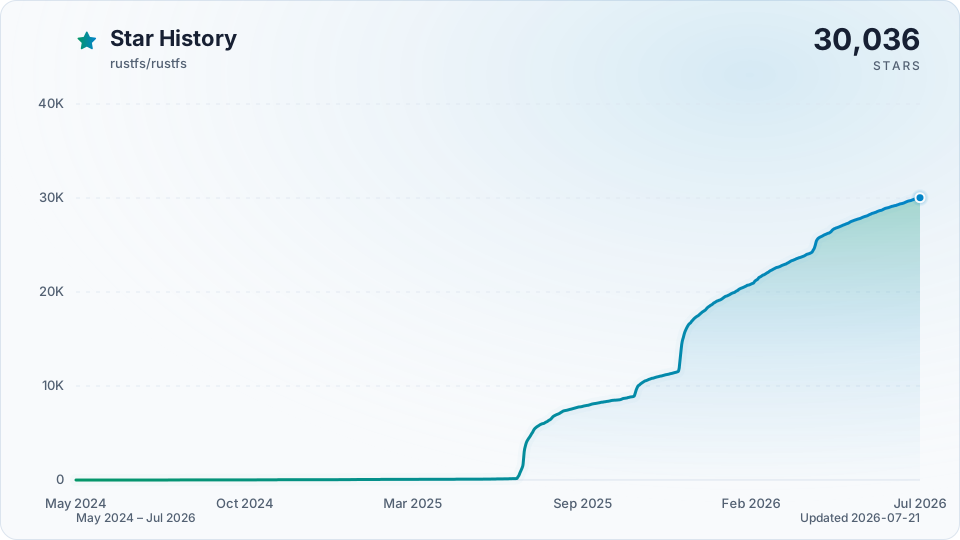
Star History
License
RustFS is a trademark of RustFS, Inc. All other trademarks are the property of their respective owners.