 Zhengchao An
b2a376c2d2
Zhengchao An
b2a376c2d2
* fix(admin): bound IAM import archive expansion

MAX_IAM_IMPORT_SIZE caps the compressed upload at 10 MB, but every member of the
archive was then read with read_to_end into an unbounded Vec. Deflate ratios well
above 100:1 are easy to construct, so a small authorized upload could expand
without limit across the seven members ImportIam reads.

Add a shared expansion budget (MAX_IAM_IMPORT_EXPANDED_SIZE, 10x the compressed
cap) drawn down by every member, and route all seven reads through one helper
that reads a byte past the remaining budget to detect overrun. Sharing the budget
bounds the archive as a whole rather than letting each member spend the full
limit independently.

Covers R03-CAN-024 through R03-CAN-030 plus R04-CAN-077 (backlog #1471) — one
fix rather than seven, since all seven call sites were byte-identical.

* fix(kms): confine local key paths and refuse silent key replacement

Local KMS key identifiers arrive from request input — the `name` tag on CreateKey,
the `keyId` body field or query parameter on DeleteKey — and were joined onto
`key_dir` with no validation. An identifier such as `../../tmp/evil` escaped the
configured directory, making key creation a constrained arbitrary-file write and
`DeleteKey` with `force_immediate` a cross-directory delete.

Validate in `master_key_path` and make it fallible, so every filesystem path in
this backend inherits the guard: decode_stored_key, load_master_key,
save_master_key, create_key and delete_key all derive their paths there. The rule
is containment rather than a character allowlist, so identifiers already in use
keep resolving; only separators, NUL, absolute paths and non-single-component
forms are refused. Note `.` and `..` are contained rather than refused — the
`.key` suffix turns them into the ordinary filenames `..key` and `...key`.

Separately, `LocalKmsBackend::create_key` had no existence check, while the
sibling `KmsClient::create_key` has always had one. Since `save_master_key`
renames over its destination, creating a key under an existing name silently
replaced its material and destroyed the ability to decrypt everything wrapped
under it — and the backend path is the one the admin API uses. It now returns
KeyAlreadyExists, matching StaticKmsBackend.

Covers R03-CAN-072, R03-CAN-073 and R07-CAN-103 (backlog #1475). R03-CAN-073
needed no separate change: delete_key routes both its load and its remove_file
through master_key_path.

* fix(swift): bound SLO manifest reads to the 2 MiB manifest limit

The three Swift SLO handlers that load a stored manifest (handle_slo_get,
handle_slo_get_manifest, handle_slo_delete) read the `<object>.slo-manifest`
object to EOF with AsyncReadExt::read_to_end. That key is predictable and
writable through the ordinary object PUT path, so a tenant can replace the
manifest with an arbitrarily large object and then make the server allocate
its full size on every SLO GET, multipart-manifest=get, or
multipart-manifest=delete request - a memory amplification bounded only by
the stored object size (CWE-400 / CWE-770). The 2 MiB manifest limit that
handle_slo_put enforces was not applied on the read side.

Introduce MAX_SLO_MANIFEST_SIZE (the existing 2 MiB PUT limit, now a named
constant) and a shared read_manifest_bytes helper that reads through a
`take(limit + 1)` and rejects anything larger, so an oversized manifest is
refused instead of being buffered first. All three call sites go through the
helper. handle_slo_put now checks the size before parsing the JSON.

Regression tests: test_read_manifest_bytes_rejects_oversized_manifest and
test_read_manifest_bytes_stops_reading_oversized_manifest (which asserts the
reader is not consumed past the limit), plus a boundary test that a manifest
at exactly 2 MiB is still accepted.

* fix(protocols): authorize every object in FTPS/WebDAV recursive deletes

The FTPS and WebDAV gateways authorized only the container before a
recursive delete and then destroyed everything inside it without a
further check:

- FTPS RMD (and DELE on a bucket path ending in '/') cleared
  s3:DeleteBucket, then delete_bucket_recursively listed the bucket and
  deleted every object.
- WebDAV DELETE on a bucket did the same via its own
  delete_bucket_recursively.
- WebDAV DELETE on a directory cleared s3:DeleteObject for the directory
  marker key ("dir/") only, then listed that prefix and deleted every
  child under it.

A principal holding s3:DeleteBucket (or s3:DeleteObject on a single
marker key) could therefore erase objects it had no s3:DeleteObject
permission for, and the operation reported success.

Deletion stays recursive - that is the expected behaviour for these
protocols - but each object now clears s3:DeleteObject on its own key
before it is removed, and the enumeration clears s3:ListBucket. A denial
aborts the whole operation with access denied rather than being skipped,
so the caller can never be told the delete succeeded while objects were
left behind or removed without authorization.

The test double gained shared-state cloning, delete_object/delete_bucket
call logs, and list/delete queue helpers so the regression tests can
observe that nothing is deleted once a deny lands.

* fix(server,ecstore): bound TLS handshakes and remote volume RPC waits

Three call sites let an unauthenticated client or a misbehaving peer hold
server resources with no deadline.

TLS listener (R03-CAN-035): process_connection awaited
`acceptor.accept(socket)` with no bound. A client that opens a TCP
connection and never finishes the handshake parks a Tokio task and a socket
forever, and the connection cap (RUSTFS_API_MAX_CONNECTIONS) is unlimited by
default, so nothing else sheds it. The handshake now runs under
accept_tls_with_deadline(), reusing the existing HTTP/1 header-read budget —
the established slow-client bound for the pre-request phase — and the
expiry is recorded through the same log/metric path as a handshake error,
under a new TIMEOUT failure kind.

Remote disk RPCs (R03-CAN-049, R03-CAN-050): list_volumes and delete_volume
passed Duration::ZERO, which execute_with_timeout treats as "no deadline",
so a peer that accepts the request and never answers stalls the coordinator
(and, for delete_volume, the bucket-deletion workflow). Both now pass
get_max_timeout_duration(), matching every sibling method in the file.

Regression tests: a silent TLS peer must be shed by the handshake deadline;
list_volumes/delete_volume against a peer that completes the TCP connect and
then goes silent must fail with DiskError::Timeout instead of hanging.

* fix(security): stop leaking signed headers and bound OIDC/KMS credentials

Three independent hygiene fixes found by the security review.

R03-CAN-018 (crates/signer): try_get_canonical_headers and get_signed_headers
logged the complete header map at DEBUG before signing. Runtime callers pass
session credentials and SSE-C key material through these headers, so anyone
able to raise the log level (or read DEBUG logs) recovered
X-Amz-Security-Token and SSE-C keys verbatim. The statements were debugging
leftovers with no operational value and are deleted rather than redacted.

R03-CAN-014 (crates/iam): the OIDC HTTP adapter buffered provider responses
with an unbounded Response::bytes(), so a configured, compromised or
attacker-pointed IdP endpoint could stream an arbitrarily large or endless
body into memory (the ValidateOidcConfig admin handler lets a ServerInfo
caller choose the endpoint). Responses are now read incrementally and fail
closed past MAX_OIDC_RESPONSE_SIZE, and the already SSRF-hardened client
builder gains request and connect timeouts so a stalled provider cannot pin
the calling task indefinitely.

R07-CAN-105 (helm): the Vault KMS token was serialized into the chart
ConfigMap, exposing it to every subject allowed to get ConfigMaps in the
namespace. It now renders into a dedicated Secret that the Deployment and
StatefulSet consume via envFrom; the Secret is separate from the main
credentials Secret so it also works when secret.existingSecret is set.

Regression tests:
- rustfs-signer: signing_never_logs_signed_header_material
- rustfs-iam: oidc_response_body_past_the_limit_is_rejected,
  oidc_response_body_at_the_limit_is_accepted
- scripts/test_helm_templates.sh: KMS token must never render in plaintext

* fix(webdav): enforce body limit, request timeout and connection cap

The configured WebDAV maximum body size was enforced from Content-Length, so a
chunked request declared no length and bypassed it entirely. The configured
request timeout was never applied to the connection at all, and the accept loop
spawned a task per connection with no bound, so an unauthenticated client could
hold resources indefinitely and in unbounded number.

Enforce the limit on bytes actually read rather than the declared length, apply
the configured timeout to the request, and bound accepted connections with a new
RUSTFS_WEBDAV_MAX_CONNECTIONS (default 1024) surfaced in the config report.

Covers R03-CAN-051, R03-CAN-052, R03-CAN-067, R04-CAN-089, R05-CAN-094 and
R05-CAN-097 (backlog #1471, #1474).

* fix(security): stop STS credentials from crossing the parent trust boundary

Two related credential-boundary holes let a short-lived STS credential act
with the full, unrestricted authority of the long-term user it was minted
from.

AddUser (R03-CAN-021, CWE-269/863): should_check_deny_only relaxes the admin
policy check to deny-only when a Console/STS session targets the IAM user it
represents. Nothing then stopped that session from calling AddUser with its
own parent's access key, so the handler wrote an attacker-chosen secret key
and status over the parent's stored Credentials via create_user ->
save_user_identity. A session that expires in minutes became permanent
control of the account. AddUser now rejects any temp or service-account
requester whose resolved parent equals the target access key, resolving the
parent the same way should_check_deny_only does (parent_user field, else the
JWT `parent` claim, since some stores persist the parent only in the token).

FTPS/SFTP/WebDAV password auth (R04-CAN-086, CWE-287/862): these protocols
looked the access key up with check_key, which falls back to the STS account
cache, and then compared only the stored secret. An STS access key plus
secret therefore authenticated with no session token presented and no
session-policy claims applied - the holder got the parent's full permissions.
Password authentication now rejects temporary credentials before the secret
comparison. The discriminator is is_temp() && !is_service_account(), the same
one IamCache::update_user_with_claims uses to route an identity into the STS
cache, so service accounts - which resolve policy from stored IAM state
rather than a client-presented token - keep working over these protocols.

Regression tests cover both predicates and pin the guards to their call
sites so neither can be dropped without a test failure.
RustFS is a high-performance, distributed object storage system built in Rust.





Getting Started · Docs · Bug reports · Discussions
English | 简体中文 | Deutsch | Español | français | 日本語 | 한국어 | Portuguese | Русский
RustFS is a high-performance, distributed object storage system built in Rust—one of the most loved programming languages worldwide. RustFS combines the simplicity of MinIO with the memory safety and raw performance of Rust. It offers broad S3 API compatibility for supported features, is completely open-source, and is optimized for data lakes, AI, and big data workloads.
Unlike other storage systems, RustFS is released under the permissible Apache 2.0 license, avoiding the restrictions of AGPL. With Rust as its foundation, RustFS delivers superior speed and secure distributed features for next-generation object storage.
Feature & Status
- High Performance: Built with Rust to ensure maximum speed and resource efficiency.
- Distributed Architecture: Scalable and fault-tolerant design suitable for large-scale deployments.
- S3 Compatibility: Seamless integration with common S3-compatible applications and tools; current coverage is tracked in the S3 compatibility matrix.
- OpenStack Swift API: Native support for Swift protocol with Keystone authentication.
- OpenStack Keystone Integration: Native support for OpenStack Keystone authentication with X-Auth-Token headers.
- Data Lake Support: Optimized for high-throughput big data and AI workloads.
- Open Source: Licensed under Apache 2.0, encouraging unrestricted community contributions and commercial usage.
- User-Friendly: Designed with simplicity in mind for easy deployment and management.
| Feature | Status | Feature | Status |
|---|---|---|---|
| S3 Core Features | ✅ Available | Bitrot Protection | ✅ Available |
| Upload / Download | ✅ Available | Single Node Mode | ✅ Available |
| Versioning | ✅ Available | Bucket Replication | ✅ Available |
| Logging | ✅ Available | Lifecycle Management | 🚧 Under Testing |
| Event Notifications | ✅ Available | Distributed Mode | 🚧 Under Testing |
| K8s Helm Charts | ✅ Available | RustFS KMS | 🚧 Under Testing |
| Keystone Auth | ✅ Available | Multi-Tenancy | ✅ Available |
| Swift API | ✅ Available | Swift Metadata Ops | 🚧 Partial |
RustFS vs MinIO Performance
Stress Test Environment:
| Type | Parameter | Remark |
|---|---|---|
| CPU | 2 Core | Intel Xeon (Sapphire Rapids) Platinum 8475B, 2.7/3.2 GHz |
| Memory | 4GB | |
| Network | 15Gbps | |
| Drive | 40GB x 4 | IOPS 3800 / Drive |
https://github.com/user-attachments/assets/2e4979b5-260c-4f2c-ac12-c87fd558072a
RustFS vs Other Object Storage
| Feature | RustFS | Other Object Storage |
|---|---|---|
| Console Experience | Powerful Console Comprehensive management interface. |
Basic / Limited Console Often overly simple or lacking critical features. |
| Language & Safety | Rust-based Memory safety by design. |
Go or C-based Potential for memory GC pauses or leaks. |
| Data Sovereignty | No Telemetry / Full Compliance Guards against unauthorized cross-border data egress. Compliant with GDPR (EU/UK), CCPA (US), and APPI (Japan). |
Potential Risk Possible legal exposure and unwanted data telemetry. |
| Licensing | Permissive Apache 2.0 Business-friendly, no "poison pill" clauses. |
Restrictive AGPL v3 Risk of license traps and intellectual property pollution. |
| Compatibility | S3-Compatible Core Works with common S3-compatible clients, with coverage tracked in the compatibility matrix. |
Variable Compatibility May lack support for local cloud vendors or specific APIs. |
| Edge & IoT | Strong Edge Support Ideal for secure, innovative edge devices. |
Weak Edge Support Often too heavy for edge gateways. |
| Risk Profile | Enterprise Risk Mitigation Clear IP rights and safe for commercial use. |
Legal Risks Intellectual property ambiguity and usage restrictions. |
Staying ahead
Star RustFS on GitHub and be instantly notified of new releases.
Quickstart
To get started with RustFS, follow these steps:
1. One-click Installation (Option 1)
curl -O https://rustfs.com/install_rustfs.sh && bash install_rustfs.sh
2. Docker Quick Start (Option 2)
The RustFS container runs as a non-root user rustfs (UID/GID 10001:10001). If you bind-mount host directories with Docker or Compose, every mounted path must be writable by that user, otherwise startup may fail with permission denied errors. This applies to data directories, log directories, and TLS certificate directories when RUSTFS_TLS_PATH is enabled.
# Create data and logs directories
mkdir -p data logs

# Change the owner of these directories
chown -R 10001:10001 data logs

# Using latest version
docker run -d -p 9000:9000 -p 9001:9001 -v $(pwd)/data:/data -v $(pwd)/logs:/logs rustfs/rustfs:latest

# Using specific version
docker run -d -p 9000:9000 -p 9001:9001 -v $(pwd)/data:/data -v $(pwd)/logs:/logs rustfs/rustfs:1.0.0-beta.11
If you use podman instead of docker, you can install the RustFS with the below command
# Create data and logs directories
mkdir -p data logs

# Run the container (podman will automatically set the folders ownership)
podman run -d -p 9000:9000 -p 9001:9001 -v $(pwd)/data:/data:Z,U -v $(pwd)/logs:/logs:Z,U rustfs/rustfs:latest
If you enable TLS with a bind-mounted certificate directory, prepare that mount the same way:
mkdir -p certs
chown -R 10001:10001 certs
You can also use Docker Compose. Using the docker-compose-simple.yml file in the root directory:
docker compose -f docker-compose-simple.yml up -d
Before running Compose with host bind mounts:
- Ensure every mounted host path is writable by
10001:10001. - If you enable TLS, ensure the certificate mount for
/opt/tlsis also readable by10001:10001. - If matching host ownership is not practical, run the
rustfsservice withuser: "<host-uid>:<host-gid>"instead. docker-compose-simple.ymlincludes avolume-permission-helperservice for named volumes.docker-compose-simple.ymlrelies on you to prepare bind-mounted host paths in advance.
Similarly, you can run the command with podman
podman compose -f docker-compose-simple.yml up -d
Webhook notification quick start (Docker):
docker run -d --name rustfs -p 9000:9000 \
  -e RUSTFS_NOTIFY_ENABLE=true \
  -e RUSTFS_NOTIFY_WEBHOOK_ENABLE_PRIMARY=on \
  -e RUSTFS_NOTIFY_WEBHOOK_ENDPOINT_PRIMARY=http://<host-ip>:3020/webhook \
  -e RUSTFS_NOTIFY_WEBHOOK_QUEUE_DIR_PRIMARY=/tmp/rustfs-events \
  rustfs/rustfs:latest
Notes:
RUSTFS_NOTIFY_ENABLE=trueenables the global notify module switch.- For ARN
arn:rustfs:sqs::primary:webhook, use instance-scoped env vars with_PRIMARY. - If queue dir is omitted, default is
/opt/rustfs/events; ensure it is writable by the container runtime user. RUSTFS_NOTIFY_WEBHOOK_SKIP_TLS_VERIFY_PRIMARYdefaults tofalse; enabling it skips webhook TLS certificate verification, allows MITM attacks, and emits a startup warning. PreferRUSTFS_NOTIFY_WEBHOOK_CLIENT_CA_PRIMARYfor private CAs.
NOTE: We recommend reviewing the docker-compose.yml file before running. It defines several services including Grafana, Prometheus, and Jaeger, which are helpful for RustFS observability. If you wish to start Redis or Nginx containers, you can specify the corresponding profiles.
3. Build from Source (Option 3) - Advanced Users
For developers who want to build RustFS Docker images from source with multi-architecture support:
# Build multi-architecture images locally
./docker-buildx.sh --build-arg RELEASE=latest

# Build and push to registry
./docker-buildx.sh --push

# Build specific version
./docker-buildx.sh --release v1.0.0 --push

# Build for custom registry
./docker-buildx.sh --registry your-registry.com --namespace yourname --push
The docker-buildx.sh script supports:
- Multi-architecture builds:
linux/amd64,linux/arm64 - Automatic version detection: Uses git tags or commit hashes
- Registry flexibility: Supports Docker Hub, GitHub Container Registry, etc.
- Build optimization: Includes caching and parallel builds
You can also use Make targets for convenience:
make docker-buildx                    # Build locally
make docker-buildx-push               # Build and push
make docker-buildx-version VERSION=v1.0.0  # Build specific version
make help-docker                      # Show all Docker-related commands
Heads-up (macOS cross-compilation): macOS keeps the default
ulimit -nat 256, socargo zigbuildor./build-rustfs.sh --platform ...may fail withProcessFdQuotaExceededwhen targeting Linux. The build script attempts to raise the limit automatically, but if you still see the warning, runulimit -n 4096(or higher) in your shell before building.
4. Build with Helm Chart (Option 4) - Cloud Native
Follow the instructions in the Helm Chart README to install RustFS on a Kubernetes cluster.
For scanner pacing, cycle budgets, bitrot cadence, lifecycle transition status,
and single-node single-disk idle CPU tuning, see
Scanner Runtime Controls. For
repeatable scanner-pressure validation, see
Scanner Benchmark Runbook. For
drive timeout knobs on slow storage — including the walk stall budget that
governs ListObjects on large prefixes — see
Drive Timeout Tuning.
5. Nix Flake (Option 5)
If you have Nix with flakes enabled:
# Run directly without installing
nix run github:rustfs/rustfs

# Build the binary
nix build github:rustfs/rustfs
./result/bin/rustfs --help

# Or from a local checkout
nix build
nix run
6. X-CMD (Option 6)
If you are an x-cmd user:
# Run directly without installing
x rustfs

# Download the binary and install it to the global environment
x env use rustfs
rustfs --help
Accessing RustFS
- Access the Console: Open your web browser and navigate to
http://localhost:9001to access the RustFS console.- Default credentials:
rustfsadmin/rustfsadmin
- Default credentials:
- Create a Bucket: Use the console to create a new bucket for your objects.
- Upload Objects: You can upload files directly through the console or use S3-compatible APIs/clients to interact with your RustFS instance.
NOTE: To access the RustFS instance via https, please refer to the TLS Configuration Docs.
OIDC Roles Claim (Microsoft Entra ID)
RustFS supports mapping an OIDC claim containing role values into the existing
authorization pipeline. The roles_claim setting is optional: when unset or
empty, only the groups claim contributes to authorization (same as older
RustFS releases). For Microsoft Entra ID app roles, set roles_claim=roles so
both console admin checks and bucket IAM policies can evaluate those roles.
Example environment configuration (opt-in roles claim):
RUSTFS_IDENTITY_OPENID_ENABLE=on
RUSTFS_IDENTITY_OPENID_CONFIG_URL="https://login.microsoftonline.com/<tenant-id>/v2.0/.well-known/openid-configuration"
RUSTFS_IDENTITY_OPENID_CLIENT_ID="<client-id>"
RUSTFS_IDENTITY_OPENID_CLIENT_SECRET="<client-secret>"
RUSTFS_IDENTITY_OPENID_SCOPES="openid,profile,email"
RUSTFS_IDENTITY_OPENID_GROUPS_CLAIM="groups"
RUSTFS_IDENTITY_OPENID_ROLES_CLAIM="roles"
Policy condition example (evaluate app roles directly with jwt:roles; when
roles_claim is configured, RustFS also merges those values into jwt:groups
for backward compatibility with older policies):
{
  "Version": "2012-10-17",
  "Statement": [
    {
      "Effect": "Allow",
      "Action": ["admin:*"],
      "Resource": ["arn:aws:s3:::*"],
      "Condition": {
        "ForAnyValue:StringEquals": {
          "jwt:roles": ["RustFS.ConsoleAdmin"]
        }
      }
    }
  ]
}
Documentation
For detailed documentation, including configuration options, API references, and advanced usage, please visit our Documentation.
Getting Help
If you have any questions or need assistance:
- Check the FAQ for common issues and solutions.
- Join our GitHub Discussions to ask questions and share your experiences.
- Open an issue on our GitHub Issues page for bug reports or feature requests.
Links
- Documentation - The manual you should read
- Changelog - What we broke and fixed
- GitHub Discussions - Where the community lives
- Discord - Chat with the RustFS community
Contact
- Bugs: GitHub Issues
- Business: hello@rustfs.com
- Jobs: jobs@rustfs.com
- General Discussion: GitHub Discussions
- Contributing: CONTRIBUTING.md
Contributors
RustFS is a community-driven project, and we appreciate all contributions. Check out the Contributors page to see the amazing people who have helped make RustFS better.

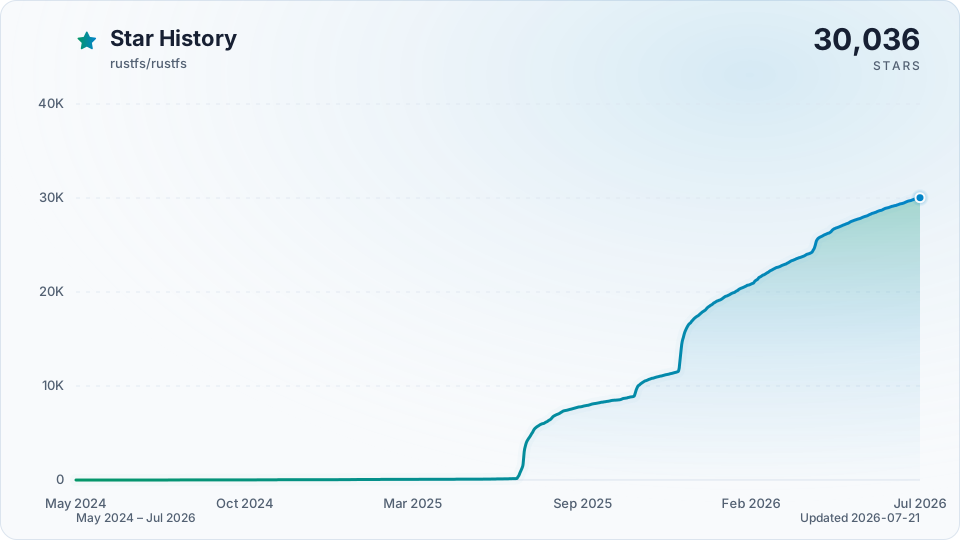
Star History
License
RustFS is a trademark of RustFS, Inc. All other trademarks are the property of their respective owners.