 唐小鸭
603bdea516
唐小鸭
603bdea516
* test(site-replication): pin retry-event lost-update against locked RMW (red)

P1-15 (rustfs/backlog#1675 B2): the site-replication retry-event writers
(enqueue/dequeue, which hang off every hook broadcast path) perform a
load -> mutate -> persist without taking SITE_REPLICATION_STATE_LOCK, so
a single process can lose a concurrent lock-holding writer's update; the
service-side reload path is equally unlocked, and no writer holds a
distributed lock across the read-modify-write, so multi-node RMW loses
updates even where the process lock is held.

Red evidence (current main): replaying enqueue's exact three steps around
a completed mark_pending_rotation_peer_acked commit wipes the rotation
ack — the final state holds the retry event but not the ack.

* fix(site-replication): route state RMW through one locked transaction

P1-15 PR1 (rustfs/backlog#1675 B2). The site-replication state object
(config/site-replication/state.json, which also carries the retry-event
queue) was mutated through read-modify-write sequences with inconsistent
locking: the retry-event writers on every hook broadcast path and the
RPC-driven service reload took no lock at all (single-process lost
updates, pinned by the red commit), and no writer held a distributed lock
across the whole RMW (cross-node lost updates everywhere).

- New admin/site_replication_state module: the state transaction boundary
  `with_site_replication_state_lock[_on]` — process mutex plus the
  distributed config-object write lock (the pattern proven by the repair
  state), with the shared path constant. The process mutex is transitional
  until PR2 migrates the remaining ~26 call sites.
- handlers: typed `update_site_replication_state` (no-lock load /
  persist-or-clear inside the boundary; normalizes the peer map exactly
  once, retiring the double-clone/double-normalize persist path, P2-22).
  Migrated: retry-event enqueue (always-write), dequeue (lock-free probe,
  transaction on hit), mark_pending_rotation/remove_peer_acked.
- service reload: the tolerant byte-level read->normalize->save now runs
  inside the same boundary via no-lock IO — a cluster-wide reload fan-out
  can no longer overwrite a concurrent state writer. Normalization
  semantics untouched (all six service-side tests unchanged and green).
- Add/PeerJoin/Edit handlers release the state guard before their peer
  fan-out: the transport helpers' retry-event bookkeeping now re-enters
  the state transaction and must not nest inside the guard (the
  adversarial review caught this as a re-entrancy deadlock; the fix
  mirrors the Remove/Rotate handlers' existing scope). The Edit non-
  refresh branch commits before fanning out — the old fanout-first order
  recorded retry events pointing at a state the local site had not saved.
- ecstore: delete_config_no_lock (+ facade/bridge exports) so the clear
  half of persist-or-clear works under the held object lock.

Red -> green: the red commit pinned the deterministic lost-update
interleaving (stale retry-event persist wiping a committed rotation ack);
the test now drives the real functions concurrently for 8 rounds and
asserts every retry event and every ack survives. Full
handlers/service site-replication unit suites green (171 + 6); dual-node
site-replication e2e (state edit fresh/stale, object replication) green;
fmt / clippy / logging guardrails clean.

Adversarial review: one blocking finding (the re-entrancy deadlock above)
fixed and re-verified by a full second pass over all 30 lock sites and
the Add/Join/Edit call graphs. Non-blocking notes recorded for PR2:
mark_* now persists on miss (persist-or-clear semantics; a miss-skip
return is a cheap follow-up), Add still holds the guard across the peer
join probe (pre-existing availability debt), and a timeout-guarded
unreachable-peer regression test for the fan-out paths.

* fix(site-replication): keep the state mutex behind an owner helper

CI's architecture migration guard lists SITE_REPLICATION_STATE_LOCK as an
owner-local static, so it may not be `pub(crate)`. Keep it private to the
new module and let the not-yet-migrated RMW call sites take it through
`site_replication_state_process_guard()` — the sanctioned owner-helper
pattern; the helper disappears with the mutex in PR2.

* fix(site-replication): keep peer-edit delivery under the state guard

Review follow-up (#5882).

Releasing the guard before the fan-out (my deadlock fix) traded the
ordering the guard used to provide: edit A could commit and stall while
edit B committed and reached a peer first, then A arrived last and won.
The peer edit handler applies whatever arrives — it has no generation or
updated-at fence — and a successful stale delivery is not repaired by the
retry queue, so the sites diverge silently.

The fan-out is back under the guard. What actually could not run there is
the retry-event bookkeeping, which re-enters the state transaction, so the
edit branch now delivers with the plain transport and settles the retry
queue after the guard is released: successes dequeue, the first failure
enqueues and is returned. Ordering and bookkeeping both preserved. The add
handler keeps its peer-edit finalize fan-out under the guard for the same
reason and releases only before bootstrap/back-fill, which send bucket-ops
(not peer edits) through retry-event transports.

The concurrency test could not tell the two guards apart — both writers
took both locks, so it passed with either removed. Replaced by two tests
that isolate one guard each, both verified by mutation:

- a process-only legacy writer (the shape the not-yet-migrated call sites
  still use) racing the transaction: fails when the transaction stops
  taking the process mutex;
- two writers that bypass the process mutex, as separate nodes do, driving
  the production object-lock path (`with_site_replication_state_object_lock`
  factored out for exactly this): fails when the distributed lock is
  removed.

Verification: handlers 173 + service 6 unit tests green; site-replication
dual-node and three-node edit e2e green; arch/layer/logging guardrails,
fmt and clippy clean.

* fix(site-replication): fence peer-edit delivery by generation

Review follow-up on the two remaining holes in the edit path.

Ordering was only process-local. `SITE_REPLICATION_STATE_LOCK` is per
node, so holding it across the fan-out orders the edits ONE node accepts
and nothing else: two nodes of the same site can both commit and reach a
peer in the opposite order, and the peer edit handler applied whatever
arrived last. Each edit now takes a generation from
`SiteReplicationState::edit_generation`, allocated in the same commit as
the edit itself — i.e. under the distributed state-object lock, so two
nodes can never share one. The generation rides the peer-edit request as
query parameters and the receiver rejects (acks without applying) a
delivery at or below the mark it already applied for that origin site,
recording the mark in the same commit as the edit it fences. Peers that
predate the fence send no parameters and are applied as before.

Retry settlement could discard a newer failure. After the guard is
released, a success for edit A removed every retry event for
(peer, peer-edit): if edit B committed, failed its own delivery and
enqueued while A was in flight, A erased it — local state B, peer on A,
nothing queued to converge them. Settlement now only removes events whose
recorded generation is not newer than the one being settled, and a later
failure never lowers the fence. Broadcast paths carry no generation and
settle unconditionally as before; their events live under their own
paths and cannot collide with a peer-edit delivery.

A departed peer's mark is dropped on load: a site that leaves drops below
two peers, which clears its state object and restarts its counter at
zero, so a leftover mark would reject every edit it sends after it
rejoins.

Tests: two-node generation uniqueness (drop the object lock and the two
nodes collide), the receiver's staleness predicate and its wiring, the
settlement interleaving (drop the fence and B's retry is erased), and the
rejoin reset.

Refs: rustfs/backlog#1675 (P1-15)
RustFS is a high-performance, distributed object storage system built in Rust.





Getting Started · Docs · Bug reports · Discussions
English | 简体中文 | Deutsch | Español | français | 日本語 | 한국어 | Portuguese | Русский
RustFS is a high-performance, distributed object storage system built in Rust—one of the most loved programming languages worldwide. RustFS combines the simplicity of MinIO with the memory safety and raw performance of Rust. It offers broad S3 API compatibility for supported features, is completely open-source, and is optimized for data lakes, AI, and big data workloads.
Unlike other storage systems, RustFS is released under the permissible Apache 2.0 license, avoiding the restrictions of AGPL. With Rust as its foundation, RustFS delivers superior speed and secure distributed features for next-generation object storage.
Feature & Status
- High Performance: Built with Rust to ensure maximum speed and resource efficiency.
- Distributed Architecture: Scalable and fault-tolerant design suitable for large-scale deployments.
- S3 Compatibility: Seamless integration with common S3-compatible applications and tools; current coverage is tracked in the S3 compatibility matrix.
- OpenStack Swift API: Native support for Swift protocol with Keystone authentication.
- OpenStack Keystone Integration: Native support for OpenStack Keystone authentication with X-Auth-Token headers.
- Data Lake Support: Optimized for high-throughput big data and AI workloads.
- Open Source: Licensed under Apache 2.0, encouraging unrestricted community contributions and commercial usage.
- User-Friendly: Designed with simplicity in mind for easy deployment and management.
| Feature | Status | Feature | Status |
|---|---|---|---|
| S3 Core Features | ✅ Available | Bitrot Protection | ✅ Available |
| Upload / Download | ✅ Available | Single Node Mode | ✅ Available |
| Versioning | ✅ Available | Bucket Replication | ✅ Available |
| Logging | ✅ Available | Lifecycle Management | 🚧 Under Testing |
| Event Notifications | ✅ Available | Distributed Mode | 🚧 Under Testing |
| K8s Helm Charts | ✅ Available | RustFS KMS | 🚧 Under Testing |
| Keystone Auth | ✅ Available | Multi-Tenancy | ✅ Available |
| Swift API | ✅ Available | Swift Metadata Ops | 🚧 Partial |
RustFS vs MinIO Performance
Stress Test Environment:
| Type | Parameter | Remark |
|---|---|---|
| CPU | 2 Core | Intel Xeon (Sapphire Rapids) Platinum 8475B, 2.7/3.2 GHz |
| Memory | 4GB | |
| Network | 15Gbps | |
| Drive | 40GB x 4 | IOPS 3800 / Drive |
https://github.com/user-attachments/assets/2e4979b5-260c-4f2c-ac12-c87fd558072a
RustFS vs Other Object Storage
| Feature | RustFS | Other Object Storage |
|---|---|---|
| Console Experience | Powerful Console Comprehensive management interface. |
Basic / Limited Console Often overly simple or lacking critical features. |
| Language & Safety | Rust-based Memory safety by design. |
Go or C-based Potential for memory GC pauses or leaks. |
| Data Sovereignty | No Telemetry / Full Compliance Guards against unauthorized cross-border data egress. Compliant with GDPR (EU/UK), CCPA (US), and APPI (Japan). |
Potential Risk Possible legal exposure and unwanted data telemetry. |
| Licensing | Permissive Apache 2.0 Business-friendly, no "poison pill" clauses. |
Restrictive AGPL v3 Risk of license traps and intellectual property pollution. |
| Compatibility | S3-Compatible Core Works with common S3-compatible clients, with coverage tracked in the compatibility matrix. |
Variable Compatibility May lack support for local cloud vendors or specific APIs. |
| Edge & IoT | Strong Edge Support Ideal for secure, innovative edge devices. |
Weak Edge Support Often too heavy for edge gateways. |
| Risk Profile | Enterprise Risk Mitigation Clear IP rights and safe for commercial use. |
Legal Risks Intellectual property ambiguity and usage restrictions. |
Staying ahead
Star RustFS on GitHub and be instantly notified of new releases.
Quickstart
To get started with RustFS, follow these steps:
1. One-click Installation (Option 1)
curl -O https://rustfs.com/install_rustfs.sh && bash install_rustfs.sh
2. Docker Quick Start (Option 2)
The RustFS container runs as a non-root user rustfs (UID/GID 10001:10001). If you bind-mount host directories with Docker or Compose, every mounted path must be writable by that user, otherwise startup may fail with permission denied errors. This applies to data directories, log directories, and TLS certificate directories when RUSTFS_TLS_PATH is enabled.
# Create data and logs directories
mkdir -p data logs

# Change the owner of these directories
chown -R 10001:10001 data logs

# Using latest version
docker run -d -p 9000:9000 -p 9001:9001 -v $(pwd)/data:/data -v $(pwd)/logs:/logs rustfs/rustfs:latest

# Using specific version
docker run -d -p 9000:9000 -p 9001:9001 -v $(pwd)/data:/data -v $(pwd)/logs:/logs rustfs/rustfs:1.0.0-rc.1
If you use podman instead of docker, you can install the RustFS with the below command
# Create data and logs directories
mkdir -p data logs

# Run the container (podman will automatically set the folders ownership)
podman run -d -p 9000:9000 -p 9001:9001 -v $(pwd)/data:/data:Z,U -v $(pwd)/logs:/logs:Z,U rustfs/rustfs:latest
If you enable TLS with a bind-mounted certificate directory, prepare that mount the same way:
mkdir -p certs
chown -R 10001:10001 certs
You can also use Docker Compose. Using the docker-compose-simple.yml file in the root directory:
docker compose -f docker-compose-simple.yml up -d
Before running Compose with host bind mounts:
- Ensure every mounted host path is writable by
10001:10001. - If you enable TLS, ensure the certificate mount for
/opt/tlsis also readable by10001:10001. - If matching host ownership is not practical, run the
rustfsservice withuser: "<host-uid>:<host-gid>"instead. docker-compose-simple.ymlincludes avolume-permission-helperservice for named volumes.docker-compose-simple.ymlrelies on you to prepare bind-mounted host paths in advance.
Similarly, you can run the command with podman
podman compose -f docker-compose-simple.yml up -d
Webhook notification quick start (Docker):
docker run -d --name rustfs -p 9000:9000 \
  -e RUSTFS_NOTIFY_ENABLE=true \
  -e RUSTFS_NOTIFY_WEBHOOK_ENABLE_PRIMARY=on \
  -e RUSTFS_NOTIFY_WEBHOOK_ENDPOINT_PRIMARY=http://<host-ip>:3020/webhook \
  -e RUSTFS_NOTIFY_WEBHOOK_QUEUE_DIR_PRIMARY=/tmp/rustfs-events \
  -e RUSTFS_OUTBOUND_ALLOW_ORIGINS=http://<host-ip>:3020 \
  rustfs/rustfs:latest
Notes:
RUSTFS_NOTIFY_ENABLE=trueenables the global notify module switch.- For ARN
arn:rustfs:sqs::primary:webhook, use instance-scoped env vars with_PRIMARY. - If queue dir is omitted, default is
/opt/rustfs/events; ensure it is writable by the container runtime user. RUSTFS_NOTIFY_WEBHOOK_SKIP_TLS_VERIFY_PRIMARYdefaults tofalse; enabling it skips webhook TLS certificate verification, allows MITM attacks, and emits a startup warning. PreferRUSTFS_NOTIFY_WEBHOOK_CLIENT_CA_PRIMARYfor private CAs.- Since
1.0.0-beta.11, webhook endpoints on private or container networks (Docker Compose service names,host.docker.internal, RFC 1918 addresses) are blocked unless their exactscheme://host:portorigin is listed inRUSTFS_OUTBOUND_ALLOW_ORIGINS(the origin only, without the path). See Outbound Connection Policy.
NOTE: We recommend reviewing the docker-compose.yml file before running. It defines several services including Grafana, Prometheus, and Jaeger, which are helpful for RustFS observability. If you wish to start Redis or Nginx containers, you can specify the corresponding profiles.
3. Build from Source (Option 3) - Advanced Users
For developers who want to build RustFS Docker images from source with multi-architecture support:
# Build multi-architecture images locally
./docker-buildx.sh --build-arg RELEASE=latest

# Build and push to registry
./docker-buildx.sh --push

# Build specific version
./docker-buildx.sh --release v1.0.0 --push

# Build for custom registry
./docker-buildx.sh --registry your-registry.com --namespace yourname --push
The docker-buildx.sh script supports:
- Multi-architecture builds:
linux/amd64,linux/arm64 - Automatic version detection: Uses git tags or commit hashes
- Registry flexibility: Supports Docker Hub, GitHub Container Registry, etc.
- Build optimization: Includes caching and parallel builds
You can also use Make targets for convenience:
make docker-buildx                    # Build locally
make docker-buildx-push               # Build and push
make docker-buildx-version VERSION=v1.0.0  # Build specific version
make help-docker                      # Show all Docker-related commands
Heads-up (macOS cross-compilation): macOS keeps the default
ulimit -nat 256, socargo zigbuildor./build-rustfs.sh --platform ...may fail withProcessFdQuotaExceededwhen targeting Linux. The build script attempts to raise the limit automatically, but if you still see the warning, runulimit -n 4096(or higher) in your shell before building.
4. Build with Helm Chart (Option 4) - Cloud Native
Follow the instructions in the Helm Chart README to install RustFS on a Kubernetes cluster.
For scanner pacing, cycle budgets, bitrot cadence, lifecycle transition status,
and single-node single-disk idle CPU tuning, see
Scanner Runtime Controls. For
repeatable scanner-pressure validation, see
Scanner Benchmark Runbook. For
drive timeout knobs on slow storage — including the walk stall budget that
governs ListObjects on large prefixes — see
Drive Timeout Tuning.
5. Nix Flake (Option 5)
If you have Nix with flakes enabled:
# Run directly without installing
nix run github:rustfs/rustfs

# Build the binary
nix build github:rustfs/rustfs
./result/bin/rustfs --help

# Or from a local checkout
nix build
nix run
6. X-CMD (Option 6)
If you are an x-cmd user:
# Run directly without installing
x rustfs

# Download the binary and install it to the global environment
x env use rustfs
rustfs --help
Accessing RustFS
- Access the Console: Open your web browser and navigate to
http://localhost:9001to access the RustFS console.- Default credentials:
rustfsadmin/rustfsadmin
- Default credentials:
- Create a Bucket: Use the console to create a new bucket for your objects.
- Upload Objects: You can upload files directly through the console or use S3-compatible APIs/clients to interact with your RustFS instance.
NOTE: To access the RustFS instance via https, please refer to the TLS Configuration Docs.
OIDC Roles Claim (Microsoft Entra ID)
RustFS supports mapping an OIDC claim containing role values into the existing
authorization pipeline. The roles_claim setting is optional: when unset or
empty, only the groups claim contributes to authorization (same as older
RustFS releases). For Microsoft Entra ID app roles, set roles_claim=roles so
both console admin checks and bucket IAM policies can evaluate those roles.
Example environment configuration (opt-in roles claim):
RUSTFS_IDENTITY_OPENID_ENABLE=on
RUSTFS_IDENTITY_OPENID_CONFIG_URL="https://login.microsoftonline.com/<tenant-id>/v2.0/.well-known/openid-configuration"
RUSTFS_IDENTITY_OPENID_CLIENT_ID="<client-id>"
RUSTFS_IDENTITY_OPENID_CLIENT_SECRET="<client-secret>"
RUSTFS_IDENTITY_OPENID_SCOPES="openid,profile,email"
RUSTFS_IDENTITY_OPENID_GROUPS_CLAIM="groups"
RUSTFS_IDENTITY_OPENID_ROLES_CLAIM="roles"
Policy condition example (evaluate app roles directly with jwt:roles; when
roles_claim is configured, RustFS also merges those values into jwt:groups
for backward compatibility with older policies):
{
  "Version": "2012-10-17",
  "Statement": [
    {
      "Effect": "Allow",
      "Action": ["admin:*"],
      "Resource": ["arn:aws:s3:::*"],
      "Condition": {
        "ForAnyValue:StringEquals": {
          "jwt:roles": ["RustFS.ConsoleAdmin"]
        }
      }
    }
  ]
}
Documentation
For detailed documentation, including configuration options, API references, and advanced usage, please visit our Documentation.
Getting Help
If you have any questions or need assistance:
- Check the FAQ for common issues and solutions.
- Join our GitHub Discussions to ask questions and share your experiences.
- Open an issue on our GitHub Issues page for bug reports or feature requests.
Links
- Documentation - The manual you should read
- Changelog - What we broke and fixed
- GitHub Discussions - Where the community lives
- Discord - Chat with the RustFS community
Contact
- Bugs: GitHub Issues
- Business: hello@rustfs.com
- Jobs: jobs@rustfs.com
- General Discussion: GitHub Discussions
- Contributing: CONTRIBUTING.md
Contributors
RustFS is a community-driven project, and we appreciate all contributions. Check out the Contributors page to see the amazing people who have helped make RustFS better.

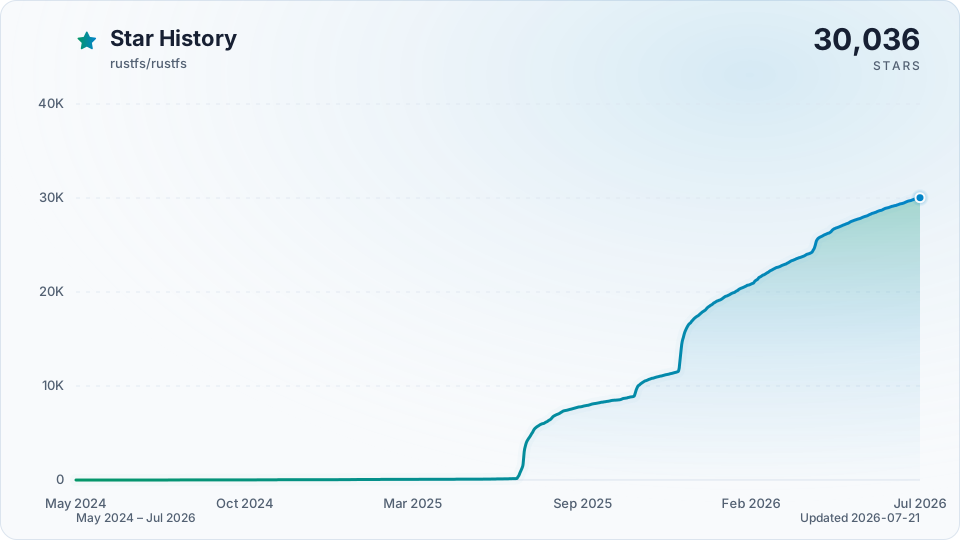
Star History
License
RustFS is a trademark of RustFS, Inc. All other trademarks are the property of their respective owners.