 Chris F Ravenscroft
385cc335ca
* use functional options pattern to inject logr (#124)

* use functional options pattern to inject logr

Signed-off-by: Jörn Friedrich Dreyer <jfd@butonic.de>

* cleanup log formatting

Signed-off-by: Jörn Friedrich Dreyer <jfd@butonic.de>

* allow clean shutdown (#126)

* fix owncloud posix query, log message and provisioning api results (#128)

Signed-off-by: Jörn Friedrich Dreyer <jfd@butonic.de>

* don't hardcode graphapi endpoint

Signed-off-by: Jörn Friedrich Dreyer <jfd@butonic.de>

* add support for write handlers (#135)

Signed-off-by: Jörn Friedrich Dreyer <jfd@butonic.de>

* config: match shadowaccount objectlcass (#136)

Signed-off-by: Jörn Friedrich Dreyer <jfd@butonic.de>

* Makefile compatiblility (#134)

Co-authored-by: Jörn Friedrich Dreyer <jfd@butonic.de>

* update travis.yml (#154)

Signed-off-by: Jörn Friedrich Dreyer <jfd@butonic.de>

* check owncloud status code is ok (#153)

Signed-off-by: Jörn Friedrich Dreyer <jfd@butonic.de>

* Bulid and push multiarch docker images (#142)

Fix #141.

With this change, a github action is added that builds a multiarch docker image on every commit, supporting x86_64, aarch64 and arm/v7.

When the action is triggered on a release or tag, it also uploads the versioned image to github container image registry.

Co-authored-by: Jörn Friedrich Dreyer <jfd@butonic.de>

* don't mix graph and provisioning api (#157)

Signed-off-by: Jörn Friedrich Dreyer <jfd@butonic.de>

* Reuse http client as much as possible and allow insecure transport (#160)

* Allow using configmaps when deploying in kubernetes (#161)

* Ensure config watcher also works in kubernetes

When using configmaps in kubernetes, the file is a symlink, and then
file-watcher is not opdated with a write event. Instead it receives a
CHMOD and a REMOVE event.

This change adds two things
1) Removal of the current wacther and adding of a new watcher for the
same path
2) The do-reload conditional is updated to also include the remove
event.

* Align write and removed conditionals

* Fix API server json formating (#163) (#164)

* Update README.md (#167)

Fixing bad port in quickstart

* Use port 3893 with ldapsearch in example (#150)

* feat: add flags for ldap listen addresses (#169)

Signed-off-by: Mark Sagi-Kazar <mark.sagikazar@gmail.com>

* Assets build fix. (#171)

* Docker build fix.

* Makefile fix.

* update readme, config and deps (#170)

Signed-off-by: Jörn Friedrich Dreyer <jfd@butonic.de>

* Remove byanke's donation fields

* Database plugins (#133)

This commit actually covers a few items. In future commits, I will keep features distinct. This is only happening this time around due to how long it took to merge this branch.

Covered:

- Database plugins (at this time: SQLite, MySQL, Postgres)
- Backends acting as middleware: added the [[Backends]] configuration directive while retaining backward compatibility with [Backend]
- Schema introspection (root DSE query with base scope)
- When proxying, insert queried attribute back in upstream response, if absent, so that the LDAP library does not filter out all entries
- When chaining backends, any backend can be used to inject OTP value in password, before reaching a non-OTP-aware backend (currently guarded by a True statement in case we find an issue (I did thoroughly test but you never know))
- Handling of special "1.1" attributes filter meaning "I do not want attributes" (RFC 4511, 4.5.1.8)
- Support for "want types only" queries, even when proxying

* Mac M1 Support and LDAP Req Attributes (#192)

* Mac M1 Support

* Augmented root DSS and schema discovery based on content of schema directory

* LDAP workaround where req. attribute gets injected in response now works with combined filters

* SubSchema query can return a minimal set, freeipa or openldap's schemas

* Feature/upgrade ldap library version (#194)

* Stronger, salted paswords using bcrypt. (#195)

* Fixed badges in README file and added a couple improvements (#196)

* fix lock for ownCloud / graph backend (#198)

Signed-off-by: Jörn Friedrich Dreyer <jfd@butonic.de>

* the config struct is only needed by the config backend (#199)

* Variable "unixid" is now respectively "UIDNumber" and "GIDNumber" for… (#201)

* fix: keep watch config file when changed,renamed,removed (#189)

I will need to run `glauth.go` through `gofmt` myself but that is fine.

* Returning when unable to start config watcher (#203)

* Introducing goconvey testing and refactoring of config and ... (#204)

* Introducing goconvey testing and refactoring of config and plugin backends.

* gofmt, oops

* Refactored re-insertion of requested attributes

* Allow bind operations with no group provided (#205)

* Support for userPrincipalName binding and browsing. (#206)

* Support for userPrincipalName binding and browsing.

* Fixed travis CI test for userprincipalname

* fixing travis tests for more users

* Rate limit after failed binds (#207)

* Capabilities -- part 2 (#214) + do not dump config at startup

* Attempting migration from Travis to Github Actions

* Migration Step#2

* Migration Step#3

* Migration Step#4

* Migration Step#5

* Migration Step#6

* Migration Step#7

* Migration Step#8

* Migration Step#9

* Migration Step#9

* Migration dev...

* Migration dev...

* Migration dev...

* Migration dev...

* Docker with plugins, first step (#215)

* Docker with plugins, first step

* Build better docker images, including plugins

* Merge back from dev to feature branch step #2

* Added capabilities to CI

* - Now creating two docker images, including one with plugins
- Moving from Travis CI to GitHub Actions

* Plugins now run on distroless (#217)

* Getting rid of Travis CI now that it doesn't support FOSS anymore.

* Internal Stats -- performance view (#221)

* Local merge

* Update CI to forget about bindata

* Forgot to cleanup the cleanup...

* assets: use stdlib "embed" package (#200)

This should make it easier to include GLAuth in other projects using `go get`

* 'Airgapping' web assets for security and preventing breakage (#227)

* v2 -- V2 hierarchy (#228)

* Search refactoring, tree traversal and scope correctness (#229)

Search refactoring, tree traversal and scope correctness.

* Feature/multi cfg (#233)

* Feature/custom attributes (#240)

* Makefiles: platform releases (#241)

* Feature/release script (#242)

* Bug/fix docker build in v2 (#244)

* Fix #246 and #252

Co-authored-by: Jörn Friedrich Dreyer <jfd@butonic.de>
Co-authored-by: Zhou Wenzong <wenzong@users.noreply.github.com>
Co-authored-by: Jairo Llopis <Yajo@users.noreply.github.com>
Co-authored-by: Benedikt Kulmann <benedikt@kulmann.biz>
Co-authored-by: Nicolai Willems <172633+nwillems@users.noreply.github.com>
Co-authored-by: Thibault Soubiran <soubi.thibault@gmail.com>
Co-authored-by: Clement JACOB <clems71@gmail.com>
Co-authored-by: Lutz Horn <code@lhorn.de>
Co-authored-by: Márk Sági-Kazár <sagikazarmark@users.noreply.github.com>
Co-authored-by: Peter Heise <pheise@koprolalie.com>
Co-authored-by: Ben Yanke <ben@benyanke.com>
Co-authored-by: fanlix <fanlix@gmail.com>
Co-authored-by: Hank Donnay <hdonnay@gmail.com>
GLAuth: LDAP authentication server for developers
Go-lang LDAP Authentication (GLAuth) is a secure, easy-to-use, LDAP server w/ configurable backends.





- Centrally manage accounts across your infrastructure
- Centrally manage SSH keys, Linux accounts, and passwords for cloud servers.
- Lightweight alternative to OpenLDAP and Active Directory for development, or a homelab.
- Store your user directory in a file, local or in S3; SQL database; or proxy to existing LDAP servers.
- Two Factor Authentication (transparent to applications)
- Multiple backends can be chained to inject features
Use it to centralize account management across your Linux servers, your OSX machines, and your support applications (Jenkins, Apache/Nginx, Graylog2, and many more!).
Contributing
- Please base all Pull Requests on dev, not master.
- Format your code autonmatically using
gofmt -d ./before committing
Quickstart
This quickstart is a great way to try out GLAuth in a non-production environment. Be warned that you should take the extra steps to setup SSL (TLS) for production use!
- Download a precompiled binary from the releases page.
- Download the example config file.
- Start the GLAuth server, referencing the path to the desired config file with
-c../glauth64 -c sample-simple.cfg
- Test with traditional LDAP tools
- For example:
ldapsearch -LLL -H ldap://localhost:3893 -D cn=serviceuser,ou=svcaccts,dc=glauth,dc=com -w mysecret -x -bdc=glauth,dc=com cn=hackers
- For example:
Make Commands
Note - makefile uses git data to inject build-time variables. For best results, run in the context of the git repo.
make all - run build binaries for platforms
make fast - run build for only linux 64 bit
make run - wrapper for the 'go run' command, setting up the needed tooling
make plugins - build additional (SQL) plugin backends
make test - run the integration test on linux64 binary
Usage:
glauth: securely expose your LDAP for external auth

Usage:
  glauth [options] -c <file|s3url>
  glauth -h --help
  glauth --version

Options:
  -c, --config <file>       Config file.
  -K <aws_key_id>           AWS Key ID.
  -S <aws_secret_key>       AWS Secret Key.
  -r <aws_region>           AWS Region [default: us-east-1].
  --ldap <address>          Listen address for the LDAP server.
  --ldaps <address>         Listen address for the LDAPS server.
  --ldaps-cert <cert-file>  Path to cert file for the LDAPS server.
  --ldaps-key <key-file>    Path to key file for the LDAPS server.
  -h, --help                Show this screen.
  --version                 Show version.
Configuration:
GLAuth can be deployed as a single server using only a local configuration file. This is great for testing, or for production if you use a tool like Puppet/Chef/Ansible:
glauth -c glauth.cfg
Here's a sample config wth hardcoded users and groups:
[backend]
  datastore = "config"
  baseDN = "dc=glauth,dc=com"
[[users]]
  name = "hackers"
  uidnumber = 5001
  primarygroup = 5501
  passsha256 = "6478579e37aff45f013e14eeb30b3cc56c72ccdc310123bcdf53e0333e3f416a"   # dogood
  sshkeys = [ "ssh-dss AAAAB3..." ]
[[users]]
  name = "uberhackers"
  uidnumber = 5006
  primarygroup = 5501
  passbcrypt = "243261243130244B62463462656F7265504F762E794F324957746D656541326B4B46596275674A79336A476845764B616D65446169784E41384F4432"   # dogood
[[groups]]
  name = "superheros"
  gidnumber = 5501
To create the password SHA hash, use this command: echo -n "mysecret" | openssl dgst -sha256
Instead of a local configuration file, GLAuth can fetch its configuration from S3. This is an easy way to ensure redundant GLAuth servers are always in-sync.
glauth -c s3://bucketname/glauth.cfg
In order to use S3, you must set your AWS credentials. Either:
- set the -K and -S command-line flags OR
- set the AWS_ACCESS_KEY_ID and AWS_SECRET_ACCESS_KEY environment variables.
More configuration options are documented here: https://github.com/glauth/glauth/blob/master/sample-simple.cfg
Chaining backends
This can be used, for instance, to inject support for Two Factor Authentication for backends that do not support the feature natively:
[[backends]]
  datastore = "ldap"
  servers = ["ldap:s//localhost:390"]

[[backends]]
  datastore = "config"

...

[[users]]
  name = "hackers"
  otpsecret = "................"
Required Fields
- Name
- The user's username
- ou
- ID of the user's primary group
- uidnumber
- The user's unix user id
- sshPublicKey
- Specify an array of public keys
Optional Fields
- otherGroups
- Array of IDs of groups the user is a member of.
- Example: [5501, 5002]
- default = blank
- givenname
- First name
- Example: John
- default = blank
- sn
- Last name
- Example: Doe
- default = blank
- disabled
- Specify if account is active.
- Set to 'true' (without quotes) to make the LDAP entry add 'AccountStatus = inactive'
- default = false (active)
- mail
- Specify an email
- example: jdoe@example.com
- default = blank
- loginshell
- Specify a different login shell for the user
- Example: /bin/sh, or /sbin/nologin
- default = /bin/bash
- homedirectory
- Specify an overridden home directory for the user
- Example: /home/itadmin
- default = /home/[username]
- otpsecret
- Specify OTP secret used to validate OTP passcode
- Example: 3hnvnk4ycv44glzigd6s25j4dougs3rk
- default = blank
- passappbcrypt
- Specify an array of app passwords which can also succesfully bind - these bypass the OTP check. Hash the same way as password.
- Example: ["c32255dbf6fd6b64883ec8801f793bccfa2a860f2b1ae1315cd95cdac1338efa","4939efa7c87095dacb5e7e8b8cfb3a660fa1f5edcc9108f6d7ec20ea4d6b3a88"]
- default = blank
- passappsha256
- Specify an array of app passwords which can also succesfully bind - these bypass the OTP check. Hash the same way as password.
- Example: ["c32255dbf6fd6b64883ec8801f793bccfa2a860f2b1ae1315cd95cdac1338efa","4939efa7c87095dacb5e7e8b8cfb3a660fa1f5edcc9108f6d7ec20ea4d6b3a88"]
- default = blank
- yubikey
- Specify Yubikey ID for maching Yubikey OTP against the user
- Example: cccjgjgkhcbb
- default = blank
Capabilities
Introduced in 2.1.0, this feature continues improving the intrinsic security model of GLAuth.
While some level of access control is already enforced when using an LDAP backend, Capabilities are now part of the Config and Database backends.
Currently, one capability is recognized: "search" -- here is how to configure it in a Config yaml file:
...
[behaviors]
  # Ignore all capabilities restrictions, for instance allowing every user to perform a search
  IgnoreCapabilities = false
...
[[users]]
  name = "hackers"
    [[users.capabilities]]
    action = "search"
    object = "ou=superheros,dc=glauth,dc=com"
    [[users.capabilities]]
    action = "search"
    object = "ou=someotherdn,dc=glauth,dc=com"
...
[[users]]
  name = "serviceuser"
    [[users.capabilities]]
    action = "search"
    object = "*"
...
For backward compatibility, you can set IgnoreCapabilities to "true"
If you are using a Database backend, check the plugins README for configuration information.
OpenSSH keys:
GLAuth can store a user's SSH authorized keys. Add one or more keys per user as shown above, then setup the goklp helper: https://github.com/appliedtrust/goklp
Strong Passwords
If you are currently using sha256 passwords (passsha256 or passappsha256) moving to strong, salted paswords is recommended. Simply switch to passbcrypt and/or passappbcrypt password types. Currently (2021) 212 is a reasonably good value, depending our your server's CPU.
Two Factor Authentication
GLAuth can be configured to accept OTP tokens as appended to a users password. Support is added for both TOTP tokens (often known by it's most prominent implementation, "Google Authenticator") and Yubikey OTP tokens.
When using 2FA, append the 2FA code to the end of the password when authenticating. For example, if your password is "monkey" and your otp is "123456", enter "monkey123456" as your password.
TOTP Configuration
To enable TOTP authentication on a user, you can use a tool like this to generate a QR code (pick 'Timeout' and optionally let it generate a random secret for you), which can be scanned and used with the Google Authenticator app. To enable TOTP authentication, configure the otpsecret for the user with the TOTP secret.
App Passwords
Additionally, you can specify an array of password hashes using the passappsha256 for app passwords. These are not OTP validated, and are hashed in the same way as a password. This allows you to generate a long random string to be used in software which requires the ability to authenticate.
However, app passwords can be used without OTP as well.
Yubikey Configuration
For Yubikey OTP token authentication, first configure your Yubikey. After this, make sure to request a Client ID and Secret key pair.
Now configure the yubikeyclientid and yubikeysecret fields in the general section in the configuration file.
To enable Yubikey OTP authentication for a user, you must specify their Yubikey ID on the users yubikey field. The Yubikey ID is the first 12 characters of the Yubikey OTP, as explained in the below chart.
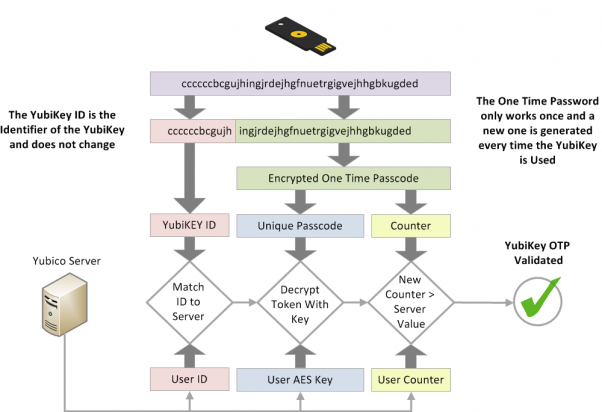
When a user has been configured with either one of the OTP options, the OTP authentication is required for the user. If both are configured, either one will work.
Backends:
For advanced users, GLAuth supports pluggable backends. Currently, it can use a local file, S3 or an existing LDAP infrastructure. In the future, we hope to have backends that support Mongo, SQL, and other datastores.
[backend]
  datastore = "ldap"
  servers = [ "ldaps://server1:636", "ldaps://server2:636" ]
Production:
Any of the architectures above will work for production. Just remember:
- Always use legit SSL certs for production!
Other Architectures
A small note about other architectures: while I expect the code is, for the most part, system-independent, there is not a good (and free) CI system which can be easily used to continuously test releases on ARM, BSD, Linux-32bit, and Windows. As such, all of the non-linux-64bit packages are provided as is. The extent of testing on these packages consists solely of cross-compiling for these architectures from a linux 64 bit system.
We will accept PRs which fix bugs on these platforms, but be aware these binaries will not be tested regularly, and instead are provided for the convenience of those who feel comfortable with this.
Building:
Logging
- using logr with increasing verbosity
- 0 you always want to see this
- 1 common logging that you might possibly want to turn off (error)
- 2 warn
- 3 notice
- 4 info
- 6 debug
- 8 trace
- 10 I would like to performance test your log collection stack
- errors really are errors that cannot be handled or returned
- returning a proper LDAP error code is handling an error
Testing
Of course, a core set of tests is being run by Github Actions CI. However, when developing new features/refactoring, a more comprehensive regression testing suite is needed.
You can run go test to execute the tests found in glauth_test.go -- better, if it is installed, you can run goconvey
Since some tests cover TOTP, you will first need to install oathtool in your environment.
You also must create a symbolink link called glauth to make it easy for the test framework to find the executable. For instance:
cd bin
ln -s glauth64 glauth
In order to test GLAuth against an LDAP backend, you will need docker. Run this command:
docker run \
    --rm \
    -d \
    -p 389:389 \
    --name openldap-service \
    --hostname ldap-service \
    --env LDAP_ORGANISATION="GLauth" \
    --env LDAP_DOMAIN="glauth.com" \
    --env LDAP_ADMIN_PASSWORD="password" \
    --env LDAP_CONFIG_PASSWORD="password" \
    --env LDAP_BASE_DN="dc=glauth,dc=com" \
    -v $PWD/misc/openldap/config:/etc/ldap/slapd.d \
    -v $PWD/misc/openldap/db:/var/lib/ldap \
    osixia/openldap:latest
Refer to this page for a somewhat more in-depth overview of testing with OpenLDAP.
Compatibility
While our stated goal for GLAuth is to provide the simplest possible authentication server, we keep finding an increasing number of client appliances that are asking fairly "existential" questions of the server. We have been working on providing answers these clients will find satisfactory.
Root DSE
RFC 4512: "An LDAP server SHALL provide information about itself and other information that is specific to each server. This is represented as a group of attributes located in the root DSE"
Test: ldapsearch -LLL -H ldap://localhost:3893 -D cn=serviceuser,ou=svcaccts,dc=glauth,dc=com -w mysecret -x -s base "(objectclass=*)"
Subschema Discovery
RFC 4512: "To read schema attributes from the subschema (sub)entry, clients MUST issue a Search operation [RFC4511] where baseObject is the DN of the subschema (sub)entry..."
Test: ldapsearch -LLL -o ldif-wrap=no -H ldap://localhost:3893 -D cn=serviceuser,ou=svcaccts,dc=glauth,dc=com -w mysecret -x -bcn=schema -s base
By default, this query will return a very minimal schema (~5 objects) -- you can ask GLAuth to return more comprehensive schemas by unpacking, in the schema/ directory, the OpenLDAP or FreeIPA schema archives found in the assets/ directory.
LDAP Backend: "1.1" attribute
RFC 4511: "A list containing only the OID "1.1" indicates that no attributes are to be returned."
Stargazers over time
