> [!IMPORTANT]
> **PGSTY Silo** (hereinafter “Silo”) is an independent, community-maintained fork of the open-source MinIO server, published by [Pigsty](https://pigsty.io) from [`pgsty/silo`](https://github.com/pgsty/silo). It is not affiliated with, endorsed by, or sponsored by MinIO, Inc. “MinIO” is used only to identify the upstream project and compatibility lineage.
> [!NOTE]
> Renamed from `pgsty/minio` to `pgsty/silo`, default branch `master` → `main`, on 2026-08-06. Artifacts under the original MinIO identity stay published on the archived [`minio`](https://github.com/pgsty/silo/tree/minio) branch and in releases up to [`RELEASE.2026-08-04T00-00-00Z`](https://github.com/pgsty/silo/releases/tag/RELEASE.2026-08-04T00-00-00Z).
## SILO 20261018000000
[SILO 20261018000000](https://github.com/pgsty/silo/releases/tag/RELEASE.2026-10-18T00-00-00Z) is available as platform archives, Linux packages, and standard or distroless Docker images for amd64 and arm64. The release tag is `RELEASE.2026-10-18T00-00-00Z`; the package version is `20261018000000.0.0`.
This release strengthens Object Lock and IAM authorization, makes scoped STS revocation durable across processes and sites, protects concurrent updates during pool migration, and improves LIST recovery, multipart cleanup, and S3 error handling. It includes Console v2.4.2 and silo-pkg v3.14.3, and is built with Go 1.27.2. Use mcli 20261018 for administration.
Read the [release notes](https://github.com/pgsty/silo/releases/tag/RELEASE.2026-10-18T00-00-00Z) before upgrading, especially the removal of strict multipart listing, coordinated server upgrades, and measured performance costs. See [CONTRIBUTORS.md](CONTRIBUTORS.md) for the people behind the code, reports, and documentation.
Current source is unreleased: Go 1.27.3, silo-pkg v3.15.1, mcli 20261025,
upstream minio-go `ab93db7ba435`, and the Console 2.5.0 candidate `258717be077b`.
It includes the Server IAM cache repair needed by Console's **Reset to default**
action. See [CHANGELOG.md](CHANGELOG.md#unreleased); the published artifacts above
retain their original component versions.
## Overview
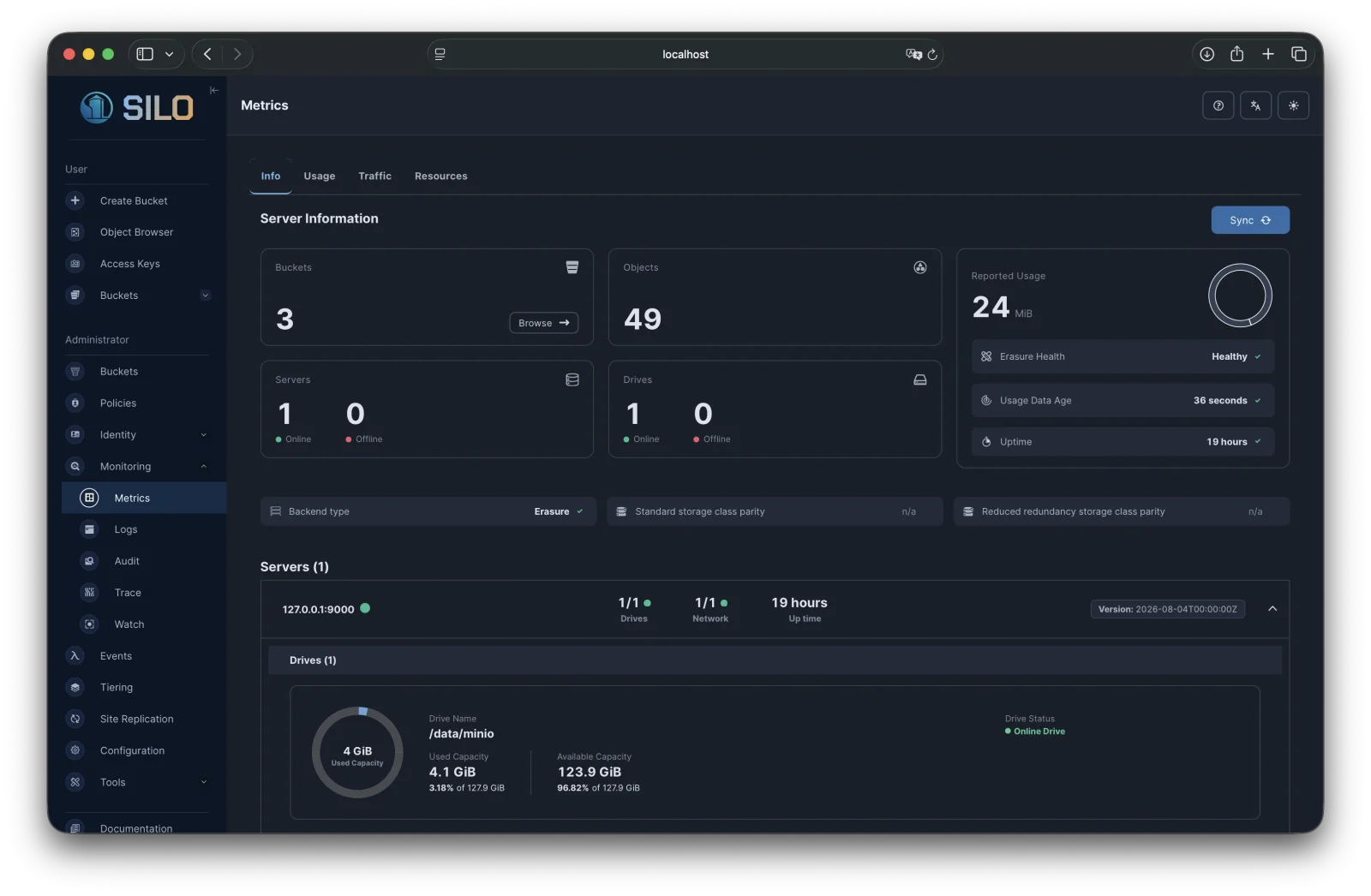
PGSTY SILO keeps one maintained release line of the open-source MinIO server alive after upstream ended community distribution: builds, packages, multi-arch images, security fixes, and the full web console. Pigsty runs it in production as its PostgreSQL backup repository.
It follows one rule — **the product and its delivery surfaces are renamed; the protocol and your data are not.** Everything else lives on [silo.pgsty.com](https://silo.pgsty.com/).
**Related:** [`pgsty/mc`](https://github.com/pgsty/mc) client (shipped as `mcli`) · [`pgsty/silo-console`](https://github.com/pgsty/silo-console) · [`pgsty/silo-pkg`](https://github.com/pgsty/silo-pkg) · [`pgsty/pigsty`](https://github.com/pgsty/pigsty)
Console on , S3 API on . The image bundles the client as `mcli`:
```bash
docker exec silo mcli alias set local http://127.0.0.1:9000 minioadmin change-me-long-password
docker exec silo mcli mb local/demo && docker exec silo mcli ls local
```
> [!WARNING]
> For production, pin a release, use unique credentials and TLS, monitor the service, keep independent backups, and test recovery. Start from the [documentation](https://silo.pgsty.com/docs/).
## Install
| Method | Where |
| :-- | :-- |
| Container | [`pgsty/silo`](https://hub.docker.com/r/pgsty/silo), multi-arch for `linux/amd64` and `linux/arm64` |
| Binaries | [GitHub Releases](https://github.com/pgsty/silo/releases) — Linux, macOS, Windows on `amd64` and `arm64` |
| Packages | RPM, DEB, and APK, also via the [Pigsty repository](https://pigsty.io/docs/repo/) |
| Kubernetes | Helm chart, see [Download & Install](https://silo.pgsty.com/download/) |
| Source | `go build -o silo . && ./silo --version` |
Every release ships checksums, SPDX SBOMs, Sigstore-signed manifests, and GitHub build attestations. Installation methods and verification commands are documented at [Download & Install](https://silo.pgsty.com/download/); migrating from upstream MinIO — taking over an existing `minio.service` and its `/etc/default/minio`, and keeping data ownership stable with a `/etc/systemd/system/silo.service.d/10-legacy-user.conf` drop-in — is covered by the [migration guide](https://silo.pgsty.com/compatibility/migration/) and the [binary & service notes](https://silo.pgsty.com/compatibility/binary/).
## Compatibility
Silo preserves S3 and storage-format compatibility, including existing `MINIO_*` variables, `minio_*` metrics, `x-minio-*` headers, `/minio/*` routes, and `.minio.sys` data. CI guards selected compatibility identifiers; release notes document intentional security and behavior changes. Silo-owned delivery surfaces use the `silo` executable, package, service, Helm chart, and container image; no `minio` server binary alias is installed.
The supported release stack is `pgsty/silo` + `pgsty/silo-console` + `pgsty/mc` + `pgsty/silo-pkg`; compatibility with unmodified upstream MinIO/MC is best effort. The Server, Console, and client retain their historical module paths where needed, while maintained code imports `github.com/pgsty/silo-pkg/v3` directly. The SDK `github.com/minio/minio-go/v7` is an explicit upstream dependency. See the current [go.mod](go.mod) for versions and replacements.
Every divergence from upstream is listed in the code-verified [compatibility audit](https://silo.pgsty.com/compatibility/server/). Treat each release as a downstream upgrade: pin versions, read the [release notes](https://silo.pgsty.com/tags/silo/), and keep a rollback path.
### TLS and Go upgrades
Server 20260916 restored Go's default key exchange; Server 20261018 retains it with Go 1.27.2.
TLS key exchange follows Go's defaults across the S3 listener, node links,
replication, identity providers, etcd, and external HTTP services. If an endpoint
cannot accept ML-KEM, `GODEBUG=tlsmlkem=0` disables the default hybrid exchanges
for the process; certificate verification remains enabled. This option does not
disable ML-DSA signatures or resolve every TLS reset. Prefer updating the
incompatible endpoint before removing the temporary setting.
If only the new SecP hybrids cause problems, `GODEBUG=tlssecpmlkem=0` disables
those groups while retaining X25519MLKEM768.
For builds targeting Go 1.27, setting either `SSL_CERT_FILE` or `SSL_CERT_DIR`
on macOS replaces Keychain trust with on-disk roots and Go's verifier. Stale or
incomplete CA paths can break previously trusted connections; unset inherited
values to restore Keychain trust. Explicit certificates in the configured `CAs`
directory remain additive to the selected root pool.
Go 1.27 binaries require macOS 13 or later. See the
[Go release notes](https://go.dev/doc/go1.27) and the
[Go 1.27 TLS and OIDC discovery guide](https://silo.pgsty.com/blog/design/go127-tls-oidc-discovery/).
## Documentation ownership
User documentation is maintained at [silo.pgsty.com](https://silo.pgsty.com/docs/),
with source in [pgsty/silo.pgsty.com](https://github.com/pgsty/silo.pgsty.com).
The remaining `docs/` tree contains inherited references, examples, and tooling
fixtures. Investigation logs, AI work records, and temporary reports are kept
outside this repository; reusable findings belong in the companion site.
See [AGENTS.md](AGENTS.md) for repository ownership and maintenance rules.
## Security & Contributing
Report vulnerabilities privately as described in [`SECURITY.md`](SECURITY.md); every fix ships with a public [advisory](https://silo.pgsty.com/blog/security/). Contributions are accepted inbound=outbound under AGPL-3.0-or-later with no CLA — only DCO sign-off (`git commit -s`) is required; see [`CONTRIBUTING.md`](CONTRIBUTING.md).
## Contributors
Every human issue or pull-request author is part of the SILO community, including open and unmerged work. We also recognize security reports, including reports sent by email, with the reporter's permission. Merged fixes, adopted proposals, and actionable reports receive priority, with first participation guiding the remaining order. Gold rings highlight reviewed significant contributions.
[View contribution notes and actual PR status](CONTRIBUTORS.md).
## Star History
## Background
Upstream wound down its community edition: the web console was cut back to a stub, prebuilt community binaries stopped, and the community repository was archived. Silo exists to keep those deployments running. The fork is a means, not an identity — if upstream restores its community edition, we will narrow our scope and offer the fixes back.
The [**Manifesto**](https://silo.pgsty.com/about/manifesto/) is the project's public commitment in eleven articles, under one discipline: every article is either something already done with public evidence, or something explicitly refused. In short:
- **Compatibility contract** — the protocol and your data do not change, and every release documents its tested rollback target and path.
- **The license cannot change** — AGPLv3, no CLA, no copyright aggregation; nobody here, ourselves included, holds enough copyright to relicense on everyone else's behalf.
- **The never list**, append-only — no paywalling existing features, no registration wall on downloads, no telemetry (upstream's phone-home paths are removed outright), no CLA, no license change, no trademark enforcement against normal use.
- **Security and release discipline** — a public advisory for every fix, and a release every one to two months, at most a quarter apart. Judge both against the public record.
Essays: [MinIO Is Dead](https://silo.pgsty.com/blog/post/minio-is-dead/) · [Who Takes Over?](https://silo.pgsty.com/blog/post/minio-alternative/) · [Long Live MinIO](https://silo.pgsty.com/blog/post/minio-resurrect/) · [Promise Kept](https://silo.pgsty.com/blog/post/minio-promise-kept/)
## License & Trademark
Silo is [AGPL-3.0-or-later](LICENSE), derived from [`minio/minio`](https://github.com/minio/minio) with upstream copyright and third-party notices preserved in [`NOTICE`](NOTICE) and [`CREDITS`](CREDITS). MinIO is a trademark of MinIO, Inc.; the name is used here only to identify the upstream project and compatibility lineage.
Details: [license](https://silo.pgsty.com/about/license/) · [attribution](https://silo.pgsty.com/about/attribution/) · [trademark](https://silo.pgsty.com/about/trademark/)