# HAProxy OpenManager
Modern, web-based management interface for HAProxy load balancers with multi-cluster support, agent-based pull architecture, and automated deployment capabilities.

## Table of Contents
1. [Project Overview](#project-overview)
- [Agent Pull Architecture](#agent-pull-architecture)
- [Features at a Glance](#features-at-a-glance)
2. [Screenshots](#screenshots)
- [Multi-Cluster & Agent Setup](#multi-cluster--agent-setup)
- [Dashboard - Real-time Monitoring](#dashboard---real-time-monitoring)
- [HAProxy Configuration](#haproxy-configuration)
- [Configuration Import & Viewer](#configuration-import--viewer)
- [Apply Management & Version Control](#apply-management--version-control)
- [Security & Certificate Management](#security--certificate-management)
- [ACME Automation](#acme-automation---automated-ssl-certificates)
- [Site Wizard - Guided Multi-Step Host Setup](#site-wizard---guided-multi-step-host-setup)
- [WAF Management](#waf-management)
- [IP Inventory](#ip-inventory---cross-cluster-ip-search)
3. [Key Capabilities](#key-capabilities)
- [Configuration & Entity Management](#configuration--entity-management)
- [Agent & Cluster Management](#agent--cluster-management)
- [Version Control & Change Management](#version-control--change-management)
- [Monitoring & Security](#monitoring--security)
- [ACME Auto SSL / Let's Encrypt](#acme-auto-ssl--lets-encrypt)
- [Integration & API](#integration--api)
4. [Architecture](#architecture)
- [System Architecture with Agent Pull Model](#system-architecture-with-agent-pull-model)
- [Component Details](#component-details)
- [Agent Pull Communication Flow](#agent-pull-communication-flow---detailed-entity-management)
5. [Features & User Interface](#features--user-interface)
- [Pool Management](#pool-management---agent-pool-organization)
- [Cluster Management](#cluster-management---multi-cluster-haproxy-administration)
- [Agent Management](#agent-management---haproxy-agent-deployment--monitoring)
- [Dashboard](#dashboard---main-overview--real-time-monitoring)
- [Frontend Management](#frontend-management---virtual-host--routing-configuration)
- [New Site Wizard](#new-site-wizard---guided-multi-step-host-setup)
- [Backend Servers](#backend-servers---server-pool-management)
- [Configuration](#configuration---haproxy-config-file-management)
- [Apply Management](#apply-management---change-tracking--deployment)
- [SSL Certificates](#ssl-certificates---centralized-tlsssl-certificate-management)
- [ACME Auto SSL](#acme-auto-ssl---automated-certificate-management)
- [WAF Management](#waf-management---web-application-firewall)
- [IP Inventory](#ip-inventory---cross-cluster-ip-search--discovery)
- [HA / VIP Management](#ha--vip-management---keepalived-virtual-ip-failover)
- [User Management](#user-management---access-control--authentication)
- [Settings](#settings---system-configuration)
6. [Getting Started - First-Time Usage](#getting-started---first-time-usage)
7. [Installation](#installation)
- [Docker Installation](#docker-installation)
- [Kubernetes/OpenShift Installation](#kubernetesopenshift-installation)
- [Standalone Installation](docs/STANDALONE_INSTALL.md)
- [Local Development](#local-development)
8. [Configuration](#configuration)
9. [API Reference](#api-reference)
10. [Development](#development)
11. [Troubleshooting](#troubleshooting)
12. [Contributing](#contributing)
13. [Use Cases](#use-cases)
14. [License](#license)
15. [Author](#author)
16. [Support](#support)
## Project Overview
HAProxy OpenManager is a comprehensive management platform designed to simplify HAProxy administration across multiple environments. It provides a unified interface for managing remote HAProxy instances through an agent-based pull architecture, supporting multi-cluster configurations with centralized control.
### Agent Pull Architecture
This project implements an **agent pull architecture** where management operations are executed through a lightweight agent service (`haproxy-agent`) installed on each target HAProxy server:
#### Conceptual Hierarchy
```
Pool (Logical Grouping)
└── Cluster (HAProxy Cluster Definition)
└── Agent 1 → HAProxy Server 1
└── Agent 2 → HAProxy Server 2
└── Agent 3 → HAProxy Server 3
```
#### Setup Flow
1. **Create Agent Pool**: First, create a pool to logically group agents (e.g., "Production Pool")
2. **Create Cluster**: Select the pool and create a cluster (e.g., "Production Cluster with 3 nodes")
3. **Deploy Agents**: Generate installation scripts for each HAProxy server, selecting the same pool
4. **Result**: Multiple agents in one pool, all managing one cluster
#### How It Works
1. **Automatic Polling**: Agents periodically poll the backend for configuration tasks (every 30 seconds)
2. **Local Execution**: Agents apply changes to local `haproxy.cfg` and reload HAProxy service
3. **No Direct Push**: Backend never directly pushes changes - agents pull on their schedule
4. **Unified Management**: All agents in a pool receive same cluster configuration
This architecture provides better security (no inbound connections to HAProxy servers), resilience (agents can retry on failure), and scalability (backend doesn't track agent state).
### Features at a Glance
✅ **Agent-Based Pull Architecture** - Secure, scalable management without inbound connections
✅ **Multi-Cluster & Pool Management** - Organize and manage multiple HAProxy clusters from one interface
✅ **Frontend/Backend/Server CRUD** - Complete entity management with visual UI
✅ **New Site Wizard** - Step-by-step guided setup for a complete proxied host (frontend + backend + servers + SSL/ACME) in one consolidated atomic apply
✅ **Bulk Config Import** - Import existing `haproxy.cfg` files with smart SSL auto-assignment
✅ **Version Control & Rollback** - Every change versioned with one-click restore capability
✅ **Real-Time Monitoring** - Live stats, health checks, and performance dashboards
✅ **SSL Certificate Management** - Centralized SSL with expiration tracking
✅ **ACME Auto SSL (Let's Encrypt)** - Automated certificate issuance, renewal, and deployment via ACME protocol
✅ **ACME DNS-01 Challenge** *(v1.8.0)* - TXT-record validation for internal/isolated clusters (no public port 80) and wildcard certificates; pluggable DNS providers (Manual + Cloudflare), opt-in, HTTP-01 unchanged
✅ **ACME Certificate Diagnostic Panel** - Automated preflight that checks agent readiness, DNS resolution, port 80 reachability, and ACME challenge ACL before issuing certificates
✅ **WAF Rules** - Web Application Firewall management and deployment
✅ **Agent Script Versioning** - Update agents via UI (Monaco editor) with auto-upgrade
✅ **Token-Based Agent Auth** - Secure token management with revoke/renew
✅ **IP Inventory** - Cross-cluster IP search to identify agents, VIPs, and backend servers by IP
✅ **HA / VIP (Keepalived) Management** - Create virtual IPs from the UI; the agent installs & configures Keepalived (unicast VRRP) with a HAProxy health-check so the VIP fails over automatically; live MASTER/BACKUP detection per node
✅ **Role-Based User Management** - Admin and user roles with granular permissions and access control
✅ **User Activity Audit Logs** - Complete audit trail of all system events
✅ **REST API** - Full programmatic access for automation and CI/CD integration
## Screenshots
### Multi-Cluster & Agent Setup
**Multi-Cluster Management** - Cluster selector dropdown showing multiple clusters with agent pools and online agent counts - switch between different clusters

**Agent Management** - Agent setup wizard with platform selection (Linux/macOS) and architecture (x86_64/ARM64)

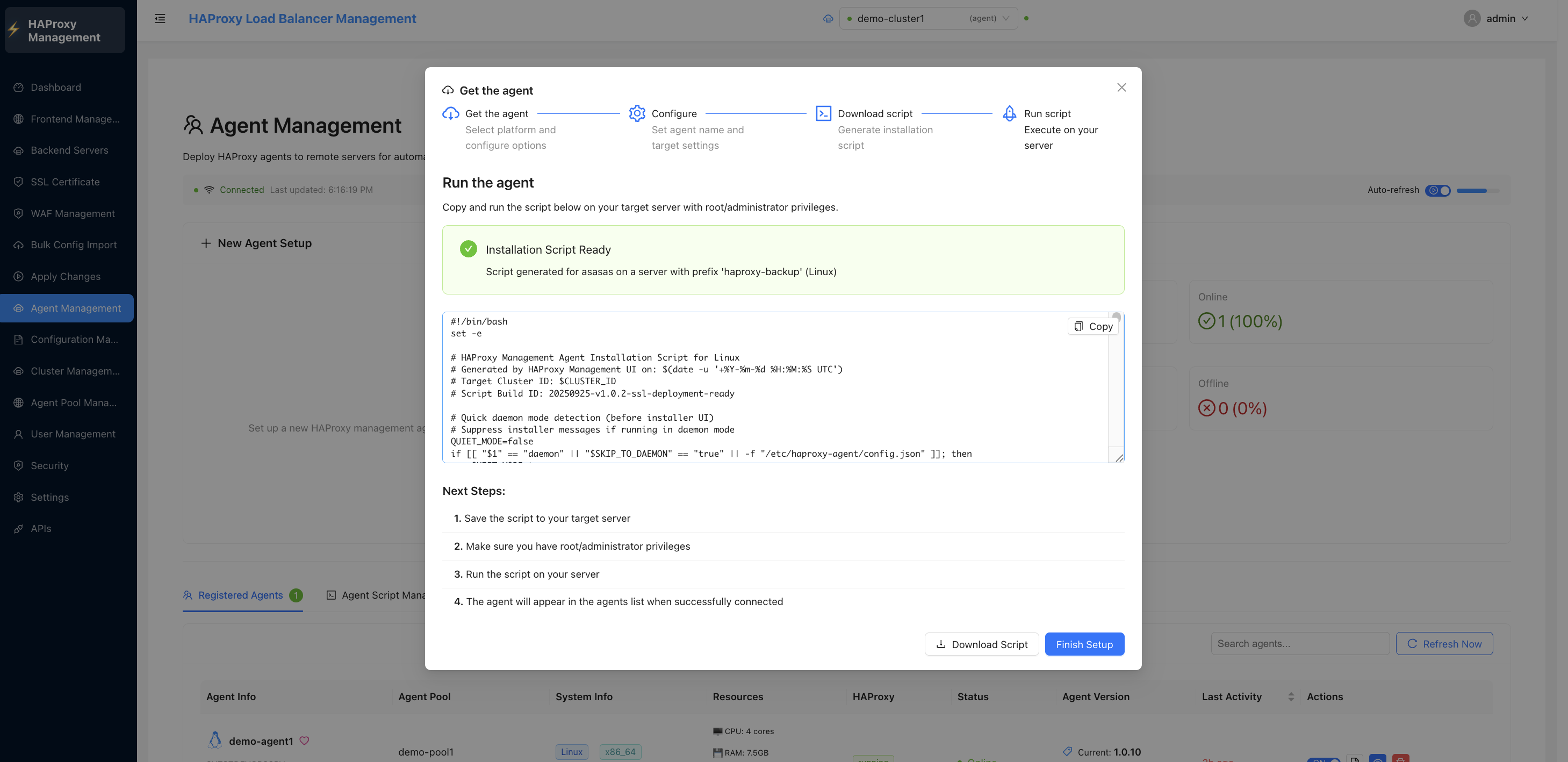
**Agent Management** - Generated installation script ready for deployment to target servers
### Dashboard - Real-time Monitoring
**Dashboard** - Overview tab showing system metrics, active servers, SSL certificates, and cluster agent health

**Dashboard** - Performance Trends with request rate and response time heatmap (24h view)

**Dashboard** - Health Matrix showing backend servers with detailed health check status and response times

**Dashboard** - Response Time Heatmap (24h) with color-coded latency visualization per backend

### HAProxy Configuration
**Frontend Management** - List view with SSL/TLS bindings, sync status, and config status

**Frontend Management** - Edit modal for configuring bind address, protocol mode, default backend, SSL/TLS, ACLs, and advanced options

**Backend Configuration** - Backend server and pool configuration page

**Backend Management** - Backends & Servers tab with 165 servers across 56 backends, health status overview

### Configuration Import & Viewer
**Bulk Config Import** - Paste existing haproxy.cfg and parse configuration

**Bulk Config Import** - Parsed entities showing 56 frontends, 55 backends, 165 servers with SSL and configuration recommendations

**Configuration Viewer** - Real-time configuration viewer to pull haproxy.cfg from live agents

### Apply Management & Version Control
**Apply Management** - Pending changes and deployment history with version tracking

**Version History** - Configuration diff viewer showing added/removed lines with summary
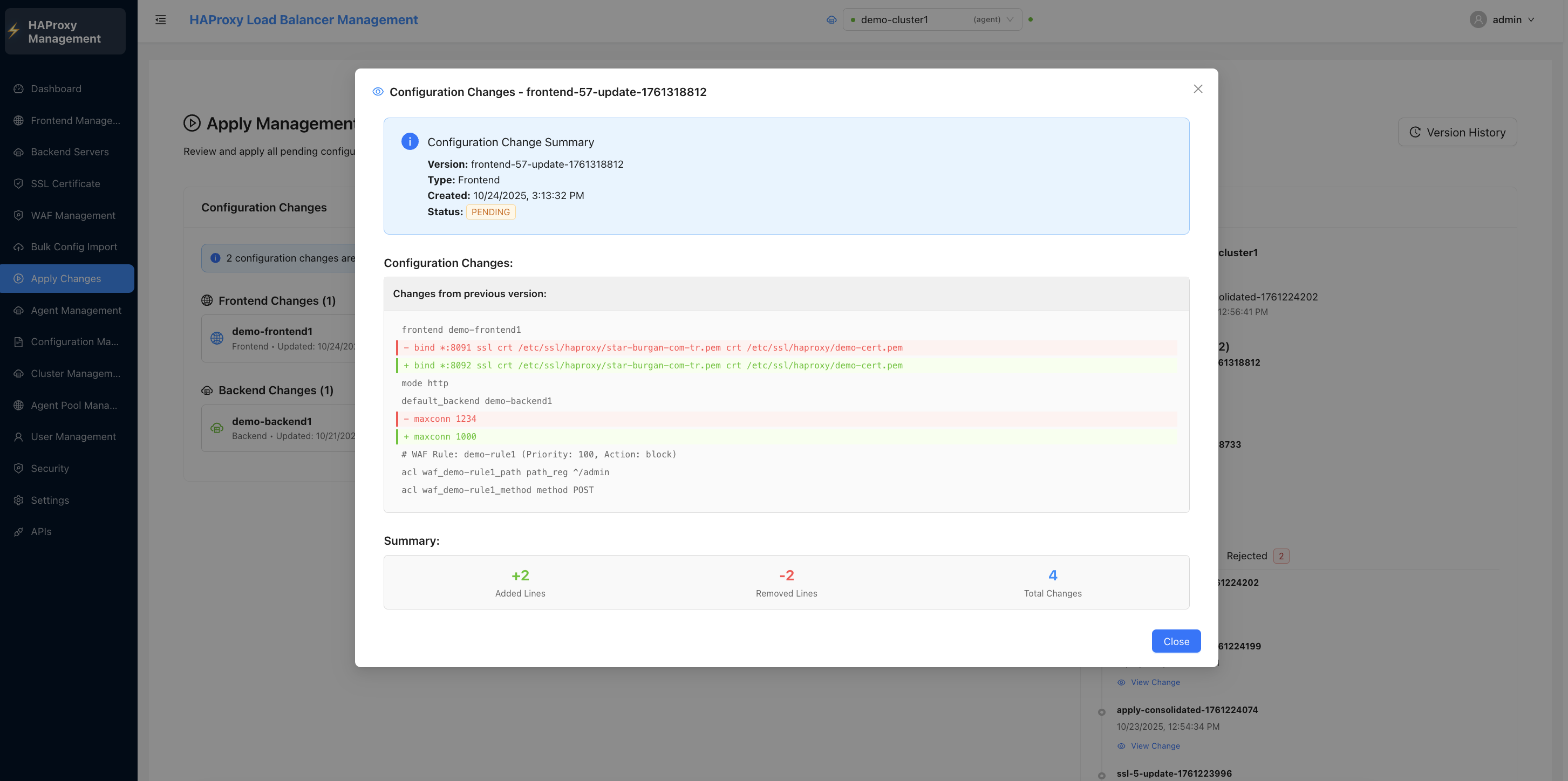
**Version History** - Complete version history with restore capabilities and deployment status

### Security & Certificate Management
**Security Management** - Agent API token management with active tokens, expiration tracking, and revoke capabilities

### ACME Automation - Automated SSL Certificates
**ACME Automation** - Setup guide with prerequisites checklist, certificate statistics, and order management

**ACME Automation** - Active certificate orders with PENDING status tracking and renewal schedule

**ACME Settings** - ACME/SSL Automation configuration with provider selection, staging mode, and auto-renewal settings

### Site Wizard - Guided Multi-Step Host Setup
**New Site Wizard** - Multi-step guided form for creating a complete proxied host (domains + backend pool + servers + frontend + SSL/ACME) with live HAProxy config validation and atomic apply

### WAF Management
**WAF Management** - WAF rule configuration with request filtering, rate limiting, and advanced options

### IP Inventory - Cross-Cluster IP Search
**IP Inventory** - Unified view of all IPs across clusters with search capability to identify which cluster, agent, or backend server an IP belongs to

## Key Capabilities
#### Configuration & Entity Management
- **Frontend Management**: Create, edit, update, and delete frontend configurations with SSL bindings, ACL rules, and routing
- **Backend Management**: Full CRUD operations for backend pools with load balancing algorithms and health checks
- **Server Management**: Add, update, remove, and configure backend servers with weights, maintenance mode, and connection limits
- **Bulk Configuration Import**: Import existing `haproxy.cfg` files to instantly manage all frontends, backends, and servers without manual recreation
- **Smart SSL Auto-Assignment**: Automatically matches and assigns SSL certificates during bulk import if they exist in SSL Management with matching names and SYNCED status - eliminates manual SSL configuration after import
- **Configuration Synchronization**: All entities (backends, frontends, servers, SSL certificates, WAF rules) auto-sync to agents
- **Configuration Viewer**: View live HAProxy configuration pulled from agents via Configuration Management page
#### Agent & Cluster Management
- **Agent-Based Management**: Lightweight agent service for secure, pull-based HAProxy management
- **Pool Management**: Organize agents into logical pools for better cluster organization
- **Multi-Cluster Support**: Manage multiple HAProxy clusters from a single interface with cluster selector
- **Agent Token Management**: Secure token-based agent installation with token revoke and renew capabilities
- **Agent Script Editor**: Monaco code editor for updating agent scripts via UI (not binary) - create new versions, rollback, and auto-upgrade all agents
- **Platform-Specific Scripts**: Auto-generated installation scripts for Linux and macOS (x86_64/ARM64)
- **HA / VIP (Keepalived) Management**: Create a virtual IP from the UI and the agents install & configure Keepalived (VRRP) with a HAProxy health-check so the VIP fails over automatically when HAProxy drops — opt-in, with live MASTER/BACKUP per node, multi-distro install, cluster-driven config path, and Apply/Reject staging
#### Version Control & Change Management
- **Apply Management**: Centralized change tracking and deployment status monitoring across all agents
- **Version Control**: Every configuration change creates a versioned snapshot with complete history
- **Configuration Restore**: Restore any previous configuration version with one-click rollback capability
- **Diff Visualization**: See exactly what changed between versions with line-by-line comparison
- **Change Tracking**: Track who made changes, when, and what entities were affected
#### Monitoring & Security
- **Real-time Monitoring**: Live statistics, health checks, and performance metrics from HAProxy stats socket
- **SSL Management**: Centralized certificate management with expiration tracking and zero-downtime updates
- **WAF Rules**: Web Application Firewall rule management and deployment for security protection
- **User Management**: Role-based access control with admin and user roles
- **User Activity Logs**: Complete audit trail of all user actions, configuration changes, and system events
#### ACME Auto SSL / Let's Encrypt
- **Automated Certificate Issuance**: Request SSL certificates from Let's Encrypt or any ACME-compatible CA directly from the UI
- **Automatic Renewal**: Hourly background task monitors certificate expiry and creates renewal orders before expiration
- **Auto-Completion of Validated Orders** *(v1.4.0)*: Independent 60-second background task drives CA-validated orders through finalize -> download -> save without requiring user intervention; multi-replica safe via PostgreSQL `FOR UPDATE SKIP LOCKED` atomic claim, plus per-order session-level `pg_advisory_lock` to serialize concurrent completion attempts (UI "Complete" + auto-task race protection)
- **Zero-Touch Deployment**: Renewed certificates are automatically applied through the same PENDING -> APPLIED pipeline as manual SSL updates, with agent notification
- **Stuck Order Detection** *(v1.4.0)*: Setup wizard surfaces orders that the CA has validated but not yet downloaded, with one-click `Complete` action and automatic 60-second retry
- **Multi-Provider Support**: Configurable ACME directory URL supports Let's Encrypt, ZeroSSL, Google Trust Services, Buypass, and custom CAs
- **HTTP-01 Challenge**: Built-in challenge responder with automatic HAProxy routing injection; reserved backend name `_acme_challenge_backend` is auto-managed and protected from manual edits / agent sync collisions
- **DNS-01 Challenge** *(v1.8.0 — Issue #35)*: Validate via a DNS TXT record instead of HTTP on port 80, for **internal/isolated clusters with no public ingress** and for **wildcard** certificates (`*.example.com`). Pluggable per-account DNS provider (Manual + Cloudflare to start; credentials encrypted at rest and verified on save), same PENDING → APPLIED pipeline, bounded automatic retry on propagation lag, and a DNS-01 event timeline. Opt-in via a global setting; HTTP-01 behaviour is unchanged. (See the *DNS-01 Challenge* subsection under ACME Auto SSL below.)
- **ACME Account Management**: Register, view, and deactivate ACME accounts from the UI
- **Staging Mode**: Test certificate issuance with Let's Encrypt staging environment before production
- **Custom Staging Endpoint** *(v1.4.0)*: Optional `staging_url_override` setting lets you point staging mode at a private ACME test CA (e.g. Pebble) without touching the production directory URL
- **External Account Binding (EAB)**: Support for CAs that require EAB (ZeroSSL, Google Trust Services). Enter the EAB Key ID and HMAC Key globally in Settings, or per-account in the Register Account dialog (a per-account value overrides the global setting; leave it blank to use the global one)
- **Structured Error Diagnostics** *(v1.4.0)*: All ACME failures (challenge, finalize, download) persist structured JSON to `letsencrypt_orders.error_detail` for clear post-mortem analysis
- **Audit Logging** *(v1.4.0)*: Every ACME operation (request, revoke, CA-chain import, account ops) is captured in `user_activity_logs` for compliance review
- **ACME Diagnostic Panel** *(v1.5.0 — Issue #13)*: Live pre-flight + post-failure diagnostics (DNS / port-80 / routing / account / agents) and merged event timeline (`acme_order_events` + correlated `user_activity_logs`) accessible from the ACME Automation page; humanized error rendering for 11+ RFC8555 problem types with backwards-compatible fallback for legacy plain-string `error_detail`; per-user 5/min rate-limit
- **New Site Setup Wizard** *(v1.5.0 — Issue #14)*: Single guided flow that creates a Backend + Servers + HTTP Frontend (and optional HTTPS Frontend with chosen SSL mode: ACME / Upload / Existing / None) in one atomic transaction, with diff preview, draft persistence (PEM stripped), and ACME-staged order completion gated by agent confirmation. Per-mode reject path cleanly rolls back including any wizard-staged ACME orders.
- **Backward Compatible**: ACME-managed and manually uploaded certificates coexist seamlessly; existing SSL workflows are completely unaffected
#### Integration & API
- **REST API**: Complete API for programmatic access and integration with CI/CD pipelines
- **Agent Pull Architecture**: Secure polling model - no inbound connections required to HAProxy servers
- **Redis Cache**: High-performance metrics caching for dashboard with configurable retention
## Architecture
### System Architecture with Agent Pull Model
```mermaid
%%{init: {'theme':'base', 'themeVariables': { 'fontSize':'16px'}}}%%
graph TB
subgraph UI_LAYER["🌐 User Interface Layer"]
USER["👤 Admin/User"] --> WEB["React UI
Nginx Proxy
:8080"]
end
subgraph BACKEND_LAYER["⚙️ Backend Layer"]
WEB <--> API["FastAPI
Backend
:8000"]
API <--> DB[("PostgreSQL
Configs & History")]
API <--> CACHE[("Redis
Metrics Cache")]
end
subgraph AGENT_LAYER["📦 Agent Pool: Production Cluster"]
direction LR
AGENT1["🤖 Agent 1
10.0.1.101
(Poll Every 30s)"]
AGENT2["🤖 Agent 2
10.0.1.102
(Poll Every 30s)"]
AGENT3["🤖 Agent 3
10.0.1.103
(Poll Every 30s)"]
HAP1["⚡ HAProxy
+ Stats Socket
+ haproxy.cfg"]
HAP2["⚡ HAProxy
+ Stats Socket
+ haproxy.cfg"]
HAP3["⚡ HAProxy
+ Stats Socket
+ haproxy.cfg"]
AGENT1 --> HAP1
AGENT2 --> HAP2
AGENT3 --> HAP3
end
API <-.->|"🔄 Pull Config
📤 Push Stats
⬇️ SSL/WAF"| AGENT1
API <-.->|"🔄 Pull Config
📤 Push Stats
⬇️ SSL/WAF"| AGENT2
API <-.->|"🔄 Pull Config
📤 Push Stats
⬇️ SSL/WAF"| AGENT3
classDef uiStyle fill:#3a5a8a,stroke:#6a9eff,stroke-width:3px,color:#fff
classDef backendStyle fill:#5a3a8a,stroke:#b39ddb,stroke-width:2px,color:#fff
classDef dbStyle fill:#3a6a3a,stroke:#66bb6a,stroke-width:2px,color:#fff
classDef agentStyle fill:#8a6a30,stroke:#ffb347,stroke-width:2px,color:#fff
classDef haproxyStyle fill:#2a6a5a,stroke:#4db6ac,stroke-width:3px,color:#fff
class USER,WEB uiStyle
class API backendStyle
class DB,CACHE dbStyle
class AGENT1,AGENT2,AGENT3 agentStyle
class HAP1,HAP2,HAP3 haproxyStyle
```
### Component Details
| Component | Technology | Purpose | Port |
|-----------|------------|---------|------|
| **Frontend** | React.js 18 + Ant Design | Web interface, dashboards, configuration UI | 3000 |
| **Backend** | FastAPI + Python | REST API, task queue, agent coordination | 8000 |
| **Database** | PostgreSQL 15 | Configuration storage, user management, agent tasks | 5432 |
| **Cache** | Redis 7 | Session storage, performance metrics caching | 6379 |
| **Reverse Proxy** | Nginx | Frontend/backend routing, SSL termination, ACME challenge routing | 8080 |
| **HAProxy Agent** | Bash Service | Polls backend, applies configs, manages HAProxy | N/A |
| **HAProxy Instances** | HAProxy 2.8+ | Load balancer instances being managed by agents | 8404+ |
| **ACME Service** | Built-in (Python) | ACME protocol client for automated certificate management | - |
### Agent Pull Communication Flow - Detailed Entity Management
This detailed sequence diagram shows the complete lifecycle of configuration management, including entity creation, agent polling, configuration application, SSL management, WAF rules, and agent upgrade process.
```mermaid
sequenceDiagram
autonumber
participant U as 👤 User Browser
participant B as ⚙️ Backend API
participant D as 💿 PostgreSQL DB
participant R as 💾 Redis Cache
participant A as 🤖 Agent
participant CFG as 📄 haproxy.cfg
participant H as ⚡ HAProxy Service
participant S as 🔌 Stats Socket
Note over U,B: ═══ PHASE 1: USER CREATES ENTITIES ═══
U->>B: Create Backend "api-backend"
B->>D: INSERT backends + servers
B->>D: CREATE version v1.0.124
B-->>U: ✅ Backend Created
U->>B: Create Frontend "web-frontend"
B->>D: INSERT frontend + SSL binding
B->>D: UPDATE version v1.0.125
B-->>U: ✅ Frontend Created
U->>B: Upload SSL Certificate
B->>D: INSERT ssl_certificates (global)
B-->>U: ✅ SSL Ready for all clusters
U->>B: Create WAF Rule
B->>D: INSERT waf_rules (rate limit)
B-->>U: ✅ WAF Rule Created
U->>B: 🚀 Click "Apply Changes"
B->>D: Mark tasks READY_FOR_DEPLOYMENT
B-->>U: ✅ Queued for deployment
Note over A,R: ═══ PHASE 2: AGENT POLLING CYCLE (30s) ═══
loop Every 30 seconds
A->>B: GET /api/agent/tasks
B->>D: Query pending tasks
B-->>A: Tasks + Version v1.0.125
A->>S: socat show stat
S-->>A: CSV Stats
A->>B: POST /api/stats/upload
B->>R: Store metrics (5min TTL)
A->>B: Check agent version
B->>D: SELECT latest_agent_version
B-->>A: Current: 1.0.10, Latest: 1.0.11
end
Note over A,CFG: ═══ PHASE 3: AGENT APPLIES CONFIG ═══
A->>A: Parse task bundle
A->>A: Generate backend config
A->>A: Generate frontend config
A->>B: Download SSL certificate
B-->>A: PEM file (encrypted)
A->>A: Write /etc/haproxy/certs/*.pem
A->>A: chmod 600 (secure)
A->>A: Generate WAF stick-table
A->>CFG: Backup haproxy.cfg
A->>CFG: Write new configuration
A->>H: haproxy -c -f haproxy.cfg
alt Config Valid
A->>H: systemctl reload haproxy
H-->>A: ✅ Reload successful
A->>CFG: Keep new config
else Config Invalid
A->>CFG: Restore backup
A->>A: ❌ Rollback complete
end
Note over A,B: ═══ PHASE 4: AGENT REPORTS STATUS ═══
A->>B: POST /api/agent/tasks/complete
B->>D: UPDATE task status = COMPLETED
B->>D: INSERT activity_logs (JSON)
B-->>A: ✅ Acknowledged
Note over U,B: ═══ PHASE 5: USER MONITORS STATUS ═══
U->>B: GET /api/apply-changes/status
B->>D: Query all agent statuses
B-->>U: 3/3 agents ✅ v1.0.125
Note over U,R: ═══ PHASE 6: DASHBOARD METRICS ═══
U->>B: GET /api/dashboard/stats
B->>R: GET haproxy:cluster:5:stats
R-->>B: Latest metrics (30s fresh)
B-->>U: Real-time dashboard data
Note over A,B: ═══ PHASE 7: AGENT AUTO-UPGRADE ═══
A->>B: Check version (in polling)
B-->>A: New version 1.0.11 available
A->>B: GET /api/agent/download/1.0.11
B->>D: SELECT agent_script WHERE version=1.0.11
B-->>A: Download script (bash/python)
A->>A: Write new script to /tmp/agent-upgrade.sh
A->>A: chmod +x agent-upgrade.sh
A->>A: Execute: /tmp/agent-upgrade.sh
Note over A: Agent Self-Upgrade Process
A->>A: Stop current agent service
A->>A: Backup old agent binary
A->>A: Install new agent version
A->>A: Update systemd service
A->>A: Start agent with new version
A->>B: POST /api/agent/upgrade/complete
B->>D: UPDATE agent version = 1.0.11
B->>D: LOG upgrade activity
B-->>A: ✅ Upgrade confirmed
A->>CFG: Read haproxy.cfg (verify integrity)
A->>H: Check HAProxy service status
H-->>A: Service running normally
Note over A,B: Agent now running v1.0.11
Continues normal polling cycle
Note over B,D: ═══ PHASE 8: ACME AUTO-RENEWAL (Hourly) ═══
B->>D: Query expiring ACME certs (within N days)
D-->>B: Cert "example.com" expires in 25 days
B->>B: Create ACME renewal order
B->>B: Respond to HTTP-01 challenges
Note over B: Next cycle: poll order status
B->>B: Order valid - download certificate
B->>D: Update cert content (PENDING)
B->>D: Create config versions (PENDING)
B->>D: Auto-apply: apply_ssl_related_configs()
B->>D: Create consolidated version (APPLIED)
B->>R: Notify agents via Redis
A->>B: Poll detects new config version
A->>B: Download renewed certificate
A->>A: Write updated cert to disk
A->>H: Reload HAProxy (zero downtime)
A->>B: Report success
```
**Key Flow Features:**
- 🔄 **Continuous Polling**: Agents poll every 30s for tasks, stats collection, and version checks
- 📄 **Config Management**: haproxy.cfg backup → validate → apply → rollback if needed
- 🔐 **SSL Handling**: Secure download, file permissions (chmod 600), automatic frontend binding
- 🤖 **ACME Auto-Renewal**: Automatic certificate renewal via ACME protocol with same Apply pipeline as manual SSL
- 🛡️ **WAF Integration**: Stick-tables generated and integrated into config
- 📊 **Stats Collection**: Parallel stats upload using socat + stats socket
- 🔄 **Auto-Upgrade**: Agents detect new versions and self-upgrade with zero-touch deployment
- ✅ **Validation**: Every config change is validated before HAProxy reload
- 📝 **Activity Logging**: All operations logged in JSON format for audit trail
## Features & User Interface
### Pool Management - Agent Pool Organization
- **Pool Creation**: Create logical pools to group HAProxy agents
- **Pool Assignment**: Associate clusters with specific pools
- **Pool Overview**: View all agents within a pool
- **Multi-Pool Support**: Manage multiple pools for different environments (prod, staging, etc.)
- **Pool-based Filtering**: Filter agents and clusters by pool
### Cluster Management - Multi-Cluster HAProxy Administration
- **Cluster Selector**: Top navigation cluster selector for context switching
- **Cluster Creation**: Define clusters and associate with agent pools
- **Cluster Status**: Monitor cluster health and connectivity
- **Default Cluster**: Set preferred default cluster
- **Cross-Cluster View**: Compare metrics across multiple clusters
- **Cluster-Scoped Operations**: All configurations are cluster-specific
### Agent Management - HAProxy Agent Deployment & Monitoring
#### Agent Script Management
Agent scripts are **not hardcoded** in the project. They are stored in the database and can be updated via the UI:
- **Script Editor**: Edit agent installation scripts directly in the UI
- **Platform Support**: Separate scripts for Linux and macOS (x86_64/ARM64)
- **Version Control**: Create new agent versions with changelog
- **Automatic Upgrade**: Deploy new agent versions to all agents with one click
- **Upgrade Process**: Agents check backend version → Download new script → Self-upgrade → Restart
**Agent Version Update Flow:**
```mermaid
%%{init: {'theme':'base', 'themeVariables': { 'fontSize':'14px'}}}%%
graph LR
subgraph USER["👤 User Actions"]
A["Edit Script
+ Create v1.0.5"] --> B["Mark as
Latest"]
end
subgraph AUTO["🤖 Automatic Process"]
C["Agents Poll"] --> D["Detect New
Version"] --> E["Download"] --> F["Self-Upgrade"] --> G["✅ Running
v1.0.5"]
end
B -.->|Trigger| C
style USER fill:#2a4a6a,stroke:#4a9eff,stroke-width:2px,color:#fff
style AUTO fill:#3a5a3a,stroke:#66bb6a,stroke-width:2px,color:#fff
style A fill:#3a5a8a,stroke:#6a9eff,stroke-width:2px,color:#fff
style B fill:#3a5a8a,stroke:#6a9eff,stroke-width:2px,color:#fff
style C fill:#4a6a4a,stroke:#66bb6a,stroke-width:2px,color:#fff
style D fill:#4a6a4a,stroke:#66bb6a,stroke-width:2px,color:#fff
style E fill:#4a6a4a,stroke:#66bb6a,stroke-width:2px,color:#fff
style F fill:#4a6a4a,stroke:#66bb6a,stroke-width:2px,color:#fff
style G fill:#2a5a2a,stroke:#66bb6a,stroke-width:3px,color:#fff
```
#### Agent Operations
- **Agent Registration**: Automatic agent registration after installation
- **Installation Scripts**: Generate platform-specific scripts (Linux/macOS ARM/x86)
- **Script Download**: One-click download of customized installation scripts
- **Agent Status**: Real-time agent connectivity and health monitoring
- **Platform Detection**: Automatic detection of OS and architecture
- **Last Seen**: Track when agents last connected to backend (updated every 30s)
- **Batch Operations**: Upgrade multiple agents simultaneously
#### Agent Logs & Monitoring
- **Log Location**: `/var/log/haproxy-agent/agent.log` on each agent server
- **Log Format**: Structured JSON for easy parsing and log aggregation
- **Log Fields**: timestamp, level, message, agent_id, cluster_id, task_id
- **Activity Tracking**: All agent activities (config updates, SSL changes, task execution)
- **Log Integration**: JSON format allows easy integration with ELK, Splunk, Datadog
- **Log Rotation**: Automatic rotation with configurable retention
**Example Log Entry (JSON):**
```json
{
"timestamp": "2025-01-15T10:30:45Z",
"level": "INFO",
"agent_id": "prod-haproxy-01",
"cluster_id": 5,
"task_id": 123,
"message": "SSL certificate updated successfully",
"details": {
"cert_name": "wildcard.example.com",
"action": "update",
"haproxy_reload": "success"
}
}
```
### Dashboard - Main Overview & Real-time Monitoring
The dashboard displays comprehensive real-time metrics collected by agents from HAProxy stats socket. Agents use `socat` to query the stats socket every 30 seconds and send CSV data to the backend, which parses and stores it in Redis for high-performance access.
**Tab-Based Navigation:**
1. **Overview Tab**:
- System-wide metrics: Total requests, active sessions, error rate
- Frontend/Backend/Server counts
- SSL certificate status and expiration warnings
- Quick health status indicators
2. **Frontends Tab**:
- Request rate per frontend with sparkline charts
- Session distribution across frontends
- Status (UP/DOWN) monitoring
- Filter by specific frontends
3. **Backends Tab**:
- Backend health matrix (all servers at a glance)
- Request distribution percentages
- Response time averages
- Active/backup server status
4. **Performance Trends Tab**:
- Response time trends (1h, 6h, 24h, 7d, 30d views)
- Request rate trends with interactive zoom
- Error rate analysis over time
- Session trends and capacity planning
5. **Capacity & Load Tab**:
- Current vs max connections
- Queue depth monitoring
- CPU/Memory utilization (if available)
- Load distribution heatmaps
6. **Health Matrix Tab**:
- Detailed server health status
- Last status check timestamps
- Check duration and latency
- Failure reasons and diagnostics
**Data Collection Flow:**
- Agents → Stats Socket (`show stat`) → CSV → Backend API → Redis → Dashboard UI
- **Agent Log Path**: `/var/log/haproxy-agent/agent.log` (JSON format for easy log aggregation)
- **Update Interval**: 30 seconds (configurable)
- **Data Retention**: 30 days in Redis (configurable)
### Frontend Management - Virtual Host & Routing Configuration
- **Frontend CRUD**: Create, edit, delete, and duplicate frontend configurations
- **Protocol Support**: HTTP, TCP, and health check mode configurations
- **Binding Configuration**: IP address, port, and SSL binding options
- **Backend Assignment**: Default backend selection and routing rules
- **SSL Configuration**: Certificate assignment and SSL protocol settings
- **ACL Rules**: Access control rules with pattern matching
- **Redirect Rules**: HTTP to HTTPS redirects and custom redirections
- **Advanced Options**: Connection limits, timeouts, and performance tuning
- **Search & Filter**: Real-time search and status-based filtering
### New Site Wizard - Guided Multi-Step Host Setup
The New Site Wizard is the recommended entry point for creating a complete proxied host. It collects every piece of configuration a host needs across a five-step guided form and creates the matching frontend + backend + servers + SSL binding as a single atomic apply.
- **5-step guided flow**:
1. **Domains** - host header / SNI / wildcard validation, IDN/Punycode normalization, port + bind-address collision check
2. **Backend** - pool name, load-balance algorithm, health check method/URI, cookie-based persistence (RFC 6265 and HAProxy-parser-safe character validation)
3. **Servers** - per-server address/port/weight, optional CA bundle reference (cluster-RBAC enforced), backup-server + cookie-value validators
4. **SSL** - three modes: existing certificate (cluster-RBAC), PEM upload (chain validation + SAN/CN match), or ACME order (account binding + preflight)
5. **Review + Dry-Run** - live `POST /api/sites/preview` runs the proposed config through `haproxy -c` and surfaces every WARNING/ERROR with a marker comment that pinpoints the offending block before anything touches the database
- **Draft persistence**: every step auto-saves to a server-side draft (30-day TTL, 50 drafts per user cap, cluster-scoped, PEM material stripped at rest)
- **Resume across sessions**: drafts can be reopened from a different browser; cluster swap mid-wizard surfaces a confirmation prompt to prevent cross-cluster contamination
- **Atomic apply**: frontend + backend + servers + SSL binding land as a single PENDING change reviewable from Apply Management - accept and apply, or reject as a whole
- **Cluster RBAC**: every step honours `user_pool_access` and cluster RBAC; SSL certificate references are validated against the target cluster at both preview AND create time
- **Hardening**: IDN/Punycode safe slug generation, cookie/header injection guards, path-traversal protection on SSL filenames, per-user-per-minute rate limit on create + preview, advisory locks against concurrent creation
- **Backwards compatible URLs**: legacy `/proxied-hosts/new` route continues to resolve to the new wizard
### Backend Servers - Server Pool Management
- **Server Management**: Add, edit, remove, and configure backend servers
- **Health Checks**: HTTP/TCP health check configuration and monitoring
- **Load Balancing**: Round-robin, least-conn, source, and URI algorithms
- **Server Weights**: Dynamic weight adjustment for load distribution
- **Maintenance Mode**: Enable/disable servers without removing configuration
- **Backup Servers**: Failover server configuration for high availability
- **Connection Limits**: Per-server connection and rate limiting
- **Monitoring Dashboard**: Real-time server status and performance metrics
### Configuration - HAProxy Config File Management
- **Syntax Editor**: Monaco editor with HAProxy syntax highlighting
- **Real-time Validation**: Configuration syntax checking and error detection
- **Configuration Templates**: Pre-built templates for common setups
- **Version Control**: Configuration versioning and rollback capabilities
- **Backup & Restore**: Automatic backups and manual restore functionality
- **Direct Editing**: Raw HAProxy configuration file editing
- **Deployment**: Apply configuration changes with validation
- **Help System**: Integrated HAProxy directive documentation
- **Real-time Config Pull**: Pull current haproxy.cfg from live HAProxy servers
- View actual running configuration
- Compare with managed configuration
- Import existing configurations
- Useful for migrating from manual to managed setup
### Apply Management - Change Tracking & Deployment
#### Change Tracking & Versioning
Every configuration change creates a new version with complete tracking:
- **Automatic Versioning**: Each apply creates a new version number (e.g., v1.0.123)
- **Version Snapshots**: Complete configuration state saved for each version
- **Diff Visualization**: See exactly what changed between versions
- Green: Added lines
- Red: Removed lines
- Yellow: Modified lines
- **Change Summary**: High-level summary of changes (added frontends, modified backends, etc.)
- **Version Metadata**: Timestamp, user, cluster, affected entities
#### Deployment & Status
- **Change Tracking**: Track all pending configuration changes before apply
- **Apply Status**: Real-time deployment status per agent
- **Bulk Apply**: Deploy changes to all agents in a cluster simultaneously
- **Success/Failure Tracking**: Monitor which agents successfully applied changes
- **Retry Mechanism**: Retry failed deployments per agent
- **Apply Logs**: Detailed logs for each deployment operation with error messages
#### Version History & Restore
**Version History Viewer:**
- View all historical configuration versions
- Compare any two versions side-by-side
- See who made changes and when
- Filter by date, user, or cluster
**Configuration Restore:**
- Restore any previous configuration version
- One-click rollback to last known good configuration
- Restore process:
1. Select previous version from history
2. Review diff (current vs target version)
3. Confirm restore
4. Agents pull restored configuration
5. HAProxy reloaded with previous config
**Use Cases:**
- Rollback after problematic deployment
- Audit configuration changes
- Compare production vs staging configurations
- Disaster recovery
### SSL Certificates - Centralized TLS/SSL Certificate Management
HAProxy OpenManager provides powerful centralized SSL/TLS certificate management with both global and cluster-specific scopes:
#### SSL Certificate Scopes
**1. Global SSL Certificates:**
- Defined once, distributed to **all clusters** and **all agents**
- Perfect for wildcard certificates or shared certificates
- When updated, all agents across all clusters automatically receive the new certificate
- Use case: `*.example.com` certificate used across all environments
**2. Cluster-Specific SSL Certificates:**
- Scoped to a specific cluster only
- Only agents in that cluster receive these certificates
- Use case: Environment-specific certificates (prod, staging, dev)
#### Certificate Operations
**Upload & Distribution:**
1. User uploads certificate via UI (PEM format: cert + private key)
2. Backend stores certificate in database
3. Agents poll backend and detect new/updated certificates
4. Agents download certificates to local disk (`/etc/haproxy/certs/`)
5. Agents update `haproxy.cfg` frontend bindings
6. HAProxy is safely reloaded with zero downtime
**Binding to Frontends:**
- SSL certificates are automatically bound to frontends based on configuration
- Frontend definition specifies which certificate to use
- Format: `bind *:443 ssl crt /etc/haproxy/certs/cert-name.pem`
**Centralized SSL Update Process:**
```
User Updates SSL in UI → All Agents Poll Backend (30s)
→ Download New Certificate → Update Frontend Bindings
→ Validate Config → Reload HAProxy (zero downtime)
```
#### Key Features
- **Certificate Upload**: PEM format certificate and private key upload
- **ACME Automation**: Automatic certificate issuance and renewal via Let's Encrypt / ACME protocol (see [ACME Auto SSL](#acme-auto-ssl---automated-certificate-management))
- **Certificate Store**: Centralized repository with encryption at rest
- **Expiration Monitoring**: Automatic expiration tracking with alerts (30, 15, 7 days)
- **Global Update**: Update one certificate, deploy to all clusters simultaneously
- **Domain Binding**: Associate certificates with specific domains/frontends
- **Certificate Validation**: Syntax and format validation before deployment
- **Renewal Tracking**: Certificate renewal status and history
- **Source Tracking**: Certificates display their source ("Manual" or "Auto (ACME)") for clear management
- **ACME Protection**: ACME-managed certificates are protected from manual content edits to prevent accidental overwrites
- **Security Profiles**: SSL/TLS protocol and cipher suite configuration
- **Zero Downtime**: Safe HAProxy reload ensures no dropped connections
### ACME Auto SSL - Automated Certificate Management
HAProxy OpenManager includes a built-in ACME client for automated SSL/TLS certificate management using the ACME protocol (RFC 8555). This enables zero-touch certificate issuance and renewal from Let's Encrypt and other ACME-compatible Certificate Authorities.
#### How ACME Auto SSL Works
```mermaid
sequenceDiagram
autonumber
participant U as Admin UI
participant B as Backend API
participant CA as ACME CA
(Let's Encrypt)
participant H as HAProxy
(via Agent)
Note over U,CA: === Certificate Request ===
U->>B: Request certificate for example.com
B->>CA: Create ACME order
CA-->>B: Order + HTTP-01 challenge token
B->>B: Store challenge token in DB
Note over CA,H: === Domain Validation ===
CA->>H: GET /.well-known/acme-challenge/{token}
H->>B: Proxy challenge request (ACME ACL)
B-->>H: Challenge response (key authorization)
H-->>CA: Challenge response
CA->>CA: Validate domain ownership
Note over B,CA: === Certificate Issuance ===
B->>CA: Finalize order (submit CSR)
CA-->>B: Signed certificate
B->>B: Store cert, status = PENDING
B->>B: Create config version (PENDING)
Note over U,B: === Manual Apply (New Certs) ===
U->>B: Click "Apply Changes"
B->>B: Mark APPLIED + consolidated config
B->>H: Notify agents
H->>H: Pull cert + reload HAProxy
```
#### Auto-Renewal Flow
Certificates are automatically renewed before expiration through a background task that runs hourly:
```mermaid
sequenceDiagram
autonumber
participant BG as Background Task
(Hourly)
participant B as Backend
participant CA as ACME CA
participant DB as Database
participant H as HAProxy Agents
BG->>DB: Find certs expiring within N days
BG->>CA: Create renewal order
CA-->>BG: Challenge token
BG->>DB: Store challenge
Note over BG,CA: Next cycle (or same)
BG->>CA: Check order status
CA-->>BG: Status: valid
BG->>CA: Download renewed certificate
Note over BG,DB: Auto-Apply (same as manual Apply)
BG->>DB: Update cert (PENDING)
BG->>DB: Create config versions (PENDING)
BG->>DB: apply_ssl_related_configs()
BG->>DB: Create consolidated version (APPLIED)
BG->>DB: Mark cert APPLIED
BG->>H: Notify agents via Redis
H->>H: Pull updated cert + reload
```
**Key behavior**: Auto-renewed certificates follow the **exact same Apply pipeline** as manual SSL updates. The cert transitions `PENDING -> APPLIED` automatically, agents are notified, and cross-cluster propagation works identically to manual Apply. No separate deployment mechanism is used.
#### ACME Certificate Diagnostic Panel
Available from the ACME Automation list (`Diagnose` button on each order, or by clicking the order's status tag), the Diagnostic Panel runs a full preflight checklist before a certificate is issued or renewed and surfaces every blocker in a single operator-friendly view:
- **Agent reachability** - verifies that at least one agent in each target cluster is online and within the last-seen window
- **DNS resolution** - resolves every domain on the order (A / AAAA / CNAME) and flags wildcards and non-resolvable names with the exact upstream resolver error
- **Port 80 reachability** - checks that the HTTP-01 challenge port is reachable from the public internet via the agent's egress path
- **ACME challenge ACL preview** - renders the `acl1 !acl1` + `http-request return` block that will be injected at apply time, so the operator can see exactly what HAProxy will receive
- **HSTS / rate-limit policy collision check** - warns if existing frontend rules would short-circuit the challenge route
- **Account binding check** - confirms a valid ACME account exists for the selected provider + cluster combination
- **Event Log timeline** - merged view of typed `acme_order_events` rows and correlated `user_activity_logs` entries; auto-tails every 5s while the order is in `pending`/`processing`
- **Humanized error display** - covers 11+ RFC8555 problem types (`badNonce`, `caa`, `connection`, `rateLimited`, `unauthorized`, ...) with full backwards compatibility for legacy plain-string error details
- **Operator-friendly error envelope** - every failure returns `{ correlation_id, field, cause, remediation }` so root-causing is one API call away
#### ACME Features
| Feature | Description |
|---------|-------------|
| **Certificate Request Wizard** | Step-by-step UI wizard: select domains, account, target clusters |
| **Multi-Provider Support** | Let's Encrypt, ZeroSSL, Google Trust Services, Buypass, or custom ACME CA |
| **Staging Mode** | Test with LE staging environment (no rate limits) before production |
| **Account Management** | Register, view details, and deactivate ACME accounts |
| **Order Tracking** | View all orders with status, domains, and challenge details |
| **Auto-Renewal** | Configurable renewal window (default: 30 days before expiry) |
| **Renewal Schedule** | Dashboard showing all ACME certs with expiry dates and renewal status |
| **HTTP-01 Challenges** | Built-in challenge responder with automatic HAProxy ACL injection |
| **EAB Support** | External Account Binding for CAs that require it |
| **Certificate Protection** | ACME-managed certs are read-only in SSL Management (content cannot be manually edited) |
| **CA Chain Import** | One-click import of CA intermediate certificates |
| **Certificate Revocation** | Revoke compromised certificates through the ACME CA |
#### ACME Configuration
ACME settings are managed through **Settings > ACME / SSL Automation** tab:
| Setting | Description | Default |
|---------|-------------|---------|
| `acme.provider` | ACME CA provider selection | `letsencrypt` |
| `acme.directory_url` | ACME directory endpoint URL | LE production URL |
| `acme.staging_mode` | Use staging environment | `false` |
| `acme.auto_renew_enabled` | Enable automatic certificate renewal | `false` |
| `acme.renew_before_days` | Days before expiry to trigger renewal | `30` |
| `acme.eab_kid` | External Account Binding Key ID (if required) | - |
| `acme.eab_hmac_key` | External Account Binding HMAC Key (if required) | - |
#### Cluster ACME Setup
For HTTP-01 challenges to work, each cluster needs ACME challenge routing enabled:
1. Go to **Cluster Management** > Edit cluster
2. Enable **ACME Challenge Routing** toggle
3. Optionally set a custom ACME backend URL
4. Apply changes
When enabled, HAProxy configuration is automatically injected with:
- An ACL matching `/.well-known/acme-challenge/` requests
- A `use_backend` rule directing challenge traffic to the management backend
- A dedicated `_acme_challenge_backend` section
This injection only affects HTTP-mode frontends and is completely removed when ACME is disabled.
#### ACME Distributed Architecture
Understanding how HTTP-01 challenges work in a distributed HAProxy environment is critical for successful certificate issuance:
```
┌─────────────────┐ DNS A Record ┌──────────────────┐
│ Let's Encrypt │ ──────────────────► │ HAProxy Node(s) │
│ (CA Server) │ HTTP GET :80 │ (VIP / Public) │
└─────────────────┘ /.well-known/ └────────┬─────────┘
acme-challenge/ │
{token} │ ACL match →
│ use_backend
│ _acme_challenge_backend
▼
┌──────────────────┐
│ OpenManager │
│ (Backend Server) │
│ Serves token │
│ response from DB │
└──────────────────┘
```
**Key Points:**
1. **Let's Encrypt connects to your HAProxy**, not directly to OpenManager
2. **DNS must resolve** the requested domain to your HAProxy node's public IP (or VIP/NAT)
3. **Port 80 must be open** from the internet to HAProxy for HTTP-01 validation
4. **HAProxy routes** the `/.well-known/acme-challenge/` path to OpenManager via the injected backend
5. **OpenManager serves** the challenge token response stored in the database
6. The `MANAGEMENT_BASE_URL` or `acme.challenge_backend_url` setting tells HAProxy where to find OpenManager
**Network Scenarios:**
| Scenario | HAProxy | OpenManager | DNS Target |
|----------|---------|-------------|------------|
| Single server | localhost:80 | localhost:5000 | Server's public IP |
| Separate servers | 10.0.0.10:80 | 10.0.0.20:5000 | HAProxy's public IP |
| Behind NAT/VIP | VIP: 1.2.3.4:80 | Internal:5000 | VIP address |
| Multi-cluster | Multiple HAProxy nodes | Central OpenManager | Each domain → respective HAProxy |
#### DNS-01 Challenge — Internal/Isolated Clusters & Wildcards *(v1.8.0 — Issue #35)*
The default **HTTP-01** challenge validates over **port 80**, so the domain must resolve publicly to an HAProxy node with ACME Challenge Routing enabled. **DNS-01** validates via a **DNS TXT record** (`_acme-challenge.`) instead, so it needs **no inbound port 80 and no public ingress** to the HAProxy node. Use it for:
- **Internal / isolated clusters** (behind a VPN/firewall, no public port 80) where you still control the domain's DNS.
- **Wildcard certificates** (`*.example.com`) — which can *only* be issued via DNS-01.
DNS-01 is **opt-in** and fully backward compatible: it is disabled until an administrator enables it, and existing HTTP-01 certificates are completely unaffected.
- **Enable it**: Settings → ACME / SSL Automation → **DNS-01 Challenge (advanced)** → turn on *Enable DNS-01 Challenge* and Save. While off, DNS-01 options are hidden and no DNS-01 orders can be created.
- **Per-account provider**: in ACME Automation, create (or reconfigure) an ACME account with **Challenge Method = DNS-01** and a **DNS Provider**. Provider credentials are **verified before saving** and **encrypted at rest** (Fernet, mirroring the VRRP/MFA secret pattern); they are never returned by the API or written to logs.
- **Supported providers**: **Manual** (publish the TXT record yourself in any DNS — including fully internal DNS — then click *Verify*; works everywhere but cannot auto-renew unattended) and **Cloudflare** (API token with `Zone:DNS:Edit` + `Zone:Read`; the TXT record is created and cleaned up automatically and renews unattended). The provider interface is pluggable — more providers can be added without changing the issuance flow.
- **Same pipeline**: after validation the certificate follows the normal PENDING → APPLIED flow (assign to clusters / Apply Management) and the agent serves it — identical to HTTP-01 from finalize onward, with **zero agent or rendered-config changes** for DNS-01.
- **Manual flow**: the order detail shows the exact `_acme-challenge.` record name + TXT value (copyable); publish it and click *I've added the records — Verify*. For Cloudflare it is automatic.
- **Resilience**: a propagation-lag failure is recovered by a **bounded fresh-order retry chain** (1 original + 3 retries with increasing backoff, kept under Let's Encrypt's rate limits); any orphaned TXT record is cleaned up by a reconcile sweep. The order detail shows a DNS-01 event timeline (publish → validation → cleanup).
- **Wildcards**: `*.example.com` is validated at `_acme-challenge.example.com`; it does **not** cover the apex — add `example.com` as a separate name if you need both (the providers handle the two coexisting TXT values automatically).
- **Scope (this release)**: the Site Wizard remains HTTP-01-only; issue DNS-01 / wildcard certificates from **ACME Automation**.
#### ACME Quick Start Guide
Follow these steps to obtain your first Let's Encrypt certificate:
**Step 1: Configure ACME Settings**
- Navigate to **Settings > ACME / SSL Automation** tab
- Select your ACME provider (default: Let's Encrypt)
- For testing, enable **Staging Mode** to avoid rate limits
- Save changes
**Step 2: Register an ACME Account**
- On the **SSL Certificates > ACME Automation** page, find the ACME Account card
- Click **Register Account** and provide a valid email address
- Accept the Terms of Service
**Step 3: Enable ACME on Clusters**
- Go to **Cluster Management** > Edit your cluster
- Enable **ACME Challenge Routing** toggle
- Set the correct **ACME Backend URL** if OpenManager is on a different server
- Save the cluster configuration
**Step 4: Apply Configuration**
- Go to **Apply Management** and apply the pending HAProxy configuration changes
- This injects the ACME challenge routing rules into HAProxy
**Step 5: Verify Challenge Routing**
Test that the challenge path is reachable through HAProxy:
```bash
curl -v http://your-haproxy-ip/.well-known/acme-challenge/test
```
Expected: HTTP 404 from OpenManager (not HAProxy's default 503). This confirms routing works.
**Step 6: Ensure DNS Resolution**
- Your domain(s) must have DNS A/AAAA records pointing to your HAProxy node's public IP
- Verify: `dig +short yourdomain.com` should return the HAProxy IP
**Step 7: Request Certificate**
- Go to **SSL Certificates > ACME Automation** tab
- Click **New Certificate** and follow the wizard
- The UI will guide you through prerequisite checks before submission
#### Troubleshooting ACME
If certificate issuance fails, check the following:
| Issue | Diagnostic Step |
|-------|----------------|
| Challenge 404 | Check `ACME-CHALLENGE` log entries in OpenManager logs |
| DNS mismatch | Verify `dig +short yourdomain.com` returns HAProxy IP |
| Port 80 blocked | Test from external: `curl http://yourdomain.com/.well-known/acme-challenge/test` |
| Config not applied | Check **Apply Management** for pending changes |
| ACME not enabled | Verify cluster has **ACME Challenge Routing** enabled |
| Account issues | Check ACME account status in **ACME Automation** page |
**Diagnostic Logging:** OpenManager provides detailed ACME logging with prefixes:
- `ACME:` — Order creation, challenge responses, finalization
- `ACME-CHALLENGE:` — Incoming challenge token requests and responses
Review application logs to trace the complete ACME flow when troubleshooting issues.
### WAF Management - Web Application Firewall
- **Rate Limiting**: Request rate limiting by IP, URL, or custom patterns
- **IP Filtering**: Whitelist/blacklist IP addresses and CIDR ranges
- **Geographic Blocking**: Country-based access restrictions
- **DDoS Protection**: Automated DDoS detection and mitigation rules
- **Custom Rules**: User-defined security rules with regex patterns
- **Attack Monitoring**: Real-time attack detection and logging
- **Rule Templates**: Pre-configured security rule templates
- **Statistics Dashboard**: WAF activity analytics and blocked request metrics
### IP Inventory - Cross-Cluster IP Search & Discovery
The IP Inventory page provides a unified view of all IP addresses across every cluster, independent of the global cluster selector. It enables quick identification of which cluster, agent, or backend server a given IP belongs to.
**Key Features:**
- **Cross-Cluster Search**: Search any IP address across all clusters simultaneously
- **IP Type Identification**: Instantly determine if an IP is an agent server IP, a keepalived VIP, or a backend server address
- **Unified Results Card**: Search results show matched IP type (Server IP, VIP, Backend), agent/server name, cluster association, and status
- **Agent Tab**: Browse all agents with cluster name, hostname, agent IP, VIP (keepalive), VRRP state (MASTER/BACKUP), status, platform, and last seen time
- **Backend Servers Tab**: Browse all backend servers with cluster, backend name, server address, status, weight, and check status
- **Cluster Color Coding**: Each cluster is assigned a consistent color tag for quick visual identification
- **Auto-Refresh**: Data refreshes automatically every 30 seconds
- **Filters**: Filter by cluster and status within each tab
**Use Cases:**
- Identify which HAProxy cluster an IP belongs to during incident response
- Find which agent is running as MASTER or BACKUP in a keepalived pair
- Locate a backend server IP across multiple clusters
- Audit all IP addresses managed by the platform
### HA / VIP Management - Keepalived Virtual IP Failover
The HA / VIP page manages **highly-available virtual IPs** backed by Keepalived (VRRP) directly from the UI — no SSHing into nodes to install/configure Keepalived by hand. It builds on the agent pull-architecture: you define the VIP centrally, click Apply, and the agents converge.
**What it does:**
- **VIP dashboard**: lists each virtual IP with its pool, VRID, per-node interface, and a **live MASTER / BACKUP / FAULT** column per node (refreshed every 30s from the existing keepalive-state heartbeat pipeline).
- **Creation form**: enter the virtual IP (+ prefix), pick the pool, and select which of the pool's HAProxy nodes participate — each with a network interface (from the node's reported interfaces), a VRRP role (MASTER/BACKUP) and a priority. VRID auto-allocates per pool; an optional VRRP secret can be set.
- **Hands-off automation**: on **Apply**, each member's `keepalived.conf` is rendered and delivered; the agent installs Keepalived if missing, writes the config + a HAProxy health-check (`vrrp_script` + `track_script`), validates with `keepalived -t`, and starts the service. When HAProxy drops on the active node, the health-check lowers VRRP priority and the **VIP fails over automatically** to a backup.
**How it works (pull-based, isolated):**
- New tables `vip_instances` + `vip_members`; the agent polls `GET /api/agents/{name}/keepalived-config` (key-authenticated, agent-bound) and converges. It is fully **isolated** from the global HAProxy apply flow — VIP changes never regenerate `haproxy.cfg`.
- **Cluster-driven path**: the `keepalived.conf` location is a cluster setting (`keepalived_config_path`, default `/etc/keepalived/keepalived.conf`) delivered to the agent dynamically — just like the HAProxy paths — so non-standard installs are supported with zero per-node effort. The default is what the keepalived service loads on every distro; if you set a non-default path, ensure the keepalived unit is configured to load it.
**Apply / Reject staging:**
- VIP edits are staged as **PENDING** and only go live on **Apply**, which records an applied snapshot. **Reject** discards pending changes and **restores the previous applied state** (a never-applied VIP is discarded). Editing a live VIP never disrupts it until you re-Apply.
**Enterprise safety:**
- **Opt-in & backward compatible** — nodes/clusters without a VIP do nothing new.
- **Never clobbers a hand-managed Keepalived** — if an unmanaged `keepalived.conf` exists, the agent reports "externally managed" and leaves it untouched.
- **Multi-distro install** — Debian/Ubuntu, RHEL/CentOS/Alma/Rocky, Fedora, SUSE/openSUSE, Alpine (apt/dnf/yum/zypper/apk).
- **Reliable detection across platforms** — MASTER/BACKUP is detected via systemd journal, syslog, and a portable interface-based check (exact-match, all VIPs).
- **Secure** — the VRRP secret is encrypted at rest and never returned by the API; the delivery endpoint requires the node's own API key.
- **Scope** — VRRP targets bare-metal / VMware / on-prem L2 networks; the UI clearly notes that AWS/Azure/GCP don't honor VRRP/gratuitous-ARP. macOS agents can't run Keepalived and are excluded (the UI warns if one is selected).
**RBAC:** gated by the `vip` permission group (`vip.read/create/update/delete/apply`); admins bypass.
### User Management - Access Control & Authentication
- **User Accounts**: Create, edit, and manage user accounts
- **Role-based Access**: Admin, user, and custom role definitions
- **Permission System**: Granular permissions for different system functions
- **User Activity**: Login history and user action audit logs
- **Password Management**: Secure password policies and reset functionality
- **Session Management**: Active session monitoring and force logout
- **API Keys**: User API key generation and management
- **Role Assignment**: Dynamic role assignment and permission updates
#### Multi-Factor Authentication (MFA) — v1.6.0 (Issue #18)
MFA is **optional per account** and **default OFF**. Existing users keep their
single-factor (username/password) login unless they choose to enable it. The
feature is fully additive: nothing changes for accounts that don't opt in.
**For end-users**
- Open **Users** → find your own row → click **Enable MFA**.
- A wizard opens with three steps:
1. **Set up** — scan the QR code with Google Authenticator / Authy /
1Password / Microsoft Authenticator, or paste the displayed secret manually.
2. **Verify** — enter the current 6-digit code from your app.
3. **Backup codes** — save the 10 single-use recovery codes (format
`XXXX-YYYY`). They are shown only once. Use the **Copy all** /
**Download .txt** buttons.
- After enrollment your sign-in becomes two-step: username/password →
6-digit TOTP (or a backup code).
- To turn MFA off again, open your row's **Disable MFA** action and enter a
current TOTP or backup code.
**For admins**
- On any user with MFA enabled, the **Reset MFA** action wipes the user's
TOTP secret, backup codes, and pending challenges. A required *reason* is
written to the audit log. After reset the user logs in with their password
and may re-enroll.
**Emergency: reset MFA for every user**
Use the CLI helper when an authenticator outage / mass key loss happens.
Double confirmation is required; the action is irreversible.
```bash
API_URL=https://hap.example.com ADMIN_TOKEN=eyJ... \
./scripts/admin-mfa-reset-all.sh
# Prompts ask for: 'yes' → 'RESET ALL MFA' → reason
# Audit log: action='mfa.disabled.admin_bulk_reset'
```
**Configuration**
- Backend env var `MFA_ENCRYPTION_KEY` — a 44-char Fernet key used to encrypt
TOTP secrets at rest. Generate with:
```bash
python3 -c "from cryptography.fernet import Fernet; print(Fernet.generate_key().decode())"
```
On Kubernetes the key lives in the `backend-secret` Secret
(`k8s/manifests/03-secrets.yaml`). The shipped manifest uses the placeholder
`mfa_encryption_key_replace_me`; replace it via your CI/CD pipeline (e.g.
`sed` step) before `kubectl apply`.
- Optional `MFA_ACCOUNT_LABEL_DOMAIN` — overrides the per-user otpauth label
domain so QR codes show e.g. `alice@hap.example.com` instead of the request
hostname.
**API endpoints (all additive)**
| Method | Path | Notes |
|---|---|---|
| `POST` | `/api/auth/login` | Returns `mfa_required:true`+`mfa_token` for MFA users; legacy shape otherwise |
| `POST` | `/api/auth/login/mfa-verify` | Submits TOTP or backup code; returns JWT |
| `GET` | `/api/mfa/status` | Self status (enabled / method / backup codes remaining) |
| `POST` | `/api/mfa/enroll/start` | Begin TOTP enrollment |
| `POST` | `/api/mfa/enroll/confirm` | Confirm enrollment, returns 10 backup codes once |
| `POST` | `/api/mfa/disable` | Self-disable (TOTP or backup required) |
| `POST` | `/api/mfa/backup-codes/regenerate` | Issue 10 fresh backup codes (TOTP only) |
| `GET` | `/api/mfa/admin/status/{id}` | Admin: any user's MFA status |
| `POST` | `/api/mfa/admin-reset/{id}` | Admin: reset a single user's MFA |
| `POST` | `/api/mfa/admin-reset-all` | Admin: emergency reset for all users |
**Rate limits (per-user, ingress-aware, operationally tunable)**
MFA endpoints are rate-limited via slowapi+Redis with a **user-aware key
function** (`backend/middleware/mfa_rate_limit_key.py`):
1. If the request carries a valid Bearer JWT → bucket is `user:`.
Each operator gets an isolated bucket; an org-wide MFA rollout is no
longer bottlenecked by the shared ingress IP.
2. Else, if the TCP peer is in `MFA_TRUSTED_PROXY_CIDRS` → bucket is the
first `X-Forwarded-For` hop (real client IP behind the ingress).
3. Else → bucket is the TCP peer (slowapi default).
Defaults live in `backend/middleware/mfa_rate_limits.py` and are sized for
**enterprise-scale** rollouts (thousands of operators). Each one is
overridable via env var; an invalid string logs a `WARNING` and falls back
to the default without crashing.
| Endpoint | Env var | Default | Bucket |
|---|---|---|---|
| `POST /api/mfa/enroll/start` | `MFA_RATE_LIMIT_ENROLL_START` | `10/minute` | per user |
| `POST /api/mfa/enroll/confirm` | `MFA_RATE_LIMIT_ENROLL_CONFIRM` | `10/minute` | per user |
| `POST /api/mfa/disable` | `MFA_RATE_LIMIT_DISABLE` | `10/minute` | per user |
| `POST /api/mfa/backup-codes/regenerate` | `MFA_RATE_LIMIT_REGENERATE_BACKUP_CODES` | `5/hour` | per user |
| `POST /api/mfa/admin-reset/{id}` | `MFA_RATE_LIMIT_ADMIN_RESET` | `60/hour` | per admin |
| `POST /api/mfa/admin-reset-all` | `MFA_RATE_LIMIT_ADMIN_RESET_ALL` | `1/day` | per admin |
Limit string format follows slowapi: `/`.
**Trusted-proxy configuration**
`MFA_TRUSTED_PROXY_CIDRS` — comma-separated CIDR list, e.g.
`10.0.0.0/8,172.16.0.0/12,192.168.0.0/16`. Empty (default) disables XFF
parsing — XFF from any peer is then ignored, which is the safe choice when
the topology is unknown. Set this when your backend sits behind a known
ingress / load balancer so anonymous flows still get per-real-IP buckets.
The pre-existing `/api/auth/login` rate-limiting policy is unchanged. On
Kubernetes, see commented overrides in
`k8s/manifests/07-configmaps.yaml::backend-config`.
### Settings - System Configuration
- **Theme Settings**: Light/dark mode toggle and UI customization
- **ACME / SSL Automation**: Configure ACME provider, directory URL, staging mode, auto-renewal, EAB credentials, and test CA connectivity
- **Notification Settings**: Alert preferences and notification channels
- **System Preferences**: Default timeouts, refresh intervals, and limits
- **Backup Settings**: Automated backup scheduling and retention policies
- **Integration Settings**: External system integrations and webhooks
- **Language Settings**: Multi-language support configuration
- **Performance Tuning**: System performance and optimization settings
## Getting Started - First-Time Usage
### Quick Start for New Users
This guide walks you through using HAProxy OpenManager for the first time, including importing your existing HAProxy configuration.
#### Setup Flow Diagram
```mermaid
graph TD
Start([🚀 Start Setup]) --> Step1[1️⃣ Create Agent Pool
HAProxy Agent Pool Management]
Step1 --> Step2[2️⃣ Create Cluster
HAProxy Cluster Management]
Step2 --> Step3[3️⃣ Generate Agent Script
Agent Management]
Step3 --> Step4[4️⃣ Run Script on HAProxy Server
SSH to server and execute]
Step4 --> Step5[5️⃣ Copy Backup Config
haproxy.cfg.initial-backup]
Step5 --> Step6[6️⃣ Import Configuration
Bulk HAProxy Config Import]
Step6 --> Step7[7️⃣ Apply Changes
Apply Management]
Step7 --> Complete([✅ Setup Complete!])
style Start fill:#2d5016,stroke:#4caf50,stroke-width:3px,color:#fff
style Step1 fill:#7b4d1e,stroke:#ff9800,stroke-width:2px,color:#fff
style Step2 fill:#7b4d1e,stroke:#ff9800,stroke-width:2px,color:#fff
style Step3 fill:#1a4971,stroke:#2196f3,stroke-width:2px,color:#fff
style Step4 fill:#4a1a4a,stroke:#9c27b0,stroke-width:2px,color:#fff
style Step5 fill:#6b1e3f,stroke:#e91e63,stroke-width:2px,color:#fff
style Step6 fill:#1a4d43,stroke:#009688,stroke-width:2px,color:#fff
style Step7 fill:#6b5d1a,stroke:#fbc02d,stroke-width:2px,color:#fff
style Complete fill:#2d5016,stroke:#4caf50,stroke-width:3px,color:#fff
```
#### Detailed Step-by-Step Instructions
##### Step 1: Create Agent Pool 📦
Navigate to **HAProxy Agent Pool Management** page.
1. Click **"Create Pool"** button
2. Fill in pool details:
- **Pool Name**: `Production Pool` (or your preferred name)
- **Description**: `Production environment HAProxy servers`
3. Click **Save**
**Purpose**: Pools logically group your HAProxy agents for better organization.
---
##### Step 2: Create Cluster 🎯
Navigate to **HAProxy Cluster Management** page.
1. Click **"Create Cluster"** button
2. Fill in cluster details:
- **Cluster Name**: `Production Cluster`
- **Description**: `Main production HAProxy cluster`
- **Select Pool**: Choose the pool created in Step 1 (`Production Pool`)
3. Click **Save**
**Purpose**: A cluster represents a logical grouping of HAProxy configurations that will be deployed to agents.
---
##### Step 3: Generate Agent Installation Script 🤖
Navigate to **Agent Management** page.
1. Click **"Create Agent"** or **"Generate Script"** button
2. Configure agent details:
- **Agent Name**: `haproxy-prod-01` (unique identifier)
- **Select Pool**: Choose the same pool from Step 1 (`Production Pool`)
- **Platform**: Select `Linux` or `macOS`
- **Architecture**: Select `x86_64` or `ARM64`
3. Click **"Generate Install Script"**
4. Click **"Download Script"** to save the installation script
**Purpose**: This generates a customized installation script that will connect your HAProxy server to the management backend.
---
##### Step 4: Install Agent on HAProxy Server 🖥️
SSH into your HAProxy server and run the installation script.
```bash
# Copy the script to your HAProxy server
scp install-agent-haproxy-prod-01.sh root@your-haproxy-server:/tmp/
# SSH to the HAProxy server
ssh root@your-haproxy-server
# Make the script executable
chmod +x /tmp/install-agent-haproxy-prod-01.sh
# Run the installation script
sudo /tmp/install-agent-haproxy-prod-01.sh
```
**What the script does:**
- Installs required dependencies (Python, socat)
- Creates `haproxy-agent` systemd service
- Starts the agent (polls backend every 30 seconds)
- **Creates initial backup**: `/etc/haproxy/haproxy.cfg.initial-backup`
- Registers the agent with the backend
**Verify installation:**
```bash
# Check agent service status
sudo systemctl status haproxy-agent
# Check agent logs
sudo tail -f /var/log/haproxy-agent/agent.log
```
Return to the UI and verify the agent appears in **Agent Management** with status "Connected ✅".
---
##### Step 5: Copy Existing HAProxy Configuration 📄
You have **three options** to get your existing HAProxy configuration:
**Option A: Using the Initial Backup (Recommended)**
On your HAProxy server, the agent created a backup of your original configuration.
```bash
# Display the backup configuration
cat /etc/haproxy/haproxy.cfg.initial-backup
```
**Copy the entire contents** of this file to your clipboard.
---
**Option B: View Configuration via UI (Easiest)**
Navigate to **Configuration Management** page in the UI.
1. Select your agent from the **Agent Selector** dropdown
2. Click **"View Configuration"** button
3. The system will fetch the live configuration from the agent
4. **Copy the entire configuration** displayed in the viewer
5. You now have the configuration ready for import!
**Benefits**: No need to SSH to the server, get configuration directly from the UI.
---
**Option C: Current Configuration File**
If the backup doesn't exist, SSH to your server and copy the current configuration:
```bash
# Display current HAProxy configuration
cat /etc/haproxy/haproxy.cfg
```
**Copy the entire contents** to your clipboard.
---
##### Step 6: Import Configuration via Bulk Import 📥
Navigate to **Bulk HAProxy Config Import** page.
1. Select your cluster from the **Cluster Selector** dropdown (top of page)
2. **Paste** the configuration copied from Step 5 into the text area
3. Click **"Parse Configuration"** button
4. Review the parsed entities:
- Frontends detected
- Backends detected
- Servers detected
- SSL certificates (if any)
5. Click **"Import Configuration"**
**What happens:**
- The system parses your HAProxy config file
- Extracts frontends, backends, servers, and SSL bindings
- Creates database entities for each component
- Prepares configuration for deployment
**Result**: Your existing HAProxy configuration is now managed by HAProxy OpenManager! 🎉
---
##### Step 7: Apply Changes to Agent 🚀
Navigate to **Apply Management** page.
1. You'll see pending changes listed:
- Frontends to be created
- Backends to be created
- Servers to be added
2. Review the changes
3. Click **"Apply Changes"** button
4. Monitor deployment status:
```
Agent: haproxy-prod-01
Status: ✅ Configuration applied successfully
Version: v1.0.1
```
**What happens:**
- Backend marks configuration tasks as ready for deployment
- Agent polls and detects pending tasks (within 30 seconds)
- Agent downloads the new configuration
- Agent validates HAProxy configuration syntax
- Agent reloads HAProxy service (zero downtime)
- Agent reports success back to backend
**Verify deployment:**
- Check that agent status shows "Applied Successfully"
- Check HAProxy is running: `systemctl status haproxy`
- Check HAProxy stats: `http://your-server:8404/stats`
---
#### ✅ Setup Complete!
Your HAProxy server is now fully managed by HAProxy OpenManager. You can now:
- ✨ **Manage Frontends**: Add, edit, delete frontends via UI
- 🖥️ **Manage Backends**: Configure backend servers and health checks
- 🔒 **Upload SSL Certificates**: Centralized SSL management
- 🛡️ **Configure WAF Rules**: Add security rules
- 📊 **Monitor Performance**: View real-time statistics on dashboard
- 🔄 **Version Control**: Track all configuration changes with rollback capability
**Next Steps:**
- Add more agents to the same pool for multi-node clusters
- Configure SSL certificates in **SSL Management**
- Set up ACME Auto SSL in **SSL Management > ACME Automation** for automated Let's Encrypt certificates
- Add WAF rules in **WAF Management**
- Monitor your cluster in **Dashboard**
---
## Installation
Choose your preferred installation method:
| Method | Best For | Guide |
|--------|----------|-------|
| **Docker** | Quick setup, single-server, Docker Compose | [Docker Installation](#docker-installation) |
| **Kubernetes/OpenShift** | Production, HA, enterprise | [Kubernetes Installation](#kubernetesopenshift-installation) |
| **Standalone** | Bare-metal, VMs, LXC, no containers | [Standalone Guide](docs/STANDALONE_INSTALL.md) |
---
### Docker Installation
#### Prerequisites
- **Docker & Docker Compose** (v20.10+)
- **Git**
- **2GB+ RAM** for all services
#### Installation Steps
1. **Clone the Repository**
```bash
git clone https://github.com/taylanbakircioglu/haproxy-openmanager.git
cd haproxy-openmanager
```
2. **Start All Services**
```bash
docker-compose up -d
```
3. **Verify Installation**
```bash
# Check all services are running
docker-compose ps
# Check API health
curl http://localhost:8080/api/clusters
```
4. **Access the Application**
- **Web Interface**: http://localhost:8080
- **API Documentation**: http://localhost:8080/docs
- **HAProxy Stats**: http://localhost:8404/stats
### Default Credentials
- **Admin User**: `admin` / `admin123`
- **Regular User**: `user` / `user123`
> ⚠️ **Security Note**: Change default passwords immediately in production environments.
#### Services Overview
The application consists of 8 Docker containers:
```bash
# Core Application Services
haproxy-openmanager-frontend # React.js web interface
haproxy-openmanager-backend # FastAPI backend
haproxy-openmanager-db # PostgreSQL database
haproxy-openmanager-redis # Redis cache
haproxy-openmanager-nginx # Nginx reverse proxy
# HAProxy Test Instances
haproxy-instance # Local test instance
haproxy-remote1 # Remote test instance 1
haproxy-remote2 # Remote test instance 2
```
### Management Commands
```bash
# Start all services
docker-compose up -d
# View logs
docker-compose logs -f [service_name]
# Stop all services
docker-compose down
# Rebuild and restart
docker-compose down && docker-compose up --build -d
# Database reset (⚠️ Destroys all data)
docker-compose down
docker volume rm haproxy-openmanager_postgres_data
docker-compose up -d
```
### Volume Management
```bash
# List volumes
docker volume ls | grep haproxy
# Backup database
docker exec haproxy-openmanager-db pg_dump -U haproxy_user haproxy_openmanager > backup.sql
# Restore database
docker exec -i haproxy-openmanager-db psql -U haproxy_user haproxy_openmanager < backup.sql
```
### Kubernetes/OpenShift Installation
#### Kubernetes Deployment
For Kubernetes environments, use the provided manifests:
```bash
# Deploy to Kubernetes
kubectl apply -f k8s/manifests/
# Check deployment status
kubectl get pods -n haproxy-openmanager
# Access via port-forward
kubectl port-forward svc/nginx-service 8080:80 -n haproxy-openmanager
```
See [k8s/manifests/README.md](k8s/manifests/README.md) for detailed Kubernetes setup instructions.
### Local Development
#### Local Development Setup
1. **Backend Development**
```bash
cd backend
python -m venv venv
source venv/bin/activate # Linux/Mac
# or
venv\Scripts\activate # Windows
pip install -r requirements.txt
uvicorn main:app --reload --host 0.0.0.0 --port 8000
```
2. **Frontend Development**
```bash
cd frontend
npm install
npm start
```
3. **Database Setup**
```bash
# Start only database and redis
docker-compose up -d postgres redis
# Run migrations
python backend/migration.py
```
## Configuration
### Environment Variables
All configuration is managed through environment variables for maximum flexibility across different deployment environments.
**📄 Configuration Template**: `.env.template`
```bash
# 1. Copy the template
cp .env.template .env
# 2. Edit (replace placeholders with your actual values)
nano .env
# 3. Start
docker-compose up -d
```
**Important**:
- `.env.template` is only a template (committed to git)
- `.env` is the actual configuration (NOT committed - in .gitignore)
- When making changes, edit `.env`, not `.env.template`!
#### Backend Configuration
```bash
# Database
DATABASE_URL="postgresql://haproxy_user:haproxy_pass@postgres:5432/haproxy_openmanager"
REDIS_URL="redis://redis:6379"
# Security
SECRET_KEY="your-secret-key-change-this-in-production"
DEBUG="False" # Set to False in production
# Public URL Configuration (IMPORTANT for agent connectivity)
# This URL is embedded in agent installation scripts
PUBLIC_URL="https://your-haproxy-openmanager.example.com"
MANAGEMENT_BASE_URL="${PUBLIC_URL}" # Optional, defaults to PUBLIC_URL
# Examples:
# Development: PUBLIC_URL="http://localhost:8000"
# Production: PUBLIC_URL="https://haproxy-openmanager.example.com"
# Production: PUBLIC_URL="https://haproxy-openmanager.yourdomain.com"
# Logging
LOG_LEVEL="INFO" # DEBUG, INFO, WARNING, ERROR, CRITICAL
# Agent Settings
AGENT_HEARTBEAT_TIMEOUT_SECONDS=15
AGENT_CONFIG_SYNC_INTERVAL_SECONDS=30
```
#### Frontend Configuration
The frontend is a Create-React-App single-page app served as a static bundle
(`serve -s build`). It uses **same-origin** (`window.location.host`) for all
`/api/*` calls — no env vars are needed in production. Routing is handled
entirely by the nginx reverse proxy in front of the frontend pod (Kubernetes
ingress + `nginx-config` ConfigMap, or `nginx/nginx.conf` for Docker Compose).
> ⚠️ **Do NOT set `REACT_APP_API_URL` in your CI/CD pipeline.** CRA inlines
> `REACT_APP_*` values into the bundle at **build time**, so any value baked
> in there overrides the runtime same-origin detection and breaks every
> deployment whose URL does not match the inlined string. Leave the variable
> unset; the bundle will resolve to whatever host the user is browsing.
```bash
# Optional, only when you intentionally need a cross-origin API
# (then CORS_ORIGINS on the backend must include the SPA's origin):
# REACT_APP_API_URL="https://api.example.com"
# Build settings
NODE_ENV="production"
GENERATE_SOURCEMAP="false"
```
#### Configuration Priority
1. **Development**: Use `.env` file in project root
2. **Docker Compose**: Environment variables in `docker-compose.yml`
3. **Kubernetes/OpenShift**: ConfigMaps (`k8s/manifests/07-configmaps.yaml`)
#### Why Parametric URLs?
All URLs are configurable via environment variables for enterprise deployment flexibility:
- ✅ **No hardcoded URLs** in source code
- ✅ **Deploy anywhere**: Development, staging, production
- ✅ **Multi-tenant support**: Each instance can have its own URL
- ✅ **Easy migration**: Change deployment location without code changes
### HAProxy Cluster Configuration
Add new HAProxy clusters through the web interface or directly via API:
```json
{
"name": "Production Cluster",
"description": "Production HAProxy cluster",
"host": "10.0.1.100",
"port": 8404,
"connection_type": "ssh",
"ssh_username": "haproxy",
"installation_type": "existing",
"deployment_type": "cluster",
"cluster_nodes": ["10.0.1.101", "10.0.1.102"],
"keepalive_ip": "10.0.1.10"
}
```
## API Reference
### Authentication
```bash
# Login and get JWT token
POST /api/auth/login
Content-Type: application/json
{
"username": "admin",
"password": "admin123"
}
Response:
{
"access_token": "eyJhbGciOiJIUzI1NiIsInR5cCI6IkpXVCJ9...",
"token_type": "bearer"
}
# Get current user
GET /api/auth/me
Authorization: Bearer
```
### Pool Management
```bash
# List all pools
GET /api/pools
Authorization: Bearer
# Create new pool
POST /api/pools
{
"name": "Production Pool",
"description": "Production environment pool"
}
# Get pool details
GET /api/pools/{pool_id}
```
### Agent Management
```bash
# List all agents
GET /api/agents
Authorization: Bearer
# Create agent and get installation script
POST /api/agents
{
"name": "HAProxy-Prod-01",
"pool_id": 1,
"platform": "linux", # linux or macos
"architecture": "x86_64" # x86_64 or arm64
}
# Agent polls for tasks (called by agent service)
GET /api/agents/{agent_id}/tasks
Authorization: Bearer
# Agent reports task completion
POST /api/agents/tasks/{task_id}/complete
{
"status": "success",
"message": "Configuration applied successfully",
"logs": "HAProxy reloaded"
}
# Get agent status
GET /api/agents/{agent_id}/status
```
### Cluster Management
```bash
# List all clusters
GET /api/clusters
Authorization: Bearer
# Create new cluster
POST /api/clusters
{
"name": "Production Cluster",
"description": "Production HAProxy cluster",
"pool_id": 1
}
# Get cluster details
GET /api/clusters/{cluster_id}
```
### Statistics & Monitoring
```bash
# Get dashboard overview
GET /api/dashboard/overview
# Get HAProxy statistics
GET /api/haproxy/stats?cluster_id=1
# Get backend server status
GET /api/backends?cluster_id=1
# Get frontend configurations
GET /api/frontends?cluster_id=1
```
### ACME / Let's Encrypt API
```bash
# List ACME accounts
GET /api/letsencrypt/accounts
Authorization: Bearer
# Register ACME account
POST /api/letsencrypt/accounts
{
"email": "admin@example.com",
"directory_url": "https://acme-v02.api.letsencrypt.org/directory",
"tos_agreed": true
}
# Deactivate ACME account
DELETE /api/letsencrypt/accounts/{account_id}
# Request certificate
POST /api/letsencrypt/certificates
{
"domains": ["example.com", "www.example.com"],
"account_id": 1,
"cluster_ids": [1, 2]
}
# List ACME orders
GET /api/letsencrypt/orders
# Get order details
GET /api/letsencrypt/orders/{order_id}
# Retry/resume order
POST /api/letsencrypt/orders/{order_id}/retry
# Cancel order
DELETE /api/letsencrypt/orders/{order_id}
# Renew certificate (create new order)
POST /api/letsencrypt/orders/{order_id}/renew
# Revoke certificate
POST /api/letsencrypt/certificates/{cert_id}/revoke
# Import CA chain certificates
POST /api/letsencrypt/import-ca-chain
# Get renewal schedule
GET /api/letsencrypt/renewal-schedule
# Check ACME prerequisites (setup status)
GET /api/letsencrypt/prerequisites
# ACME Settings
GET /api/settings/acme
PUT /api/settings/acme
GET /api/settings/acme/test-connection?directory_url=https://...
```
### Configuration Management
```bash
# Get HAProxy configuration
GET /api/haproxy/config?cluster_id=1
# Update configuration
PUT /api/haproxy/config?cluster_id=1
Content-Type: text/plain
# Validate configuration
POST /api/haproxy/config/validate
```
## Development
### Project Structure
```
haproxy-openmanager/
├── backend/ # FastAPI backend application
│ ├── main.py # Main application entry point
│ ├── config.py # Application configuration
│ ├── auth_middleware.py # Authentication middleware
│ ├── agent_notifications.py # Agent notification system
│ ├── database/ # Database layer
│ │ ├── connection.py # Database connection management
│ │ └── migrations.py # Database migration scripts
│ ├── models/ # SQLAlchemy ORM models
│ │ ├── user.py # User model
│ │ ├── cluster.py # Cluster model
│ │ ├── agent.py # Agent model
│ │ ├── frontend.py # Frontend configuration model
│ │ ├── backend.py # Backend configuration model
│ │ ├── ssl.py # SSL certificate model
│ │ └── waf.py # WAF rules model
│ ├── routers/ # API route handlers
│ │ ├── auth.py # Authentication endpoints
│ │ ├── user.py # User management
│ │ ├── cluster.py # Cluster management
│ │ ├── agent.py # Agent management
│ │ ├── frontend.py # Frontend configuration
│ │ ├── backend.py # Backend configuration
│ │ ├── ssl.py # SSL certificate management
│ │ ├── letsencrypt.py # ACME/Let's Encrypt endpoints
│ │ ├── settings.py # System settings (incl. ACME config)
│ │ ├── waf.py # WAF rules management
│ │ ├── dashboard.py # Dashboard statistics
│ │ ├── configuration.py # Configuration viewer
│ │ └── security.py # Security & token management
│ ├── services/ # Business logic services
│ │ ├── haproxy_config.py # HAProxy config generation
│ │ ├── acme_service.py # ACME protocol client (RFC 8555)
│ │ └── dashboard_stats_service.py # Stats aggregation
│ ├── middleware/ # Custom middleware
│ │ ├── activity_logger.py # Activity logging
│ │ ├── error_handler.py # Error handling
│ │ └── rate_limiter.py # API rate limiting
│ ├── utils/ # Utility functions
│ │ ├── auth.py # Authentication utilities
│ │ ├── haproxy_config_parser.py # Config parser
│ │ ├── haproxy_stats_parser.py # Stats parser
│ │ ├── haproxy_validator.py # Config validator
│ │ ├── ssl_parser.py # SSL certificate parser
│ │ ├── activity_log.py # Activity log utilities
│ │ ├── logging_config.py # Logging configuration
│ │ └── agent_scripts/ # Agent installation scripts
│ │ ├── linux_install.sh # Linux agent installer
│ │ └── macos_install.sh # macOS agent installer
│ ├── tests/ # Backend tests
│ │ ├── conftest.py # Pytest configuration
│ │ └── test_*.py # Test files
│ ├── requirements.txt # Python dependencies
│ └── Dockerfile # Backend Docker image
│
├── frontend/ # React.js frontend application
│ ├── src/
│ │ ├── components/ # React components
│ │ │ ├── Login.js # Login page
│ │ │ ├── DashboardV2.js # Main dashboard
│ │ │ ├── AgentManagement.js # Agent management
│ │ │ ├── ClusterManagement.js # Cluster management
│ │ │ ├── PoolManagement.js # Pool management
│ │ │ ├── FrontendManagement.js # Frontend config
│ │ │ ├── BackendServers.js # Backend config
│ │ │ ├── SSLManagement.js # SSL certificates
│ │ │ ├── ACMEAutomation.js # ACME Auto SSL UI
│ │ │ ├── WAFManagement.js # WAF rules
│ │ │ ├── ApplyManagement.js # Apply changes
│ │ │ ├── Configuration.js # Config viewer
│ │ │ ├── BulkConfigImport.js # Bulk import
│ │ │ ├── IPInventory.js # IP inventory & search
│ │ │ ├── VersionHistory.js # Version history
│ │ │ ├── UserManagement.js # User management
│ │ │ ├── Security.js # Security & tokens
│ │ │ ├── Settings.js # Settings page
│ │ │ ├── EntitySyncStatus.js # Sync status
│ │ │ └── dashboard/ # Dashboard components
│ │ │ └── *.js # Dashboard tabs & charts
│ │ ├── contexts/ # React contexts
│ │ │ ├── AuthContext.js # Authentication context
│ │ │ ├── ClusterContext.js # Cluster selection context
│ │ │ ├── ThemeContext.js # Theme (dark/light mode)
│ │ │ └── ProgressContext.js # Global progress indicator
│ │ ├── utils/ # Utility functions
│ │ │ ├── api.js # API client
│ │ │ ├── agentSync.js # Agent sync utilities
│ │ │ ├── colors.js # Color utilities
│ │ │ └── dashboardCache.js # Dashboard caching
│ │ ├── App.js # Main app component
│ │ ├── App.css # Global styles
│ │ └── index.js # React entry point
│ ├── public/
│ │ └── index.html # HTML template
│ ├── package.json # Node dependencies
│ └── Dockerfile # Frontend Docker image
│
├── docs/ # Documentation
│ └── screenshots/ # UI screenshots
│ ├── dashboard-overview.png
│ ├── frontend-management.png
│ ├── backend-configuration.png
│ ├── bulk-import.png
│ └── *.png # Other screenshots
│
├── k8s/ # Kubernetes/OpenShift manifests
│ └── manifests/
│ ├── 00-namespace.yaml # Namespace
│ ├── 01-service-accounts.yaml # Service accounts
│ ├── 02-rbac.yaml # RBAC roles
│ ├── 03-secrets.yaml # Secrets
│ ├── 04-storage.yaml # Persistent volumes
│ ├── 05-postgres.yaml # PostgreSQL deployment
│ ├── 06-redis.yaml # Redis deployment
│ ├── 07-configmaps.yaml # ConfigMaps
│ ├── 08-backend.yaml # Backend deployment
│ ├── 09-frontend.yaml # Frontend deployment
│ ├── 10-nginx.yaml # Nginx deployment
│ ├── 11-routes.yaml # OpenShift routes
│ ├── 12-ingress.yaml # Kubernetes ingress
│ ├── 13-hpa.yaml # Horizontal Pod Autoscaler
│ ├── deploy.sh # Deployment script
│ └── cleanup.sh # Cleanup script
│
├── nginx/ # Nginx reverse proxy
│ └── nginx.conf # Nginx configuration
│
├── haproxy/ # Sample HAProxy configs
│ ├── haproxy.cfg # Sample configuration
│ ├── haproxy-simple.cfg # Simple example
│ ├── haproxy-remote1.cfg # Remote example 1
│ └── haproxy-remote2.cfg # Remote example 2
│
├── scripts/ # Utility scripts
│ ├── check-agent-logs.sh # Check agent logs
│ ├── check-agent-stats.sh # Check agent stats
│ ├── check-haproxy-stats-socket.sh # Check stats socket
│ ├── cleanup-cluster-entities.sh # Cleanup entities
│ ├── cleanup-soft-deleted.sh # Cleanup soft deletes
│ ├── update-agent-version.sh # Update agent version
│ └── test-stats-parser.py # Test stats parser
│
├── utils/ # Uninstall utilities
│ ├── uninstall-agent-linux.sh # Linux uninstaller
│ └── uninstall-agent-macos.sh # macOS uninstaller
│
├── docker-compose.yml # Docker Compose configuration
├── docker-compose.localtest.yml # Local development/testing overrides
├── docker-compose.test.yml # Test environment
├── version.json # Application version metadata
├── build-images.sh # Build Docker images
├── pytest.ini # Pytest configuration
├── README.md # This file
├── CONFIG.md # Configuration documentation
├── TESTING.md # Testing documentation
├── UPGRADE_GUIDE.md # Upgrade guide
└── LICENSE # MIT License
```
### Adding New Features
1. **Backend API Endpoints**: Add to `backend/main.py`
2. **Frontend Components**: Add to `frontend/src/components/`
3. **Database Changes**: Update `backend/init.sql` and create migration
4. **HAProxy Features**: Extend `backend/haproxy_client.py`
## Troubleshooting
### Common Issues
#### 1. Connection Refused to HAProxy
```bash
# Check if HAProxy is running
curl http://localhost:8404/stats
# Check HAProxy configuration
docker exec haproxy-instance haproxy -c -f /usr/local/etc/haproxy/haproxy.cfg
# View HAProxy logs
docker logs haproxy-instance
```
#### 2. Database Connection Issues
```bash
# Check database status
docker exec haproxy-openmanager-db pg_isready -U haproxy_user
# Check database logs
docker logs haproxy-openmanager-db
# Reset database
docker-compose down
docker volume rm haproxy-openmanager_postgres_data
docker-compose up -d
```
#### 3. SSH Connection Issues
```bash
# Test SSH connectivity
ssh -i ~/.ssh/id_rsa user@remote-server
# Check SSH key permissions
chmod 600 ~/.ssh/id_rsa
chmod 644 ~/.ssh/id_rsa.pub
# Verify SSH service
systemctl status ssh # on remote server
```
#### 4. Frontend Build Issues
```bash
# Clear node modules and reinstall
cd frontend
rm -rf node_modules package-lock.json
npm install
# Check for port conflicts
lsof -i :3000
```
#### 5. Phantom Pending Changes / Orphan Config Versions
**Symptom:** Apply Management shows pending changes that can't be applied or rejected, or shows entities from wrong cluster.
**Root Cause:** Orphan config versions - versions that reference entities from different clusters or deleted entities (entity ID reuse bug).
**Solution (Automatic):**
- **Modern versions (v1.1.0+):** Orphan versions are automatically detected and cleaned when you:
- Open Apply Management page (orphans filtered out from display)
- Click "Apply Changes" (orphans deleted before apply)
- Click "Reject All" (orphans deleted before reject)
**Manual Cleanup (if needed):**
```sql
-- Connect to database
kubectl exec -it -- psql -U haproxy_user -d haproxy_openmanager
-- Find orphan versions (example for cluster_id=2)
SELECT cv.id, cv.version_name, cv.cluster_id,
CASE
WHEN cv.version_name ~ 'backend-[0-9]+-'
THEN (SELECT cluster_id FROM backends WHERE id = SUBSTRING(cv.version_name FROM 'backend-([0-9]+)-')::int)
ELSE NULL
END as entity_cluster
FROM config_versions cv
WHERE cv.cluster_id = 2 AND cv.status = 'PENDING';
-- Delete orphan versions (where entity_cluster != 2 or NULL)
DELETE FROM config_versions
WHERE id IN (SELECT id FROM ...);
```
**Prevention:**
- Always delete backends/frontends in the correct cluster
- Use Apply Changes workflow (don't skip)
- Keep backend/frontend names unique across clusters
#### 6. Apply Changes Stuck - HAProxy Configuration Validation Errors
**Symptom:** Pending changes in Apply Management remain stuck and are not applied by agents, or agents report configuration failures.
**Root Cause:** The generated HAProxy configuration has syntax errors or validation issues that prevent HAProxy from accepting the new config.
**Diagnosis - Check HAProxy Validation on Agent Server:**
```bash
# SSH to the agent server where changes are stuck
ssh user@agent-server
# Check agent logs for validation errors
sudo tail -f /var/log/haproxy-agent/agent.log
# The agent writes the new config to /tmp/haproxy-new-config.cfg before applying
# Manually validate the configuration file
sudo /usr/sbin/haproxy -c -f /tmp/haproxy-new-config.cfg
# If validation fails, you'll see detailed error messages like:
# [ALERT] parsing [/tmp/haproxy-new-config.cfg:45] : 'bind' : missing address, port or path
# [ALERT] parsing [/tmp/haproxy-new-config.cfg:78] : unknown keyword 'ssl-certificate'
```
**Common Validation Issues:**
1. **Invalid SSL Certificate Reference:**
```
[ALERT] 'bind' : unable to load SSL certificate '/etc/haproxy/certs/missing-cert.pem'
```
- Solution: Ensure SSL certificate was uploaded and synced to the agent
- Check: `ls -la /etc/haproxy/certs/`
2. **Backend Server Not Defined:**
```
[ALERT] 'use_backend' : unable to find required use_backend: 'backend-name'
```
- Solution: Ensure backend exists and is defined before the frontend that uses it
3. **Invalid ACL Syntax:**
```
[ALERT] parsing [config:42] : error detected while parsing ACL 'acl-name'
```
- Solution: Fix ACL syntax in Frontend Management
4. **Port Already in Use:**
```
[ALERT] Starting frontend GLOBAL: cannot bind socket
```
- Solution: Check if another service is using the same port
**Recovery Steps:**
1. **View Generated Config:**
```bash
# On agent server - view the new config that failed validation
sudo cat /tmp/haproxy-new-config.cfg
# Compare with current working config
sudo cat /etc/haproxy/haproxy.cfg
```
2. **Check Agent Logs:**
```bash
# See full error context and rollback messages
sudo tail -100 /var/log/haproxy-agent/agent.log | grep -A 10 "validation failed"
```
3. **Fix Issues in UI:**
- Go to Apply Management → View pending changes
- Identify the problematic entity (frontend, backend, SSL certificate)
- Edit or delete the problematic entity
- Reject current pending changes
- Re-apply after fixing
4. **Emergency Rollback:**
```bash
# On agent server - agent automatically keeps backup
sudo ls -la /etc/haproxy/haproxy.cfg.backup*
# Manually restore if needed (agent usually does this automatically on validation failure)
sudo cp /etc/haproxy/haproxy.cfg.backup.TIMESTAMP /etc/haproxy/haproxy.cfg
sudo systemctl reload haproxy
```
**Prevention:**
- Always test configurations incrementally (don't make too many changes at once)
- Use Configuration Viewer to preview generated HAProxy config before applying
- Ensure SSL certificates are uploaded before creating frontends that use them
- Keep backend names unique and descriptive
- Test ACL syntax before saving
#### 7. ACME Certificate Issues
**Symptom:** ACME certificate request stuck in "pending" or challenge validation fails.
**Diagnosis:**
```bash
# Check backend logs for ACME errors
kubectl logs deployment/backend -n haproxy-openmanager | grep "ACME"
# Verify ACME challenge endpoint is accessible through the managed HAProxy instance
curl http://your-domain/.well-known/acme-challenge/test
# Check if ACME is enabled on the cluster
curl -H "Authorization: Bearer $TOKEN" http://localhost:8080/api/clusters | jq '.[].acme_enabled'
```
**Common Issues:**
1. **Challenge validation failed**: Ensure HAProxy cluster has `acme_enabled=true` and HTTP-mode frontends are configured
2. **DNS not pointing correctly**: The domain must resolve to the IP of the HAProxy instance(s) managed by the cluster's agents
3. **Rate limited**: Let's Encrypt has rate limits; use staging mode (`acme.staging_mode=true`) for testing
4. **Stuck orders**: Orders stuck > 24h are logged as warnings; check backend logs
5. **Firewall blocking**: Port 80 must be open for HTTP-01 challenges from the CA
**ACME Auto-Renewal Not Working:**
```bash
# Check if auto-renewal is enabled
curl -H "Authorization: Bearer $TOKEN" http://localhost:8080/api/settings/acme
# Verify background task is running (check backend logs)
kubectl logs deployment/backend -n haproxy-openmanager | grep "ACME RENEWAL"
```
Settings to verify:
- `acme.auto_renew_enabled` must be `true`
- `acme.renew_before_days` controls when renewal triggers (default: 30 days)
- Certificate must have `auto_renew=true` and `source=letsencrypt`
### Debug Mode
Enable debug logging:
```bash
# Backend debug mode
export DEBUG=True
export LOG_LEVEL=DEBUG
# Frontend development mode
export NODE_ENV=development
export REACT_APP_DEBUG=true
```
### Log Locations
```bash
# Application logs
docker logs haproxy-openmanager-backend
docker logs haproxy-openmanager-frontend
# HAProxy logs
docker logs haproxy-instance
# Database logs
docker logs haproxy-openmanager-db
# System logs (on remote servers)
journalctl -u haproxy
journalctl -u keepalived
```
## Contributing
1. Fork the repository
2. Create a feature branch (`git checkout -b feature/amazing-feature`)
3. Commit changes (`git commit -m 'Add amazing feature'`)
4. Push to branch (`git push origin feature/amazing-feature`)
5. Open a Pull Request
### How to Contribute
1. **Report Bugs**: Open an issue with detailed reproduction steps
2. **Suggest Features**: Share your ideas for new features or improvements
3. **Submit PRs**: Fix bugs, add features, or improve documentation
4. **Improve Docs**: Help make the documentation clearer and more comprehensive
5. **Share**: Star the project and share it with others
### Development Guidelines
- Follow PEP 8 for Python code
- Use ESLint/Prettier for JavaScript code
- Add tests for new features
- Update documentation for API changes
- Ensure Docker builds work correctly
- Follow existing code style and conventions
- Write clear commit messages
- Keep PRs focused on a single change
## Use Cases
1. **Enterprise HAProxy Management**: Manage multiple HAProxy clusters across different environments
2. **DevOps Automation**: Automated configuration deployment with version control
3. **Multi-Tenant Setups**: Separate pools and clusters for different teams/projects
4. **Monitoring & Analytics**: Real-time metrics and performance tracking
5. **Security Management**: Centralized SSL certificate and WAF rule management
## License
This project is licensed under the **GNU Affero General Public License v3.0 (or later)** — see the [LICENSE](LICENSE) file for the full text.
A short summary:
- You are free to use, modify, and distribute this software.
- If you run a modified version as a network service (e.g., SaaS), you must make the modified source available to its users (AGPL §13).
- Any redistribution or derivative work must remain under AGPL-3.0-or-later.
## Author
**Taylan Bakırcıoğlu**
Burgan Bank - DevOps / Product Group Manager
LinkedIn: [linkedin.com/in/taylanbakircioglu](https://www.linkedin.com/in/taylanbakircioglu/)
Developed with ❤️ for the HAProxy community
## Support
- **Documentation**: This README and inline code documentation
- **Issues**: [GitHub Issues](https://github.com/taylanbakircioglu/haproxy-openmanager/issues)
- **Pull Requests**: Contributions are welcome!
## Related Projects
- [HAProxy](https://www.haproxy.org/) - The load balancer being managed
- [FastAPI](https://fastapi.tiangolo.com/) - Backend framework
- [React.js](https://reactjs.org/) - Frontend framework
- [Ant Design](https://ant.design/) - UI component library
---
## Release Notes
- **v1.8.3** (2026-06-25) — **Agent heartbeat JSON fix** (Issue #31): a self-hosted agent could fail every heartbeat with `HTTP 400 Invalid JSON: Expecting property name enclosed in double quotes` when the system-info block it collects came back empty on an unusual host, leaving a stray comma in the hand-built heartbeat JSON. The agent script now substitutes a valid placeholder when that block is empty so it can no longer emit a stray comma, and the backend heartbeat endpoint now parses valid payloads as-is and, only when a body fails to parse, tolerates that specific malformed pattern (a leading or doubled comma) so an already-deployed agent recovers on its next heartbeat after this build is deployed. Backend + agent-script only; healthy agents of every version are byte-for-byte unaffected.
- **v1.8.2** (2026-06-25) — **ACME nonce fix** (Issue #35 follow-up): the ACME client now scopes the anti-replay nonce **per certificate authority** so a nonce issued by one CA is never sent to another. This fixes ZeroSSL/Google account registration failing with `malformed: The Replay Nonce could not be base64url-decoded` (the client previously shared one nonce across CAs and only auto-retried on `badNonce`). Account registration now always uses a fresh nonce from the target CA, and the retry covers this case too. Backend-only; HTTP-01 and Let's Encrypt are unaffected.
- **v1.8.1** (2026-06-24) — **ACME DNS-01 fixes** (Issue #35 follow-up): Cloudflare API tokens are now sanitized so a pasted token with quotes/spaces no longer fails with "Invalid request headers"; ZeroSSL/Google **External Account Binding (EAB)** can be entered per-account in the register dialog and EAB-required failures show a clear message; and **Apply Management** now categorizes cluster ACME enable/disable changes under their own "ACME Challenge Routing" section and **Apply/Reject All** correctly process them (previously "Rejected 0 HA/VIP change(s)"), consistent with every other entity. Fully backward compatible.
- **v1.8.0** (2026-06-23) — **ACME DNS-01 challenge support** (Issue #35): Auto SSL can now validate via a **DNS TXT record** (`_acme-challenge.`) instead of HTTP-01 on port 80, enabling certificates for **internal/isolated clusters with no public ingress** and **wildcard** certificates (`*.example.com`). Pluggable **per-account DNS provider** (Manual + Cloudflare to start; credentials verified on save and **encrypted at rest**, never returned by the API or logged), the same **PENDING → APPLIED** pipeline, a **bounded automatic retry** on propagation lag, and a **DNS-01 event timeline** in the order detail. **Opt-in** via Settings → ACME (global switch, default off); **HTTP-01 is byte-for-byte unchanged**, with **zero agent or rendered-config changes**. Manual DNS-01 certificates cannot auto-renew unattended; the UI states this and disables auto-renew for them.
- **v1.7.8** (2026-06-07) — HA / VIP apply progress now shows **per-node** convergence: a multi-node VIP's apply popup reads "Syncing HA/VIP… 1/2 node(s) converged" (matching the HA/VIP table) instead of a coarse per-change count. Frontend-only.
- **v1.7.7** (2026-06-07) — HA / VIP apply-progress consistency: applying a VIP change (or approving a delete) used to flash the progress popup green instantly while the HA/VIP page still showed `SYNCING (0/1)` for a couple of minutes. The popup now **keeps showing "Syncing HA/VIP… X/Y node(s) converged"** until each member node reports the VIP `ACTIVE` (create/edit) or fully torn down (delete) — exactly like the HAProxy agent-sync widget — then completes green. It's a fire-and-forget background poll (the Apply button is released immediately), bounded at ~5 min so an offline node can't spin forever (then it completes with an informational "still converging — track on the HA/VIP page"). Frontend-only; no backend/agent/schema change.
- **v1.7.6** (2026-06-07) — HA / VIP UX + accuracy polish: (1) the on-prem/L2 cloud caveat is now a **subtle, collapsed-by-default "Network requirements" info link** instead of a prominent yellow warning. (2) The delete dialog is simplified — deletion is **always a graceful teardown** (stop & disable keepalived, remove our config, release the VIP, keep the package); the confusing "also uninstall the package" checkbox was removed (it was a no-op on any node whose keepalived predates the install marker, and package removal is better handled as a deliberate node-decommission step — the `purge_package` API remains for that). (3) The agent now reports keepalived **FAULT** state (e.g. when the chosen interface has no usable IPv4) instead of misreporting it as BACKUP, so a misconfigured VIP shows red/FAULT in the UI. (1)+(2) are frontend-only; (3) is an additive agent-script change — push it via **Agent Script Management → Reset to Defaults**, then **Upgrade**.
- **v1.7.5** (2026-06-07) — HA / VIP "View Change" fix: editing a VIP (e.g. priority + virtual IP) now shows a **real line diff — only the lines that actually changed** — in Apply Management's View Change, instead of rendering the whole `keepalived.conf` as "added". Also fixes a doubled `+ +` prefix (the VIP diff now stores lines without a +/- prefix, matching the standard config diff). View-only; no schema, agent, apply, or render change.
- **v1.7.4** (2026-06-06) — HAProxy config-generator robustness fix: a frontend that uses a stick counter (`track-sc` or an `sc_*_rate(...)` fetch, e.g. a rate-limit `http-request deny if { sc_http_req_rate(0) gt N }`) but declares **no `stick-table`** caused HAProxy to fatally reject the whole cluster config with *"table '<frontend>' used but not configured"*. This happened where rate-limit directives had been baked into a frontend's stored `request_headers`/`options` (by an older version or a config import). The generator now **auto-injects a default `stick-table`** in that case. Purely additive — it only fires when a counter is used and no table exists (a config that was already invalid), so frontends that already declare a stick-table or don't rate-limit are byte-unchanged.
- **v1.7.3** (2026-06-06) — HA / VIP backward-compat fix: the v1.7.2 deletion-tracking list now only resurfaces VIPs deleted through the **new approval flow** (gated on `last_config_status='APPLIED'`), so a VIP soft-deleted under an earlier version's immediate-delete is no longer shown as `DELETING`. Display-only; no schema or agent change.
- **v1.7.2** (2026-06-06) — HA / VIP safety & visibility follow-up:
- **Approval-gated deletion (safety).** Deleting a *running* VIP from the UI no longer takes effect immediately — it is **staged for Apply Management** and the VIP **keeps running, untouched**, until you **Approve** it (Reject keeps it). The agent is told to tear keepalived down **only after approval**, so a misclick can never tear down a production VIP — an agent never deletes without an explicit human approval. The deletion is trackable through the standard Apply popup and a **DELETING** status on the HA/VIP tab. (A VIP that was never applied is removed at once — nothing is running to tear down.)
- **Diagnostics view** — a per-VIP search-icon modal showing each node's keepalived deploy state, the message it reported, last-ack time and live VRRP state (handy while a fresh install is SYNCING, ~30s), plus the exact node-side log commands.
- **Opt-in package uninstall** — the safe default keeps the keepalived package (stop & disable, remove our config, release the VIP); a default-off checkbox additionally uninstalls the package **only on nodes where OpenManager installed it** (an admin's pre-existing keepalived is never removed, tracked via an install marker).
- Adds additive `purge_on_teardown` + `pending_delete` columns; `SCHEMA_VERSION` 5 → 7 (idempotent; existing data/passwords unaffected). Agent script updated — push it via **Agent Script Management → Reset to Defaults**, then **Upgrade** agents.
- **v1.7.1** (2026-06-06) — HA / VIP follow-up: a VIP can now be created on a **single node** — a Keepalived-managed floating IP **without** failover (e.g. a one-box HAProxy that wants a stable address, or before a second node is added). Add a second node anytime for real VRRP failover. A single-node VIP renders a clean **multicast** config (no bare `unicast_src_ip`, which `keepalived -t` rejects); multi-node behaviour is unchanged. The Create-VIP form now auto-selects the first chosen node as **MASTER** and shows an in-UI notice that, on Apply, Keepalived is **installed automatically from the node's OS package repositories** (apt/dnf/yum/zypper/apk — the node must reach its repos / an internal mirror), while a hand-managed Keepalived is still left untouched. No schema change.
- **v1.7.0** (2026-06-05) — Feature (Issue #27): **HA / VIP (Keepalived) management** from the UI. A new "HA / VIP" tab lets you create a virtual IP, pick a per-node interface, and select which pool nodes participate (with MASTER/BACKUP roles + priorities); on Apply, the agent installs & configures Keepalived (unicast VRRP, cloud-safe default) with a HAProxy health-check so the VIP fails over automatically when HAProxy drops, and the tab shows live MASTER/BACKUP per node. Fully **opt-in and backward compatible** — nodes/clusters without a VIP are untouched, and a node already running a hand-managed Keepalived is detected and never overwritten (reported as "externally managed"). Pending VIP changes can be **Rejected** to fully restore the last applied state. Keepalived is installed across the major distros (Debian/Ubuntu, RHEL/CentOS/Alma/Rocky, Fedora, SUSE/openSUSE, Alpine), and live MASTER/BACKUP detection works across distros/init systems (journald + log files + portable interface-based detection). On-prem/L2 scope (VRRP); a clear in-UI notice covers the cloud caveat. Adds two new tables (`vip_instances`, `vip_members`) — `SCHEMA_VERSION` bumps to 3 (idempotent re-run; existing data and passwords unaffected). A new "HA / VIP" tab lets you create a virtual IP, pick a per-node interface, and select which pool nodes participate (with MASTER/BACKUP roles + priorities); on Apply, the agent installs & configures Keepalived (unicast VRRP, cloud-safe default) with a HAProxy health-check so the VIP fails over automatically when HAProxy drops, and the tab shows live MASTER/BACKUP per node. Fully **opt-in and backward compatible** — nodes/clusters without a VIP are untouched, and a node already running a hand-managed Keepalived is detected and never overwritten (reported as "externally managed"). Pending VIP changes can be **Rejected** to fully restore the last applied state. Keepalived is installed across the major distros (Debian/Ubuntu, RHEL/CentOS/Alma/Rocky, Fedora, SUSE/openSUSE, Alpine), and live MASTER/BACKUP detection works across distros/init systems (journald + log files + portable interface-based detection). On-prem/L2 scope (VRRP); a clear in-UI notice covers the cloud caveat. Adds two new tables (`vip_instances`, `vip_members`) — `SCHEMA_VERSION` bumps to 3 (idempotent re-run; existing data and passwords unaffected).
- **v1.6.5** (2026-06-02) — Security: re-pinned the bundled nginx reverse-proxy image to `nginx:1.31.1-alpine` (mainline patched release) for the nginx "poolslip" advisory (fixed in mainline 1.31.1+ / stable 1.30.2+). Supersedes the v1.6.4 stable pin. No config, schema, or behavior changes.
- **v1.6.4** (2026-06-02) — Security: pinned the bundled nginx reverse-proxy image to a patched stable release (`nginx:1.30.2-alpine`) for the nginx "poolslip" advisory (mainline ≤ 1.31.0 affected; fixed in stable 1.30.2+). The product's nginx config uses no `rewrite` capture groups, so the config-level mitigation did not apply — the fix is the version pin. No config, schema, or behavior changes.
- **v1.6.3** (2026-06-01) — Bugfix: a backend **server** toggled OFF (`is_active=false`) disappeared from the UI with no way to reactivate it. `GET /api/backends` now honors `include_inactive` for servers (previously only backends), so disabled servers stay visible with an OFF switch + "Inactive" tag and can be re-enabled; soft-deleted (pending-delete) servers stay hidden. A Reject of a server toggle now correctly rolls back `is_active` (entity snapshot). Startup migrations are hardened for multiple replicas / rolling deploys (advisory lock + schema-version gate, so an already-current schema isn't re-migrated under a serving peer's load). Version is reported consistently across all layers. No schema changes; config generation unchanged (disabled servers stay commented out).
- **v1.6.2** (2026-05-30) — Bugfixes: (1) agents (which authenticate with their `X-API-Key` token) could not reach `GET /api/clusters` / `/api/clusters/{id}` after the v1.5.x cluster-read hardening, breaking agent assignment ("401: Authorization header missing"); these endpoints now accept either a user JWT or an agent token (anonymous access is still rejected). (2) The uninstall-script generator returned 400 for macOS agents (which report platform `darwin`); it now normalizes the platform the same way the install generator does. No UI or schema changes.
- **v1.6.1** (2026-05-21) — Security patch: bump `axios` to 1.16.x (prototype-pollution hardening, header-injection fix, keep-alive memory leak fix) and `fast-uri` to 3.1.2 (GHSA-v39h-62p7-jpjc). No functional changes.
For full release notes and the list of features delivered in each version (v1.5.x Site Wizard + ACME Diagnostic Panel, v1.4.0 ACME stability + enterprise audit, v1.3.0, ...) see the [GitHub Releases](https://github.com/taylanbakircioglu/haproxy-openmanager/releases) page.
---
**Made with ❤️ for the HAProxy community**