
 # certctl — Self-Hosted Certificate Lifecycle Platform
[](LICENSE)
[](https://goreportcard.com/report/github.com/shankar0123/certctl)
[](https://github.com/shankar0123/certctl/releases)
[](https://github.com/shankar0123/certctl/stargazers)
TLS certificate lifespans are shrinking fast. The CA/Browser Forum passed [Ballot SC-081v3](https://cabforum.org/2025/04/11/ballot-sc081v3-introduce-schedule-of-reducing-validity-and-data-reuse-periods/) unanimously in April 2025, setting a phased reduction: **200 days** by March 2026, **100 days** by March 2027, and **47 days** by March 2029. Organizations managing dozens or hundreds of certificates can no longer rely on spreadsheets, calendar reminders, or manual renewal workflows. The math doesn't work — at 47-day lifespans, a team managing 100 certificates is processing 7+ renewals per week, every week, forever.
certctl is a self-hosted platform that automates the entire certificate lifecycle — from issuance through renewal to deployment — with zero human intervention. It works with any certificate authority, deploys to any server, and keeps private keys on your infrastructure where they belong. It's free, self-hosted, and covers the same lifecycle that enterprise platforms charge $100K+/year for.
```mermaid
gantt
title TLS Certificate Maximum Lifespan — CA/Browser Forum Ballot SC-081v3
dateFormat YYYY-MM-DD
axisFormat
todayMarker off
section 2015
5 years (1825 days) :done, 2020-01-01, 1825d
section 2018
825 days :done, 2020-01-01, 825d
section 2020
398 days :active, 2020-01-01, 398d
section 2026
200 days :crit, 2020-01-01, 200d
section 2027
100 days :crit, 2020-01-01, 100d
section 2029
47 days :crit, 2020-01-01, 47d
```
> **Actively maintained — shipping weekly.** Found something? [Open a GitHub issue](https://github.com/shankar0123/certctl/issues) — issues get triaged same-day. CI runs the full test suite with race detection, static analysis, and vulnerability scanning on every commit.
**Ready to try it?** Jump to the [Quick Start](#quick-start) — you'll have a running dashboard in under 5 minutes.
## Why certctl Exists
Certificate lifecycle tooling today falls into two camps: expensive enterprise platforms (Venafi, Keyfactor, Sectigo) that cost six figures and take months to deploy, or single-purpose tools (cert-manager, certbot) that handle one slice of the problem. If you run a mixed infrastructure — some NGINX, some Apache, a few HAProxy nodes, IIS on Windows, maybe an F5 — and you need to manage certificates from multiple CAs, there's nothing self-hosted that covers the full lifecycle without vendor lock-in.
certctl fills that gap. It's **CA-agnostic** — plug in any certificate authority: Let's Encrypt via ACME, Smallstep step-ca, HashiCorp Vault PKI, DigiCert CertCentral, your enterprise ADCS via sub-CA mode, or any custom CA through a shell script adapter. Run multiple issuers simultaneously for different certificate types.
It's **target-agnostic**. Agents deploy certificates to NGINX, Apache, HAProxy, Traefik, Caddy, Envoy, Postfix, Dovecot, IIS (local PowerShell or remote WinRM), F5 BIG-IP (proxy agent), and any Linux/Unix server via SSH/SFTP — all using the same pluggable connector model. The control plane never initiates outbound connections — agents poll for work, which means certctl works behind firewalls, across network zones, and in air-gapped environments.
For a detailed comparison with other competitors and enterprise platforms, see [Why certctl?](docs/why-certctl.md)
## Who Is This For
**Platform engineering and DevOps teams** managing 10–500+ certificates across mixed infrastructure who need automated renewal, deployment, and a single dashboard for visibility. If you're currently running certbot cron jobs, manually renewing certs, or stitching together scripts — certctl replaces all of that.
**Security and compliance teams** who need an immutable audit trail, certificate ownership tracking, policy enforcement, and evidence for SOC 2, PCI-DSS 4.0, or NIST SP 800-57 audits.
**Small teams without enterprise budgets** who need the lifecycle automation that Venafi and Keyfactor provide but can't justify six-figure licensing for a 50-server environment.
## What It Does
- **Certificates renew and deploy themselves.** The scheduler monitors expiration, creates renewal jobs, issues certificates through your CA, and deploys them to target servers — all without human intervention. ACME ARI (RFC 9773) lets your CA tell certctl exactly when to renew. Ready for 45-day and 6-day certificate lifetimes (SC-081v3 and Let's Encrypt shortlived profiles).
- **You see everything in one place.** The operational dashboard shows every certificate across every server: status, ownership, expiration timeline, deployment history with TLS verification, discovery triage, and real-time agent fleet health. Bulk operations (renew, revoke, reassign) work across selections.
- **Private keys never leave your servers.** Agents generate ECDSA P-256 keys locally and submit only the CSR. The control plane never touches private keys. Post-deployment TLS verification confirms the right certificate is actually being served.
- **Discover what you don't know about.** Agents scan filesystems for existing PEM/DER certificates. The network scanner probes TLS endpoints across CIDR ranges without requiring agents. Both feed into a triage workflow where you claim, dismiss, or import discovered certificates.
- **Everything is auditable.** Immutable append-only audit trail records every lifecycle action, every API call, and every approval decision. Certificate digest emails deliver daily briefings. Prometheus metrics endpoint for Grafana dashboards.
- **Standards-based protocol support.** EST server (RFC 7030) for device and WiFi certificate enrollment. ACME ARI (RFC 9773) for CA-directed renewal timing. S/MIME certificate issuance with email protection EKU for end-to-end encrypted email. DER-encoded X.509 CRL and embedded OCSP responder for revocation infrastructure.
- **Multiple interfaces for different workflows.** REST API (107 routes) for automation, CLI for scripting, MCP server for AI assistants (Claude, Cursor, Windsurf), Helm chart for Kubernetes, and the web dashboard (24 pages) for day-to-day operations.
For the full capability breakdown, including the policy engine, certificate profiles, approval workflows, certificate export (PEM/PKCS#12), and more, see the [Feature Inventory](docs/features.md).
## Supported Integrations
### Certificate Issuers
| Issuer | Status | Type |
|--------|--------|------|
| Local CA (self-signed + sub-CA) | Implemented | `GenericCA` |
| ACME v2 (Let's Encrypt, Sectigo) | Implemented (HTTP-01 + DNS-01 + DNS-PERSIST-01) | `ACME` |
| ACME EAB (ZeroSSL, Google Trust) | Implemented (auto-fetch EAB from ZeroSSL) | `ACME` |
| step-ca | Implemented | `StepCA` |
| OpenSSL / Custom CA | Implemented | `OpenSSL` |
| Vault PKI | Implemented | `VaultPKI` |
| DigiCert CertCentral | Implemented | `DigiCert` |
| Sectigo SCM | Implemented | `Sectigo` |
| Google CAS | Implemented | `GoogleCAS` |
| AWS ACM Private CA | Implemented | `AWSACMPCA` |
**Note:** ADCS integration is handled via the Local CA's sub-CA mode — certctl operates as a subordinate CA with its signing certificate issued by ADCS. Any CA with a shell-accessible signing interface can be integrated today via the OpenSSL/Custom CA connector.
### Deployment Targets
| Target | Status | Type |
|--------|--------|------|
| NGINX | Implemented | `NGINX` |
| Apache httpd | Implemented | `Apache` |
| HAProxy | Implemented | `HAProxy` |
| Traefik | Implemented | `Traefik` |
| Caddy | Implemented | `Caddy` |
| Envoy | Implemented | `Envoy` |
| Postfix | Implemented | `Postfix` |
| Dovecot | Implemented | `Dovecot` |
| Microsoft IIS | Implemented (local + WinRM) | `IIS` |
| F5 BIG-IP | Implemented (proxy agent) | `F5` |
| SSH (Agentless) | Implemented | `SSH` |
| Windows Cert Store | Implemented | `WinCertStore` |
| Java Keystore | Implemented | `JavaKeystore` |
| Kubernetes Secrets | Implemented | `KubernetesSecrets` |
### Notifiers
| Notifier | Status | Type |
|----------|--------|------|
| Email (SMTP) | Implemented | `Email` |
| Webhooks | Implemented | `Webhook` |
| Slack | Implemented | `Slack` |
| Microsoft Teams | Implemented | `Teams` |
| PagerDuty | Implemented | `PagerDuty` |
| OpsGenie | Implemented | `OpsGenie` |
All connectors are pluggable — build your own by implementing the [connector interface](docs/connectors.md).
### Screenshots
# certctl — Self-Hosted Certificate Lifecycle Platform
[](LICENSE)
[](https://goreportcard.com/report/github.com/shankar0123/certctl)
[](https://github.com/shankar0123/certctl/releases)
[](https://github.com/shankar0123/certctl/stargazers)
TLS certificate lifespans are shrinking fast. The CA/Browser Forum passed [Ballot SC-081v3](https://cabforum.org/2025/04/11/ballot-sc081v3-introduce-schedule-of-reducing-validity-and-data-reuse-periods/) unanimously in April 2025, setting a phased reduction: **200 days** by March 2026, **100 days** by March 2027, and **47 days** by March 2029. Organizations managing dozens or hundreds of certificates can no longer rely on spreadsheets, calendar reminders, or manual renewal workflows. The math doesn't work — at 47-day lifespans, a team managing 100 certificates is processing 7+ renewals per week, every week, forever.
certctl is a self-hosted platform that automates the entire certificate lifecycle — from issuance through renewal to deployment — with zero human intervention. It works with any certificate authority, deploys to any server, and keeps private keys on your infrastructure where they belong. It's free, self-hosted, and covers the same lifecycle that enterprise platforms charge $100K+/year for.
```mermaid
gantt
title TLS Certificate Maximum Lifespan — CA/Browser Forum Ballot SC-081v3
dateFormat YYYY-MM-DD
axisFormat
todayMarker off
section 2015
5 years (1825 days) :done, 2020-01-01, 1825d
section 2018
825 days :done, 2020-01-01, 825d
section 2020
398 days :active, 2020-01-01, 398d
section 2026
200 days :crit, 2020-01-01, 200d
section 2027
100 days :crit, 2020-01-01, 100d
section 2029
47 days :crit, 2020-01-01, 47d
```
> **Actively maintained — shipping weekly.** Found something? [Open a GitHub issue](https://github.com/shankar0123/certctl/issues) — issues get triaged same-day. CI runs the full test suite with race detection, static analysis, and vulnerability scanning on every commit.
**Ready to try it?** Jump to the [Quick Start](#quick-start) — you'll have a running dashboard in under 5 minutes.
## Why certctl Exists
Certificate lifecycle tooling today falls into two camps: expensive enterprise platforms (Venafi, Keyfactor, Sectigo) that cost six figures and take months to deploy, or single-purpose tools (cert-manager, certbot) that handle one slice of the problem. If you run a mixed infrastructure — some NGINX, some Apache, a few HAProxy nodes, IIS on Windows, maybe an F5 — and you need to manage certificates from multiple CAs, there's nothing self-hosted that covers the full lifecycle without vendor lock-in.
certctl fills that gap. It's **CA-agnostic** — plug in any certificate authority: Let's Encrypt via ACME, Smallstep step-ca, HashiCorp Vault PKI, DigiCert CertCentral, your enterprise ADCS via sub-CA mode, or any custom CA through a shell script adapter. Run multiple issuers simultaneously for different certificate types.
It's **target-agnostic**. Agents deploy certificates to NGINX, Apache, HAProxy, Traefik, Caddy, Envoy, Postfix, Dovecot, IIS (local PowerShell or remote WinRM), F5 BIG-IP (proxy agent), and any Linux/Unix server via SSH/SFTP — all using the same pluggable connector model. The control plane never initiates outbound connections — agents poll for work, which means certctl works behind firewalls, across network zones, and in air-gapped environments.
For a detailed comparison with other competitors and enterprise platforms, see [Why certctl?](docs/why-certctl.md)
## Who Is This For
**Platform engineering and DevOps teams** managing 10–500+ certificates across mixed infrastructure who need automated renewal, deployment, and a single dashboard for visibility. If you're currently running certbot cron jobs, manually renewing certs, or stitching together scripts — certctl replaces all of that.
**Security and compliance teams** who need an immutable audit trail, certificate ownership tracking, policy enforcement, and evidence for SOC 2, PCI-DSS 4.0, or NIST SP 800-57 audits.
**Small teams without enterprise budgets** who need the lifecycle automation that Venafi and Keyfactor provide but can't justify six-figure licensing for a 50-server environment.
## What It Does
- **Certificates renew and deploy themselves.** The scheduler monitors expiration, creates renewal jobs, issues certificates through your CA, and deploys them to target servers — all without human intervention. ACME ARI (RFC 9773) lets your CA tell certctl exactly when to renew. Ready for 45-day and 6-day certificate lifetimes (SC-081v3 and Let's Encrypt shortlived profiles).
- **You see everything in one place.** The operational dashboard shows every certificate across every server: status, ownership, expiration timeline, deployment history with TLS verification, discovery triage, and real-time agent fleet health. Bulk operations (renew, revoke, reassign) work across selections.
- **Private keys never leave your servers.** Agents generate ECDSA P-256 keys locally and submit only the CSR. The control plane never touches private keys. Post-deployment TLS verification confirms the right certificate is actually being served.
- **Discover what you don't know about.** Agents scan filesystems for existing PEM/DER certificates. The network scanner probes TLS endpoints across CIDR ranges without requiring agents. Both feed into a triage workflow where you claim, dismiss, or import discovered certificates.
- **Everything is auditable.** Immutable append-only audit trail records every lifecycle action, every API call, and every approval decision. Certificate digest emails deliver daily briefings. Prometheus metrics endpoint for Grafana dashboards.
- **Standards-based protocol support.** EST server (RFC 7030) for device and WiFi certificate enrollment. ACME ARI (RFC 9773) for CA-directed renewal timing. S/MIME certificate issuance with email protection EKU for end-to-end encrypted email. DER-encoded X.509 CRL and embedded OCSP responder for revocation infrastructure.
- **Multiple interfaces for different workflows.** REST API (107 routes) for automation, CLI for scripting, MCP server for AI assistants (Claude, Cursor, Windsurf), Helm chart for Kubernetes, and the web dashboard (24 pages) for day-to-day operations.
For the full capability breakdown, including the policy engine, certificate profiles, approval workflows, certificate export (PEM/PKCS#12), and more, see the [Feature Inventory](docs/features.md).
## Supported Integrations
### Certificate Issuers
| Issuer | Status | Type |
|--------|--------|------|
| Local CA (self-signed + sub-CA) | Implemented | `GenericCA` |
| ACME v2 (Let's Encrypt, Sectigo) | Implemented (HTTP-01 + DNS-01 + DNS-PERSIST-01) | `ACME` |
| ACME EAB (ZeroSSL, Google Trust) | Implemented (auto-fetch EAB from ZeroSSL) | `ACME` |
| step-ca | Implemented | `StepCA` |
| OpenSSL / Custom CA | Implemented | `OpenSSL` |
| Vault PKI | Implemented | `VaultPKI` |
| DigiCert CertCentral | Implemented | `DigiCert` |
| Sectigo SCM | Implemented | `Sectigo` |
| Google CAS | Implemented | `GoogleCAS` |
| AWS ACM Private CA | Implemented | `AWSACMPCA` |
**Note:** ADCS integration is handled via the Local CA's sub-CA mode — certctl operates as a subordinate CA with its signing certificate issued by ADCS. Any CA with a shell-accessible signing interface can be integrated today via the OpenSSL/Custom CA connector.
### Deployment Targets
| Target | Status | Type |
|--------|--------|------|
| NGINX | Implemented | `NGINX` |
| Apache httpd | Implemented | `Apache` |
| HAProxy | Implemented | `HAProxy` |
| Traefik | Implemented | `Traefik` |
| Caddy | Implemented | `Caddy` |
| Envoy | Implemented | `Envoy` |
| Postfix | Implemented | `Postfix` |
| Dovecot | Implemented | `Dovecot` |
| Microsoft IIS | Implemented (local + WinRM) | `IIS` |
| F5 BIG-IP | Implemented (proxy agent) | `F5` |
| SSH (Agentless) | Implemented | `SSH` |
| Windows Cert Store | Implemented | `WinCertStore` |
| Java Keystore | Implemented | `JavaKeystore` |
| Kubernetes Secrets | Implemented | `KubernetesSecrets` |
### Notifiers
| Notifier | Status | Type |
|----------|--------|------|
| Email (SMTP) | Implemented | `Email` |
| Webhooks | Implemented | `Webhook` |
| Slack | Implemented | `Slack` |
| Microsoft Teams | Implemented | `Teams` |
| PagerDuty | Implemented | `PagerDuty` |
| OpsGenie | Implemented | `OpsGenie` |
All connectors are pluggable — build your own by implementing the [connector interface](docs/connectors.md).
### Screenshots
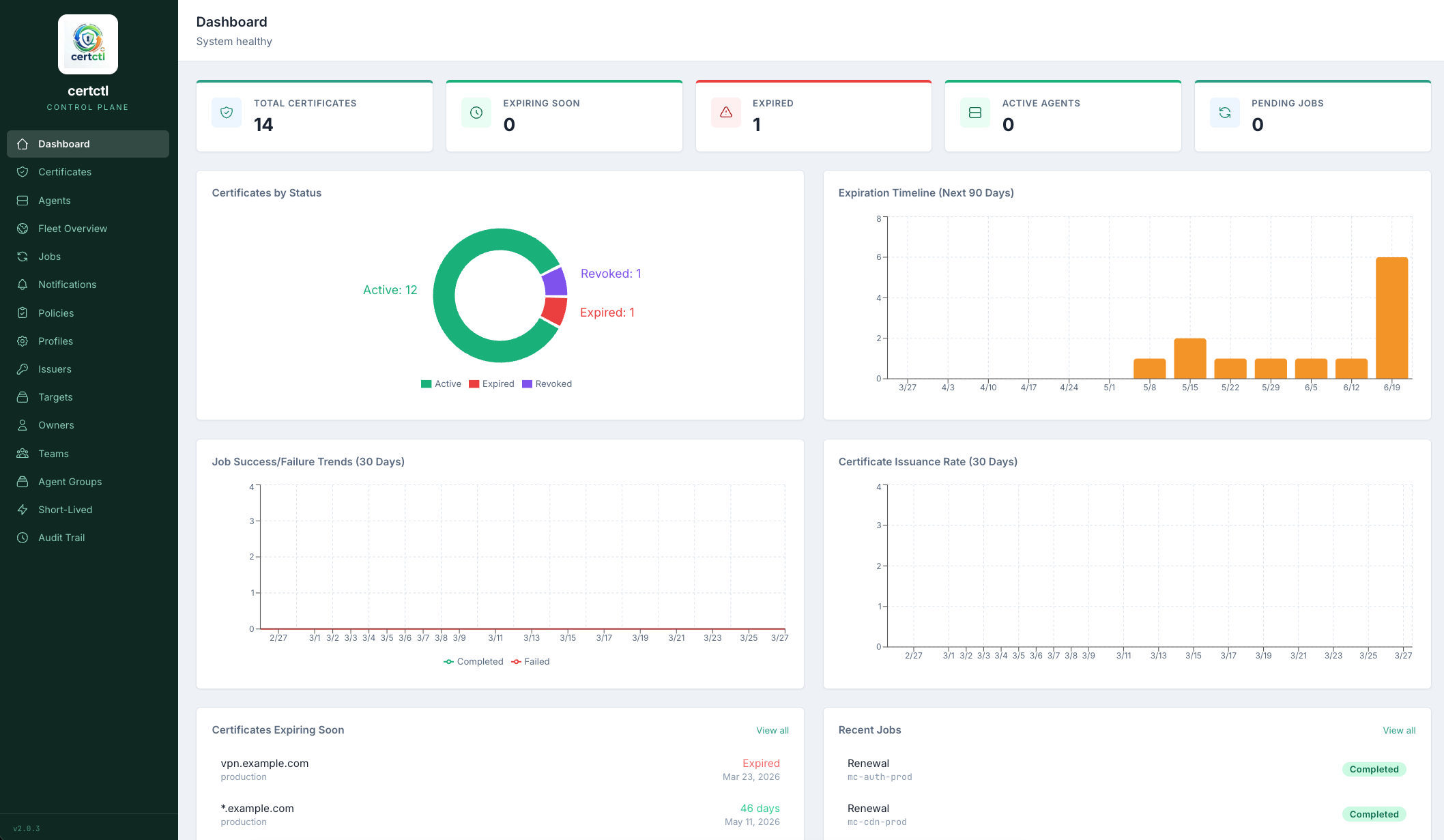 Dashboard Stats, expiration heatmap, renewal trends |
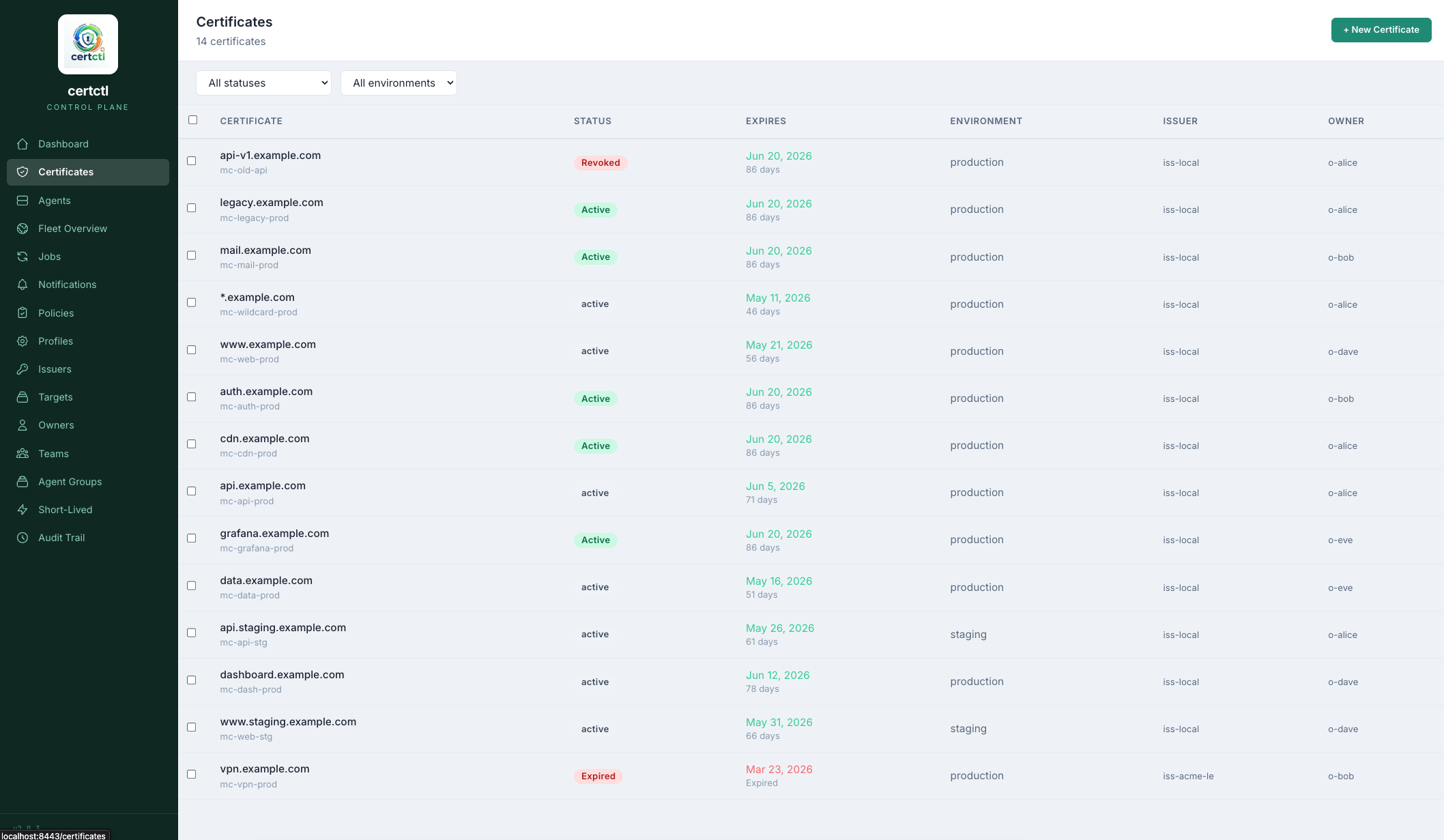 Certificates Inventory with status, owner, team filters |
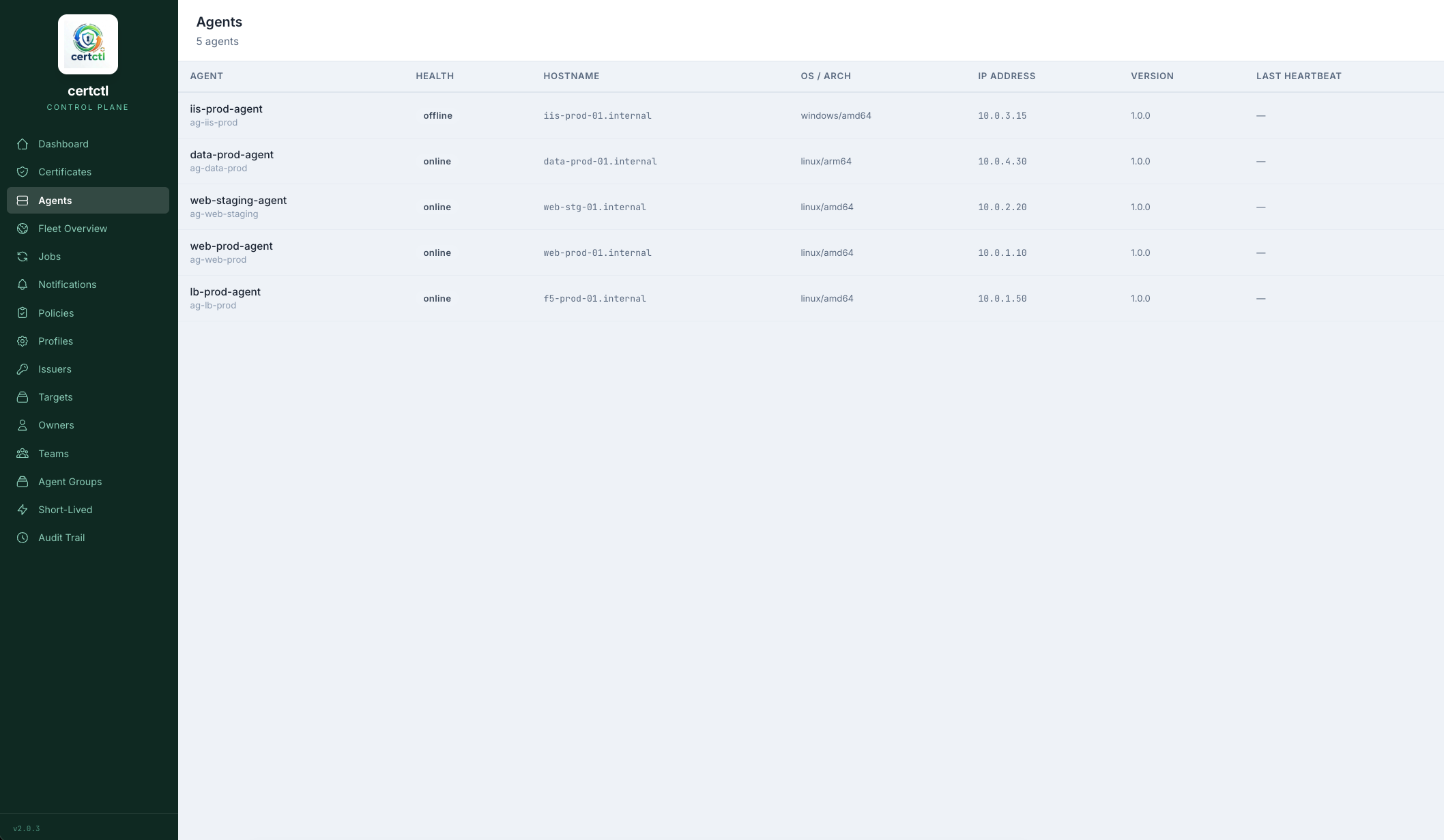 Agents Fleet health, OS/arch, IP, version |
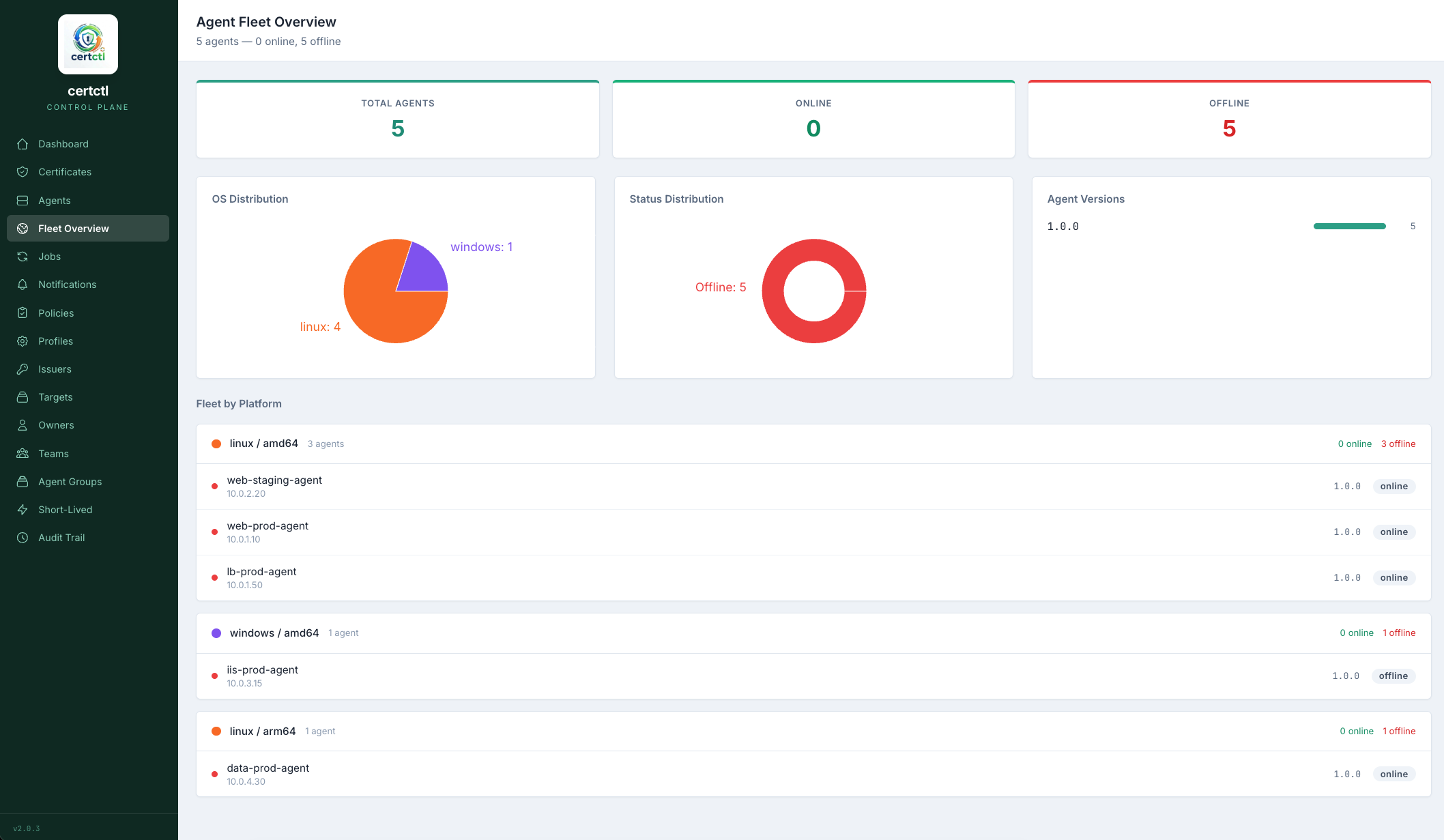 Fleet Overview OS distribution, status breakdown |
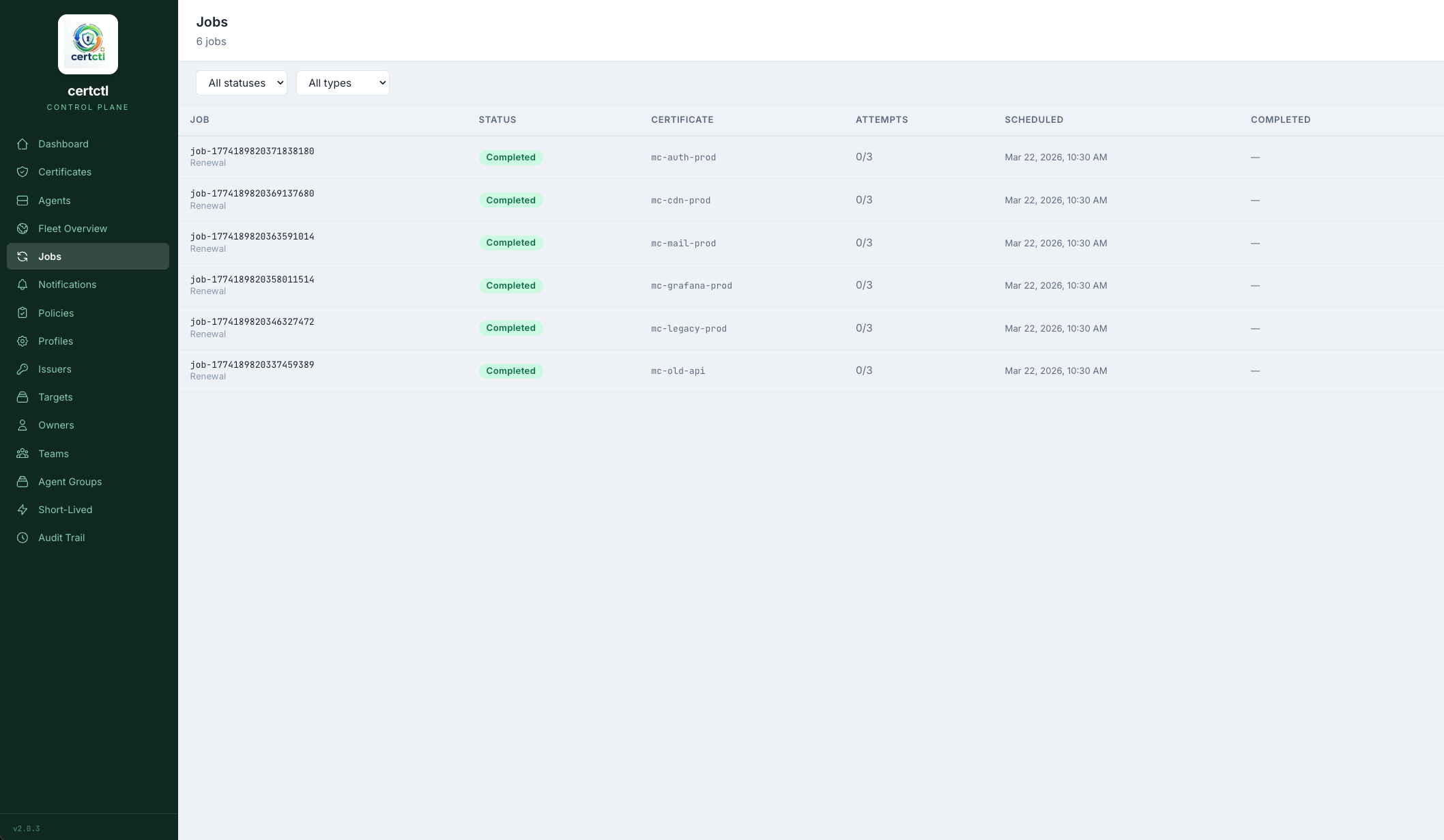 Jobs Issuance, renewal, deployment queue |
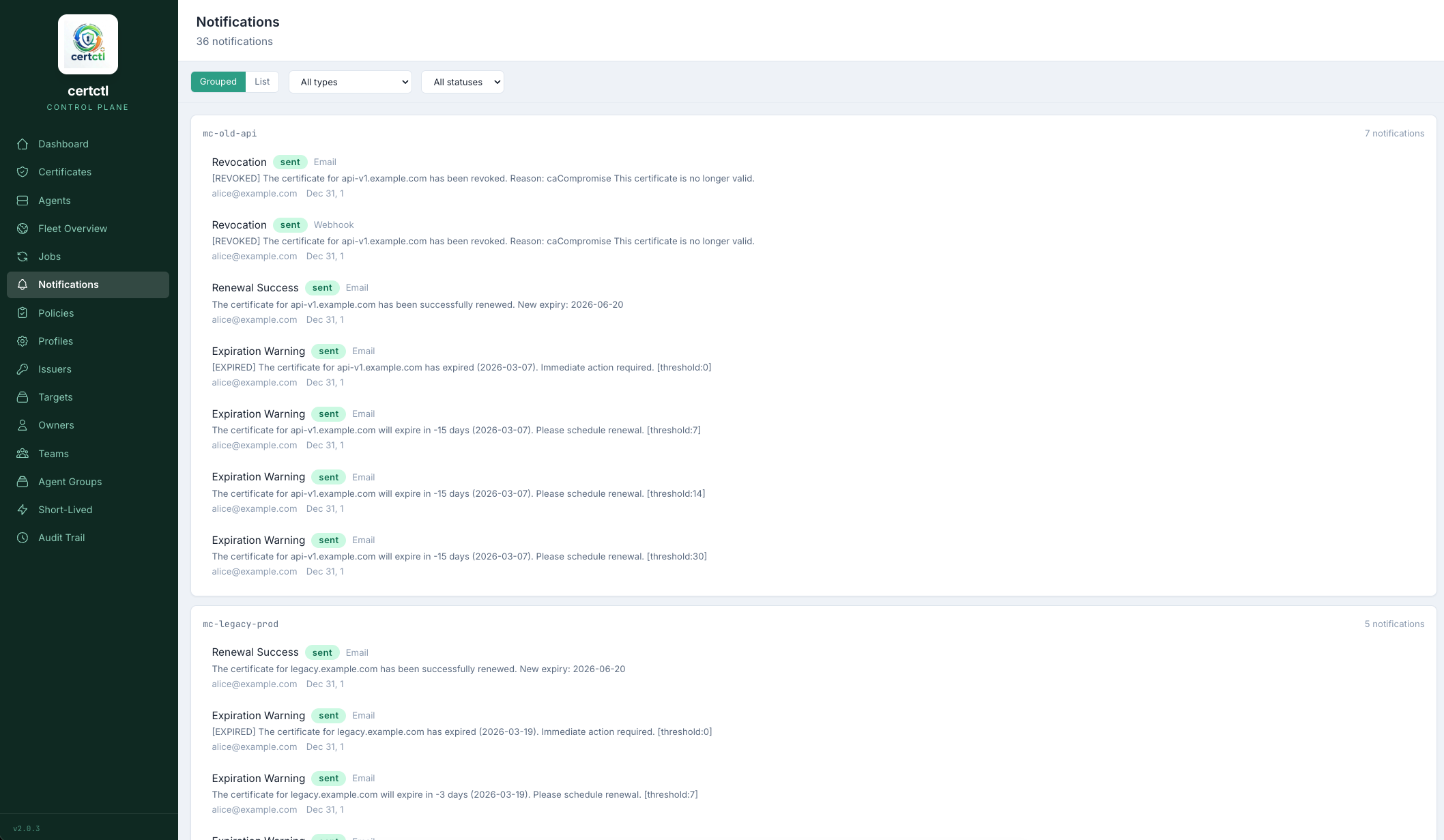 Notifications Expiration warnings, renewal results |
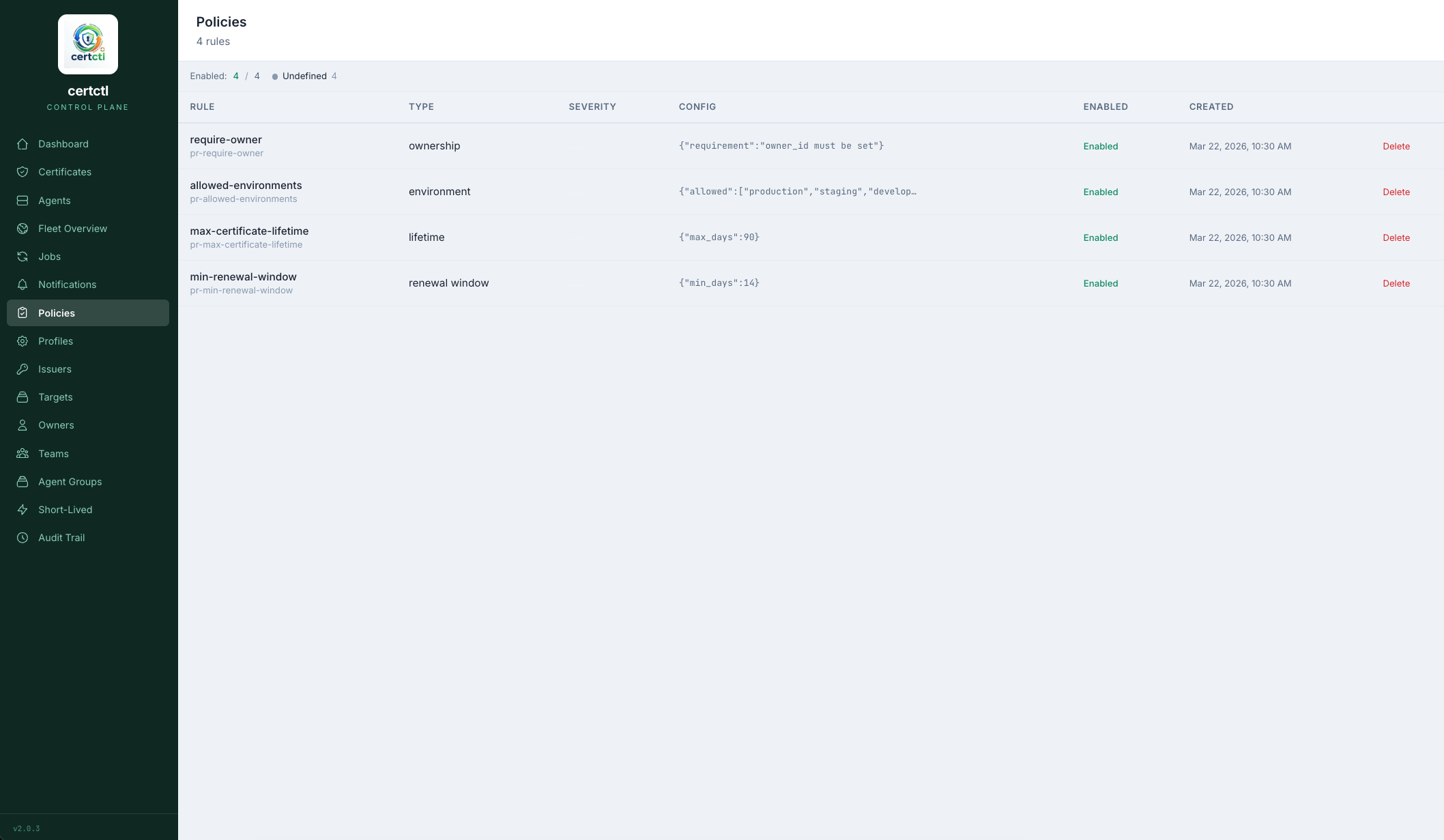 Policies Ownership, lifetime, renewal rules |
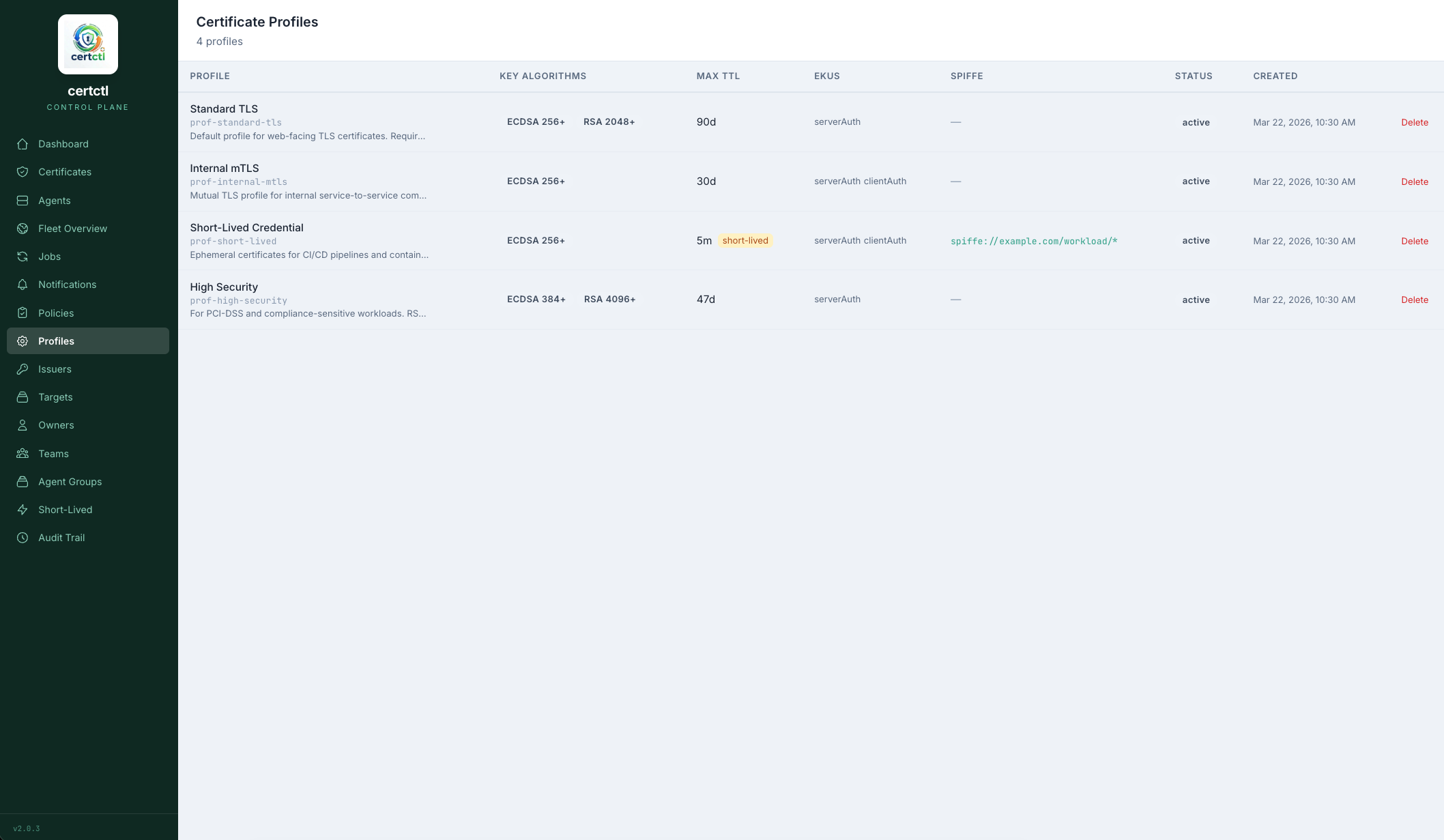 Profiles Key types, max TTL, crypto constraints |
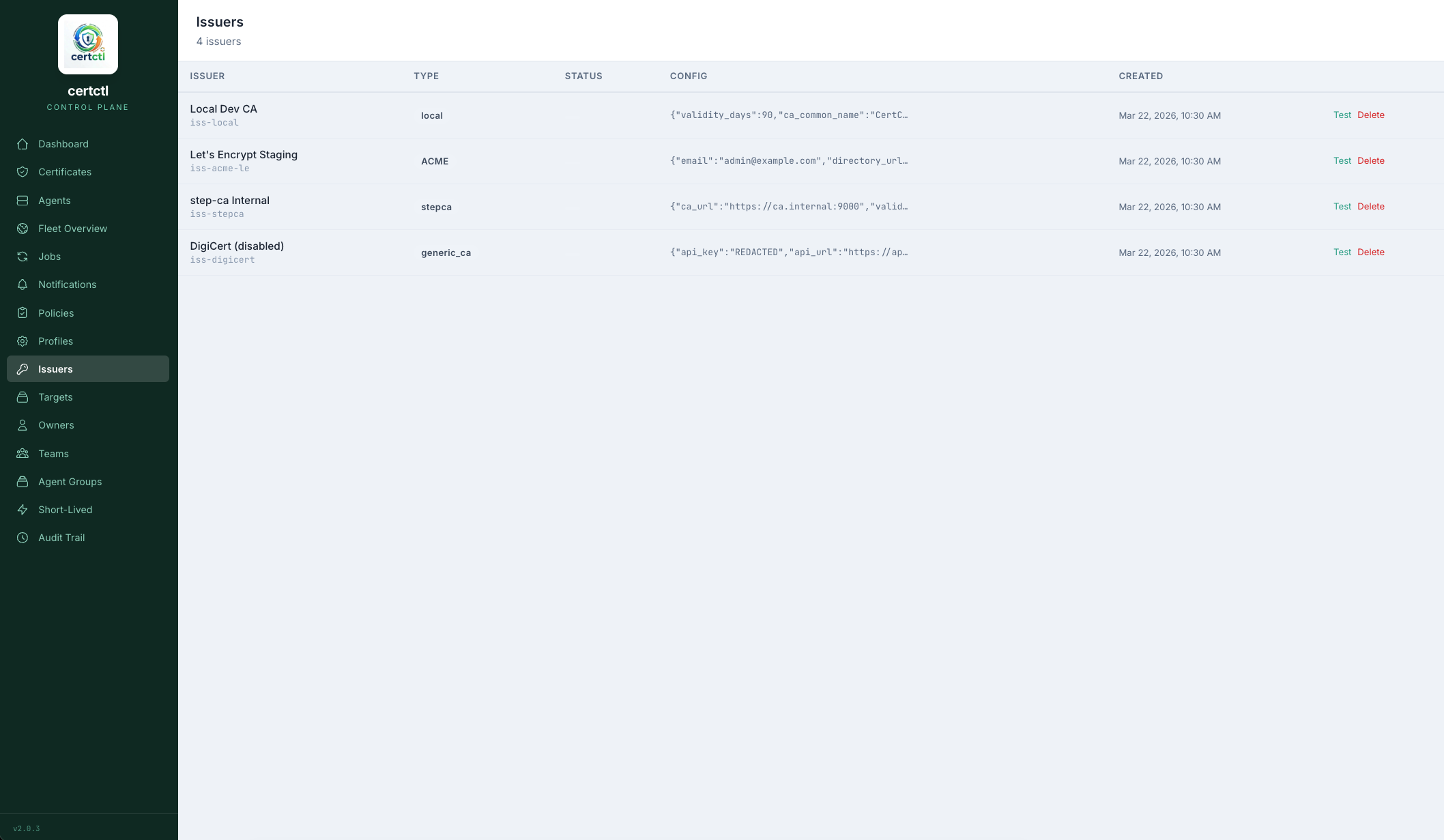 Issuers Local CA, ACME, step-ca, Vault PKI, DigiCert |
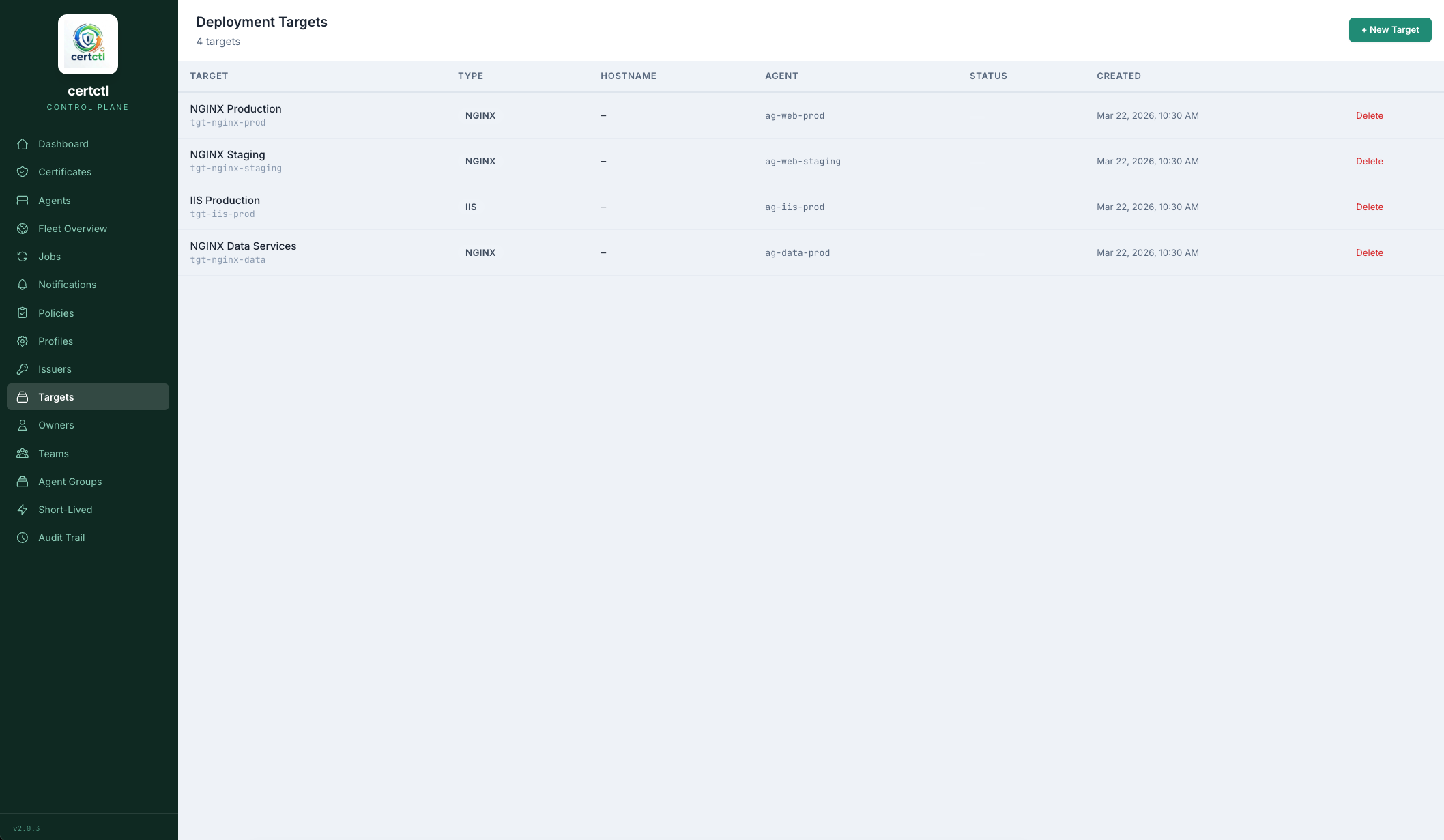 Targets NGINX, Apache, HAProxy, Traefik, Caddy, IIS deployment |
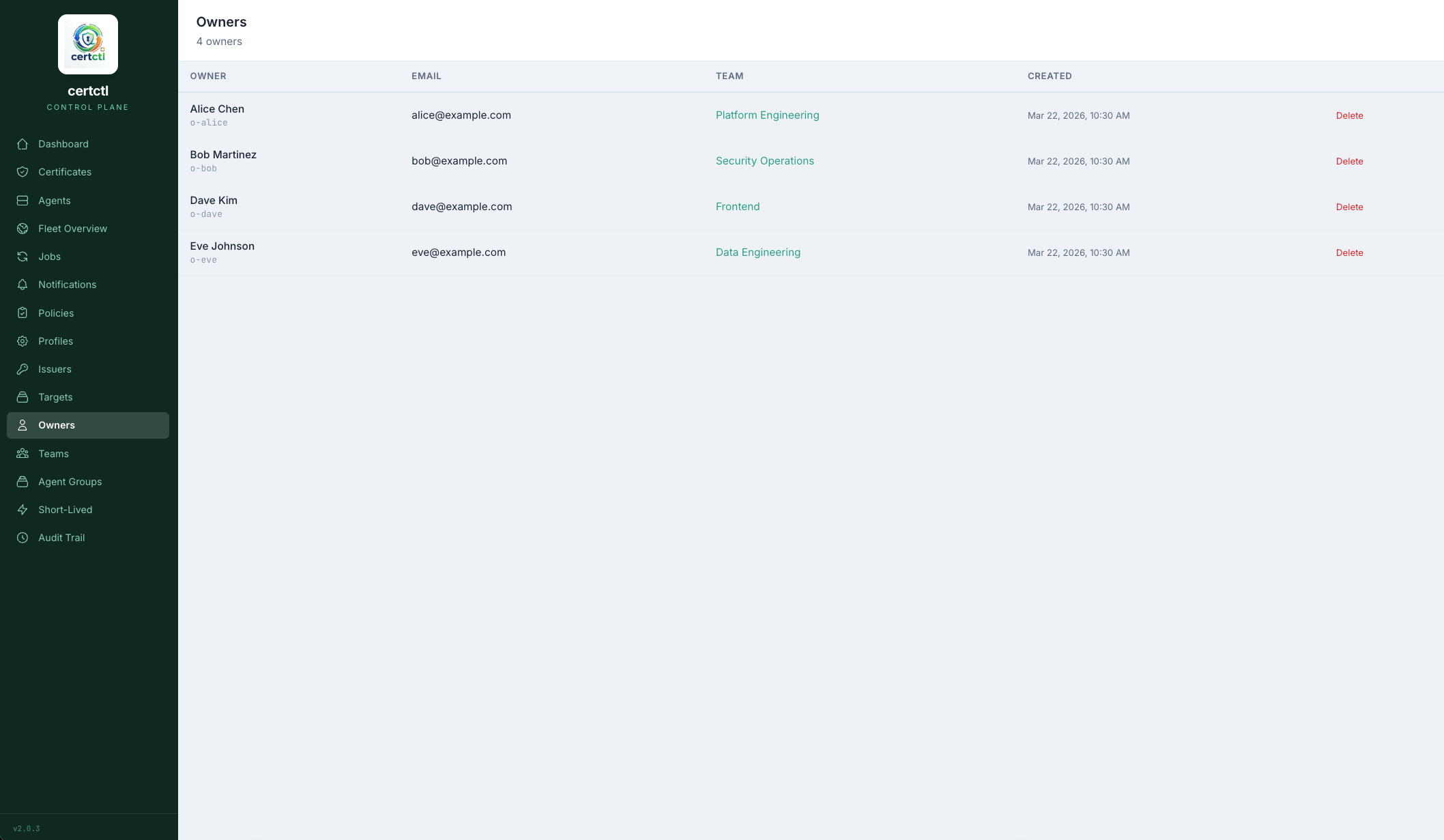 Owners Cert ownership with team assignment |
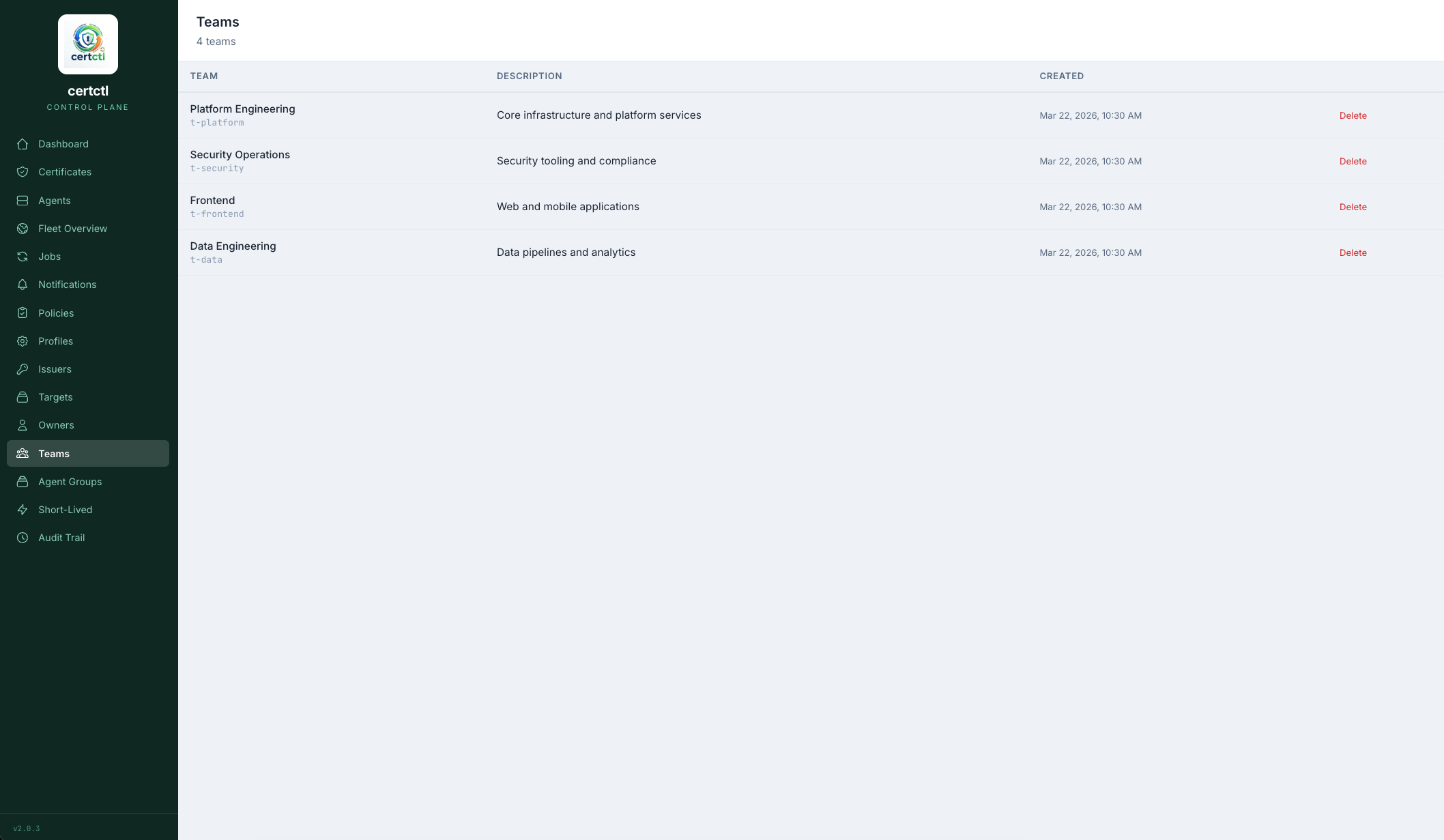 Teams Org grouping for notification routing |
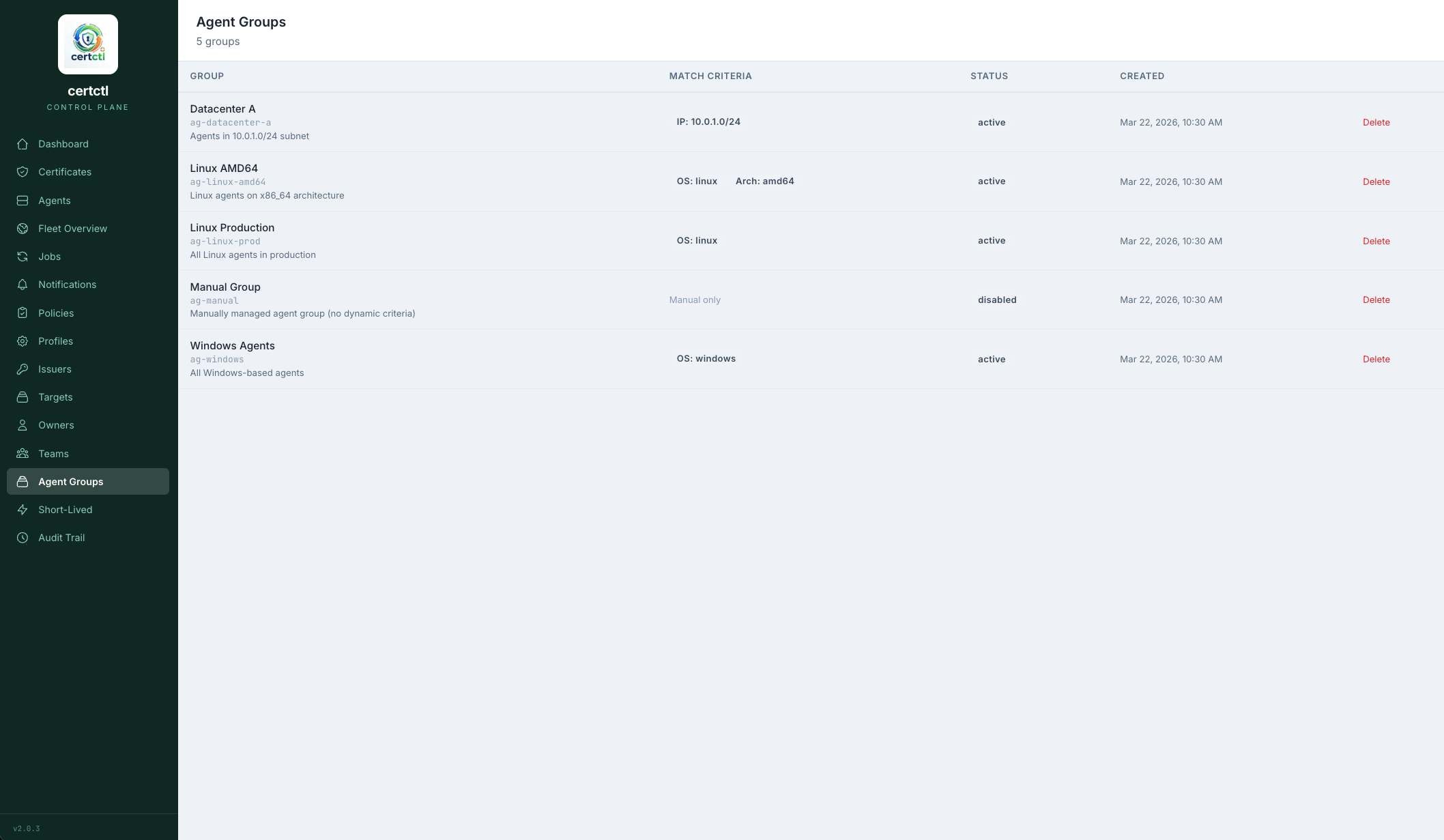 Agent Groups Dynamic grouping by OS, arch, CIDR |
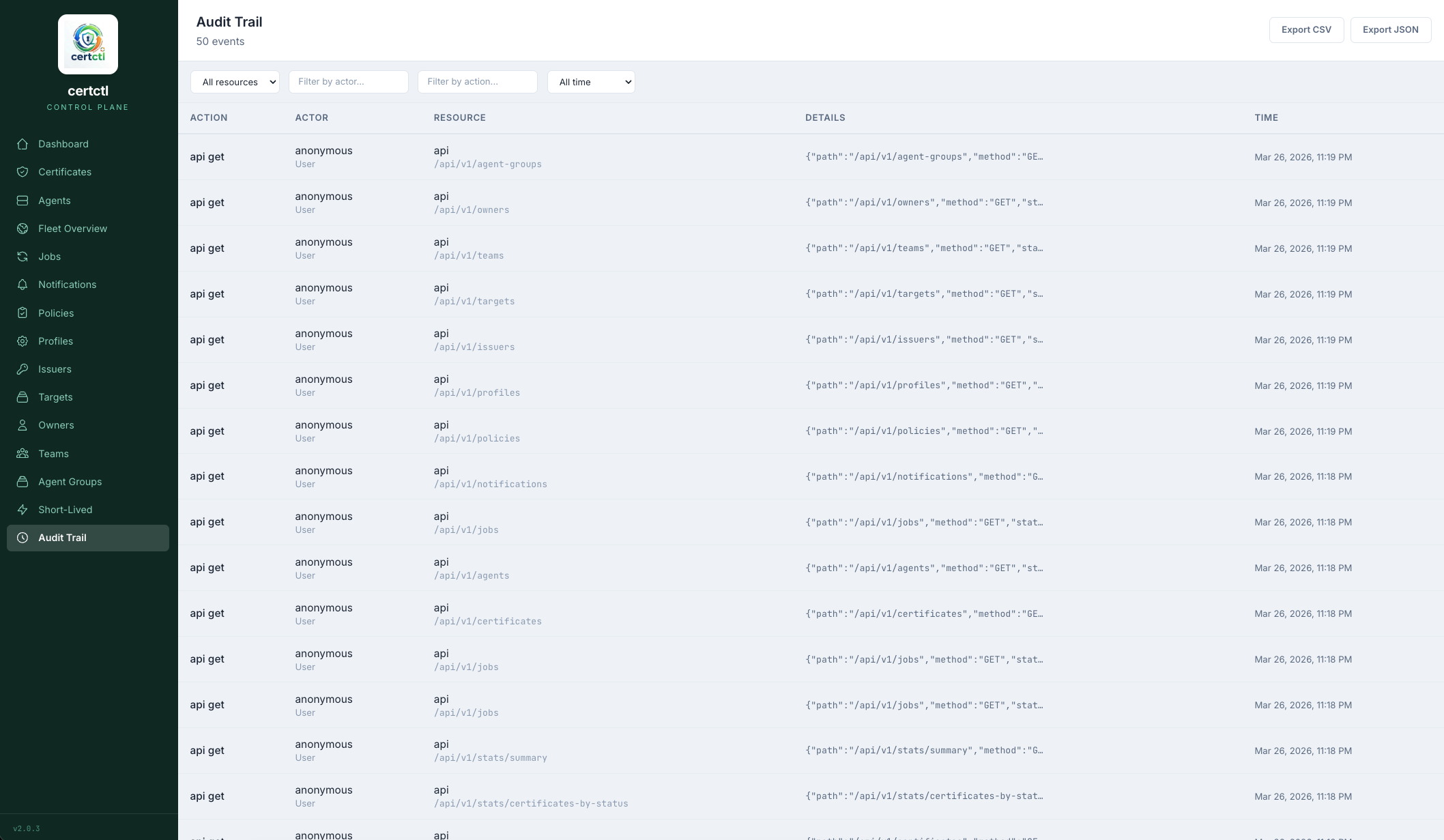 Audit Trail Immutable log, CSV/JSON export |
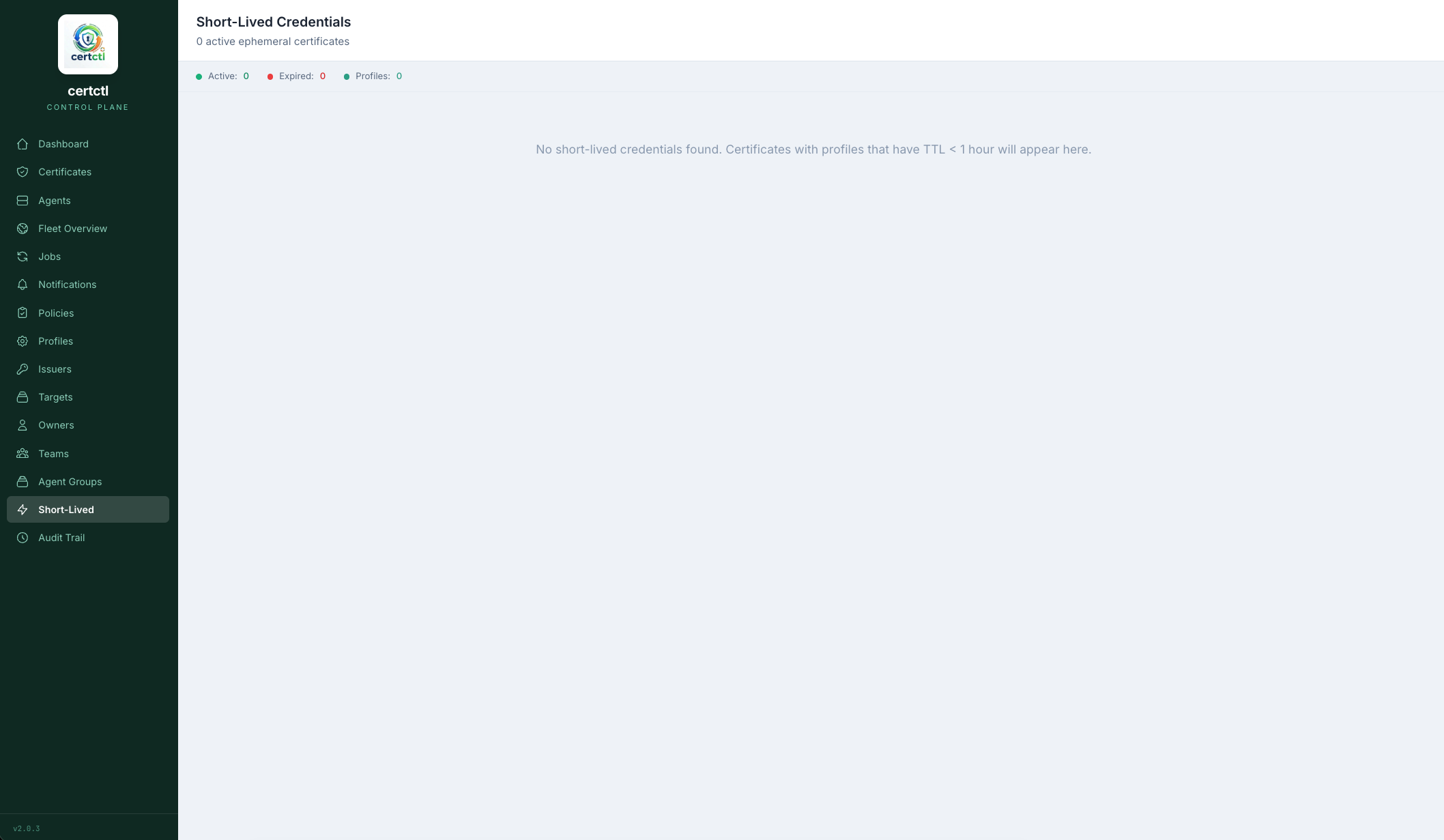 Short-Lived Creds Ephemeral certs with live TTL countdown |