
 # certctl — Self-Hosted Certificate Lifecycle Platform
```mermaid
timeline
title TLS Certificate Maximum Lifespan (CA/Browser Forum Ballot SC-081v3)
2015 : 5 years
2018 : 825 days
2020 : 398 days
March 2026 : 200 days
March 2027 : 100 days
March 2029 : 47 days
```
TLS certificate lifespans are shrinking fast. The CA/Browser Forum passed [Ballot SC-081v3](https://cabforum.org/2025/04/11/ballot-sc081v3-introduce-schedule-of-reducing-validity-and-data-reuse-periods/) unanimously in April 2025, setting a phased reduction: **200 days** by March 2026, **100 days** by March 2027, and **47 days** by March 2029. Organizations managing dozens or hundreds of certificates can no longer rely on spreadsheets, calendar reminders, or manual renewal workflows. The math doesn't work — at 47-day lifespans, a team managing 100 certificates is processing 7+ renewals per week, every week, forever.
certctl is a self-hosted platform that automates the entire certificate lifecycle — from issuance through renewal to deployment — with zero human intervention. It works with any certificate authority, deploys to any server, and keeps private keys on your infrastructure where they belong.
[](LICENSE)
[](https://goreportcard.com/report/github.com/shankar0123/certctl)

## Documentation
| Guide | Description |
|-------|-------------|
| [Why certctl?](docs/why-certctl.md) | Competitive positioning — how certctl compares to open-source and enterprise certificate management platforms |
| [Concepts](docs/concepts.md) | TLS certificates explained from scratch — for beginners who know nothing about certs |
| [Quick Start](docs/quickstart.md) | Get running in 5 minutes — dashboard, API, CLI, discovery, stakeholder demo flow |
| [Advanced Demo](docs/demo-advanced.md) | Issue a certificate end-to-end with technical deep-dives |
| [Architecture](docs/architecture.md) | System design, data flow diagrams, security model |
| [Feature Inventory](docs/features.md) | Complete reference of all V2 capabilities, API endpoints, and configuration |
| [Connectors](docs/connectors.md) | Build custom issuer, target, and notifier connectors |
| [Compliance Mapping](docs/compliance.md) | SOC 2 Type II, PCI-DSS 4.0, NIST SP 800-57 alignment guides |
## Contents
- [Why certctl Exists](#why-certctl-exists)
- [What It Does](#what-it-does)
- [Screenshots](#screenshots)
- [Quick Start](#quick-start)
- [Architecture](#architecture)
- [Configuration](#configuration)
- [MCP Server](#mcp-server-ai-integration)
- [CLI](#cli)
- [API Overview](#api-overview)
- [Integrations](#supported-integrations)
- [Development](#development)
- [Security](#security)
- [Roadmap](#roadmap)
- [License](#license)
## Why certctl Exists
Certificate lifecycle tooling today falls into two camps: expensive enterprise platforms (Venafi, Keyfactor, Sectigo) that cost six figures and take months to deploy, or single-purpose tools (cert-manager, certbot) that handle one slice of the problem. If you run a mixed infrastructure — some NGINX, some Apache, a few HAProxy nodes, maybe an F5 — and you need to manage certificates from multiple CAs, there's nothing self-hosted that covers the full lifecycle without vendor lock-in.
certctl fills that gap. It's **CA-agnostic** — the issuer connector interface means you can plug in any certificate authority: a self-signed local CA for dev, Let's Encrypt via ACME for public certs, Smallstep step-ca for your private PKI, your enterprise ADCS via sub-CA mode, or any custom CA through a shell script adapter. You're never locked to a single CA vendor, and you can run multiple issuers simultaneously for different certificate types.
It's also **target-agnostic**. Agents deploy certificates to NGINX, Apache, and HAProxy today, with Traefik and Caddy support coming next — all using the same pluggable connector model for any server that accepts cert files. The control plane never initiates outbound connections — agents poll for work, which means certctl works behind firewalls, across network zones, and in air-gapped environments.
### How It Compares
| | **certctl** | **CertKit** | **CertWarden** | **Certimate** | **CZERTAINLY** | **KeyTalk** | **cert-manager** |
|---|---|---|---|---|---|---|---|
| **License** | BSL 1.1 → Apache 2.0 | Proprietary (agent OSS) | MIT | MIT | MIT + commercial | Proprietary | Apache 2.0 |
| **Self-hosted** | Yes | No (SaaS) | Yes | Yes | Yes (K8s required) | On-prem or cloud | Yes (K8s only) |
| **CA support** | ACME, step-ca, Local CA, OpenSSL, EST | ACME only | ACME only | ACME (5+ CAs) | Multi-CA (connectors) | Multi-CA | ACME, Venafi, Vault |
| **Agent deployment** | Yes (default) | Yes | No (API pull) | No | Via connectors | Yes | N/A (K8s) |
| **Private key isolation** | Yes (agent-side) | Yes (Keystore, paid) | No | No | Varies | Yes | K8s Secrets |
| **Server targets** | NGINX, Apache, HAProxy | NGINX, Apache, HAProxy, IIS + more | None | 110+ (cloud/CDN-focused) | Via connectors | Undocumented | K8s-native |
| **Policy engine** | Yes (5 rule types) | No | No | No | RA profiles | Undocumented | No |
| **Certificate discovery** | Yes (filesystem + network) | No | No | No | Yes (connectors) | Undocumented | No |
| **Audit trail** | Yes (immutable, every API call) | Planned | No | No | Yes | Yes | No |
| **CRL / OCSP** | Yes | No | No | No | Yes | Undocumented | No |
| **API coverage** | 95 endpoints | REST API | Minimal | REST API | REST API | REST API | K8s CRDs |
| **AI integration (MCP)** | Yes (78 tools) | No | No | No | No | No | No |
| **Free tier** | Unlimited | 3 certificates | Unlimited | Unlimited | Unlimited | None | Unlimited |
certctl occupies a distinct position: full lifecycle automation with agent-based key isolation, multi-CA support, network discovery, and revocation infrastructure — self-hosted on any Linux server, no Kubernetes required. Enterprise platforms (Venafi, Keyfactor, Sectigo) offer broader ecosystems at $75K-$250K+/yr. For a detailed comparison, see [Why certctl?](docs/why-certctl.md)
## What It Does
certctl gives you a single pane of glass for every TLS certificate in your organization:
- **Web dashboard** — full certificate inventory with status, ownership, expiration heatmaps, and bulk operations
- **REST API** — 95 endpoints under `/api/v1/` + `/.well-known/est/` for complete automation
- **Agents** — generate private keys locally, discover existing certs on disk, submit CSRs (private keys never leave your servers)
- **Network scanner** — discovers certificates on TLS endpoints across CIDR ranges without requiring agents
- **EST server** (RFC 7030) — device and WiFi certificate enrollment via industry-standard protocol
- **Approval workflows** — require human sign-off on renewals before deployment
- **Background scheduler** — watches expiration dates and triggers renewals automatically, handling constant rotation at 47-day lifespans without human involvement
**Core capabilities:**
- **Full lifecycle automation** — issuance, renewal, deployment, and revocation with zero human intervention. Configurable renewal policies trigger jobs automatically based on expiration thresholds.
- **CA-agnostic issuer connectors** — Local CA (self-signed + sub-CA for enterprise root chains), ACME v2 with HTTP-01, DNS-01, and DNS-PERSIST-01 challenges (Let's Encrypt, ZeroSSL, Sectigo, Google Trust Services, any ACME-compatible CA), External Account Binding (EAB) for CAs that require it (auto-fetched for ZeroSSL), Smallstep step-ca (native /sign API), and OpenSSL/Custom CA (delegate to any shell script). Pluggable interface — add your own CA in one file.
- **Agent-side key generation** — agents generate ECDSA P-256 keys locally, store them with 0600 permissions, and submit only the CSR. Private keys never touch the control plane. This is the default mode, not an opt-in feature.
- **Certificate discovery** — agents scan filesystems for existing PEM/DER certificates and report findings for triage. The network scanner probes TLS endpoints across CIDR ranges to find certificates you didn't know existed.
- **Revocation infrastructure** — RFC 5280 revocation with all standard reason codes, DER-encoded X.509 CRL per issuer, embedded OCSP responder, and short-lived certificate exemption (certs under 1 hour skip CRL/OCSP).
- **Policy engine** — 5 rule types with violation tracking and severity levels. Certificate profiles enforce allowed key types, maximum TTL, and crypto constraints at enrollment time.
- **Immutable audit trail** — every action recorded to an append-only log. Every API call recorded with method, path, actor, SHA-256 body hash, response status, and latency. No update or delete on audit records.
- **Operational dashboard** — Full React GUI with certificate inventory, bulk operations (multi-select renew/revoke/reassign), deployment timeline visualization, inline policy editing, agent fleet overview, expiration heatmaps, real-time short-lived credential tracking, discovery triage workflow, network scan management, and interactive approval/rejection flow.
- **Observability** — JSON and Prometheus metrics endpoints, 5 stats API endpoints for dashboards, structured slog logging with request ID propagation. Compatible with Prometheus, Grafana Agent, Datadog Agent, and Victoria Metrics.
- **Notifications** — threshold-based alerting with deduplication. Routes to email, webhooks, Slack, Microsoft Teams, PagerDuty, and OpsGenie.
- **EST enrollment (RFC 7030)** — built-in Enrollment over Secure Transport server for device certificate enrollment. Supports WiFi/802.1X, MDM, and IoT use cases. PKCS#7 certs-only wire format, accepts PEM or base64-encoded DER CSRs, configurable issuer and profile binding.
- **Multi-purpose certificates** — certificate profiles support arbitrary EKU (Extended Key Usage) constraints. TLS (serverAuth/clientAuth) today, with S/MIME (emailProtection) and code signing support coming in v2.0.2.
- **AI and CLI access** — MCP server exposes all 78 API operations as tools for Claude, Cursor, and any MCP-compatible client. CLI tool with 12 subcommands for terminal workflows and scripting.
### Screenshots
# certctl — Self-Hosted Certificate Lifecycle Platform
```mermaid
timeline
title TLS Certificate Maximum Lifespan (CA/Browser Forum Ballot SC-081v3)
2015 : 5 years
2018 : 825 days
2020 : 398 days
March 2026 : 200 days
March 2027 : 100 days
March 2029 : 47 days
```
TLS certificate lifespans are shrinking fast. The CA/Browser Forum passed [Ballot SC-081v3](https://cabforum.org/2025/04/11/ballot-sc081v3-introduce-schedule-of-reducing-validity-and-data-reuse-periods/) unanimously in April 2025, setting a phased reduction: **200 days** by March 2026, **100 days** by March 2027, and **47 days** by March 2029. Organizations managing dozens or hundreds of certificates can no longer rely on spreadsheets, calendar reminders, or manual renewal workflows. The math doesn't work — at 47-day lifespans, a team managing 100 certificates is processing 7+ renewals per week, every week, forever.
certctl is a self-hosted platform that automates the entire certificate lifecycle — from issuance through renewal to deployment — with zero human intervention. It works with any certificate authority, deploys to any server, and keeps private keys on your infrastructure where they belong.
[](LICENSE)
[](https://goreportcard.com/report/github.com/shankar0123/certctl)

## Documentation
| Guide | Description |
|-------|-------------|
| [Why certctl?](docs/why-certctl.md) | Competitive positioning — how certctl compares to open-source and enterprise certificate management platforms |
| [Concepts](docs/concepts.md) | TLS certificates explained from scratch — for beginners who know nothing about certs |
| [Quick Start](docs/quickstart.md) | Get running in 5 minutes — dashboard, API, CLI, discovery, stakeholder demo flow |
| [Advanced Demo](docs/demo-advanced.md) | Issue a certificate end-to-end with technical deep-dives |
| [Architecture](docs/architecture.md) | System design, data flow diagrams, security model |
| [Feature Inventory](docs/features.md) | Complete reference of all V2 capabilities, API endpoints, and configuration |
| [Connectors](docs/connectors.md) | Build custom issuer, target, and notifier connectors |
| [Compliance Mapping](docs/compliance.md) | SOC 2 Type II, PCI-DSS 4.0, NIST SP 800-57 alignment guides |
## Contents
- [Why certctl Exists](#why-certctl-exists)
- [What It Does](#what-it-does)
- [Screenshots](#screenshots)
- [Quick Start](#quick-start)
- [Architecture](#architecture)
- [Configuration](#configuration)
- [MCP Server](#mcp-server-ai-integration)
- [CLI](#cli)
- [API Overview](#api-overview)
- [Integrations](#supported-integrations)
- [Development](#development)
- [Security](#security)
- [Roadmap](#roadmap)
- [License](#license)
## Why certctl Exists
Certificate lifecycle tooling today falls into two camps: expensive enterprise platforms (Venafi, Keyfactor, Sectigo) that cost six figures and take months to deploy, or single-purpose tools (cert-manager, certbot) that handle one slice of the problem. If you run a mixed infrastructure — some NGINX, some Apache, a few HAProxy nodes, maybe an F5 — and you need to manage certificates from multiple CAs, there's nothing self-hosted that covers the full lifecycle without vendor lock-in.
certctl fills that gap. It's **CA-agnostic** — the issuer connector interface means you can plug in any certificate authority: a self-signed local CA for dev, Let's Encrypt via ACME for public certs, Smallstep step-ca for your private PKI, your enterprise ADCS via sub-CA mode, or any custom CA through a shell script adapter. You're never locked to a single CA vendor, and you can run multiple issuers simultaneously for different certificate types.
It's also **target-agnostic**. Agents deploy certificates to NGINX, Apache, and HAProxy today, with Traefik and Caddy support coming next — all using the same pluggable connector model for any server that accepts cert files. The control plane never initiates outbound connections — agents poll for work, which means certctl works behind firewalls, across network zones, and in air-gapped environments.
### How It Compares
| | **certctl** | **CertKit** | **CertWarden** | **Certimate** | **CZERTAINLY** | **KeyTalk** | **cert-manager** |
|---|---|---|---|---|---|---|---|
| **License** | BSL 1.1 → Apache 2.0 | Proprietary (agent OSS) | MIT | MIT | MIT + commercial | Proprietary | Apache 2.0 |
| **Self-hosted** | Yes | No (SaaS) | Yes | Yes | Yes (K8s required) | On-prem or cloud | Yes (K8s only) |
| **CA support** | ACME, step-ca, Local CA, OpenSSL, EST | ACME only | ACME only | ACME (5+ CAs) | Multi-CA (connectors) | Multi-CA | ACME, Venafi, Vault |
| **Agent deployment** | Yes (default) | Yes | No (API pull) | No | Via connectors | Yes | N/A (K8s) |
| **Private key isolation** | Yes (agent-side) | Yes (Keystore, paid) | No | No | Varies | Yes | K8s Secrets |
| **Server targets** | NGINX, Apache, HAProxy | NGINX, Apache, HAProxy, IIS + more | None | 110+ (cloud/CDN-focused) | Via connectors | Undocumented | K8s-native |
| **Policy engine** | Yes (5 rule types) | No | No | No | RA profiles | Undocumented | No |
| **Certificate discovery** | Yes (filesystem + network) | No | No | No | Yes (connectors) | Undocumented | No |
| **Audit trail** | Yes (immutable, every API call) | Planned | No | No | Yes | Yes | No |
| **CRL / OCSP** | Yes | No | No | No | Yes | Undocumented | No |
| **API coverage** | 95 endpoints | REST API | Minimal | REST API | REST API | REST API | K8s CRDs |
| **AI integration (MCP)** | Yes (78 tools) | No | No | No | No | No | No |
| **Free tier** | Unlimited | 3 certificates | Unlimited | Unlimited | Unlimited | None | Unlimited |
certctl occupies a distinct position: full lifecycle automation with agent-based key isolation, multi-CA support, network discovery, and revocation infrastructure — self-hosted on any Linux server, no Kubernetes required. Enterprise platforms (Venafi, Keyfactor, Sectigo) offer broader ecosystems at $75K-$250K+/yr. For a detailed comparison, see [Why certctl?](docs/why-certctl.md)
## What It Does
certctl gives you a single pane of glass for every TLS certificate in your organization:
- **Web dashboard** — full certificate inventory with status, ownership, expiration heatmaps, and bulk operations
- **REST API** — 95 endpoints under `/api/v1/` + `/.well-known/est/` for complete automation
- **Agents** — generate private keys locally, discover existing certs on disk, submit CSRs (private keys never leave your servers)
- **Network scanner** — discovers certificates on TLS endpoints across CIDR ranges without requiring agents
- **EST server** (RFC 7030) — device and WiFi certificate enrollment via industry-standard protocol
- **Approval workflows** — require human sign-off on renewals before deployment
- **Background scheduler** — watches expiration dates and triggers renewals automatically, handling constant rotation at 47-day lifespans without human involvement
**Core capabilities:**
- **Full lifecycle automation** — issuance, renewal, deployment, and revocation with zero human intervention. Configurable renewal policies trigger jobs automatically based on expiration thresholds.
- **CA-agnostic issuer connectors** — Local CA (self-signed + sub-CA for enterprise root chains), ACME v2 with HTTP-01, DNS-01, and DNS-PERSIST-01 challenges (Let's Encrypt, ZeroSSL, Sectigo, Google Trust Services, any ACME-compatible CA), External Account Binding (EAB) for CAs that require it (auto-fetched for ZeroSSL), Smallstep step-ca (native /sign API), and OpenSSL/Custom CA (delegate to any shell script). Pluggable interface — add your own CA in one file.
- **Agent-side key generation** — agents generate ECDSA P-256 keys locally, store them with 0600 permissions, and submit only the CSR. Private keys never touch the control plane. This is the default mode, not an opt-in feature.
- **Certificate discovery** — agents scan filesystems for existing PEM/DER certificates and report findings for triage. The network scanner probes TLS endpoints across CIDR ranges to find certificates you didn't know existed.
- **Revocation infrastructure** — RFC 5280 revocation with all standard reason codes, DER-encoded X.509 CRL per issuer, embedded OCSP responder, and short-lived certificate exemption (certs under 1 hour skip CRL/OCSP).
- **Policy engine** — 5 rule types with violation tracking and severity levels. Certificate profiles enforce allowed key types, maximum TTL, and crypto constraints at enrollment time.
- **Immutable audit trail** — every action recorded to an append-only log. Every API call recorded with method, path, actor, SHA-256 body hash, response status, and latency. No update or delete on audit records.
- **Operational dashboard** — Full React GUI with certificate inventory, bulk operations (multi-select renew/revoke/reassign), deployment timeline visualization, inline policy editing, agent fleet overview, expiration heatmaps, real-time short-lived credential tracking, discovery triage workflow, network scan management, and interactive approval/rejection flow.
- **Observability** — JSON and Prometheus metrics endpoints, 5 stats API endpoints for dashboards, structured slog logging with request ID propagation. Compatible with Prometheus, Grafana Agent, Datadog Agent, and Victoria Metrics.
- **Notifications** — threshold-based alerting with deduplication. Routes to email, webhooks, Slack, Microsoft Teams, PagerDuty, and OpsGenie.
- **EST enrollment (RFC 7030)** — built-in Enrollment over Secure Transport server for device certificate enrollment. Supports WiFi/802.1X, MDM, and IoT use cases. PKCS#7 certs-only wire format, accepts PEM or base64-encoded DER CSRs, configurable issuer and profile binding.
- **Multi-purpose certificates** — certificate profiles support arbitrary EKU (Extended Key Usage) constraints. TLS (serverAuth/clientAuth) today, with S/MIME (emailProtection) and code signing support coming in v2.0.2.
- **AI and CLI access** — MCP server exposes all 78 API operations as tools for Claude, Cursor, and any MCP-compatible client. CLI tool with 12 subcommands for terminal workflows and scripting.
### Screenshots
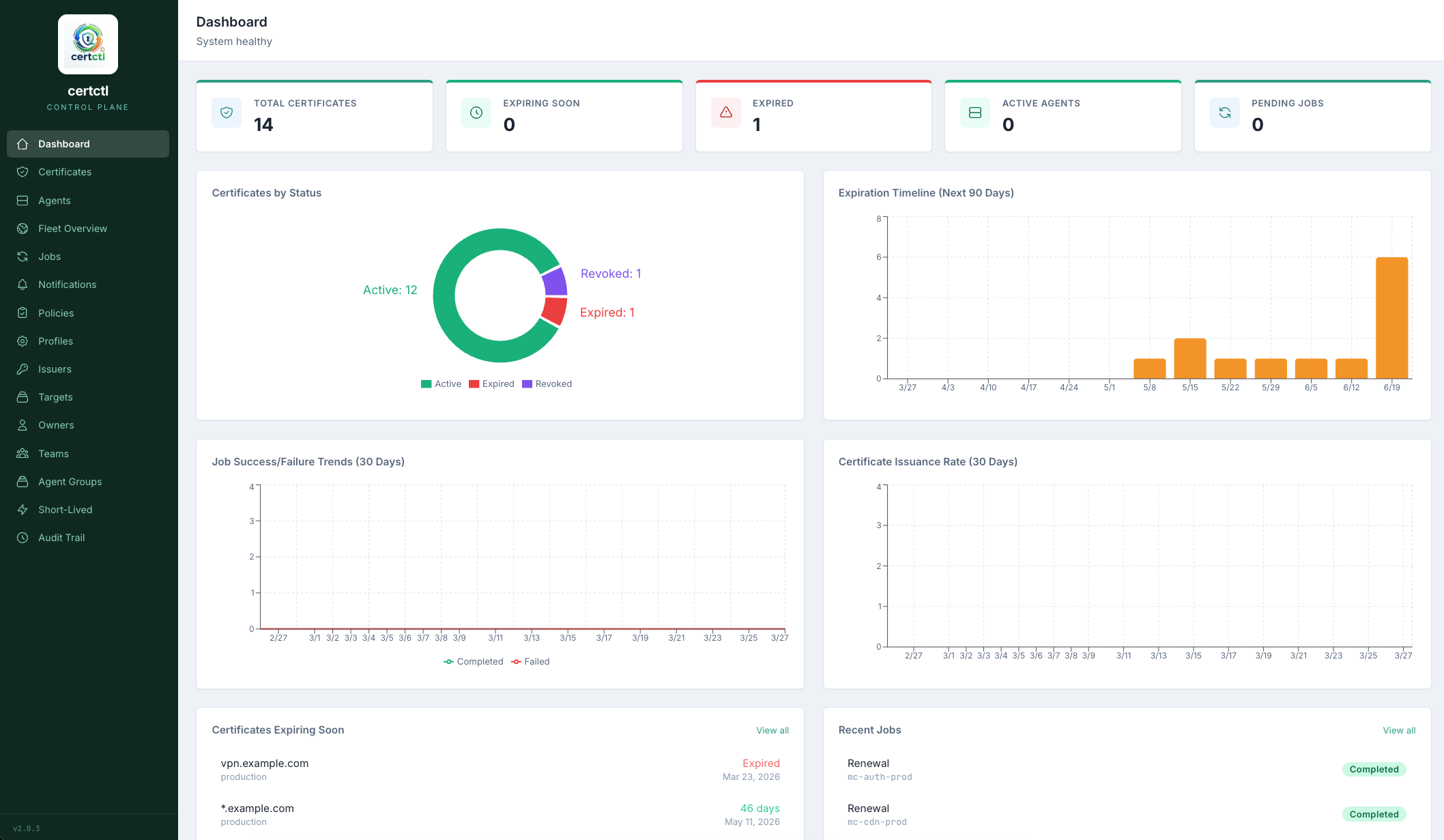 Dashboard Stats, expiration heatmap, renewal trends |
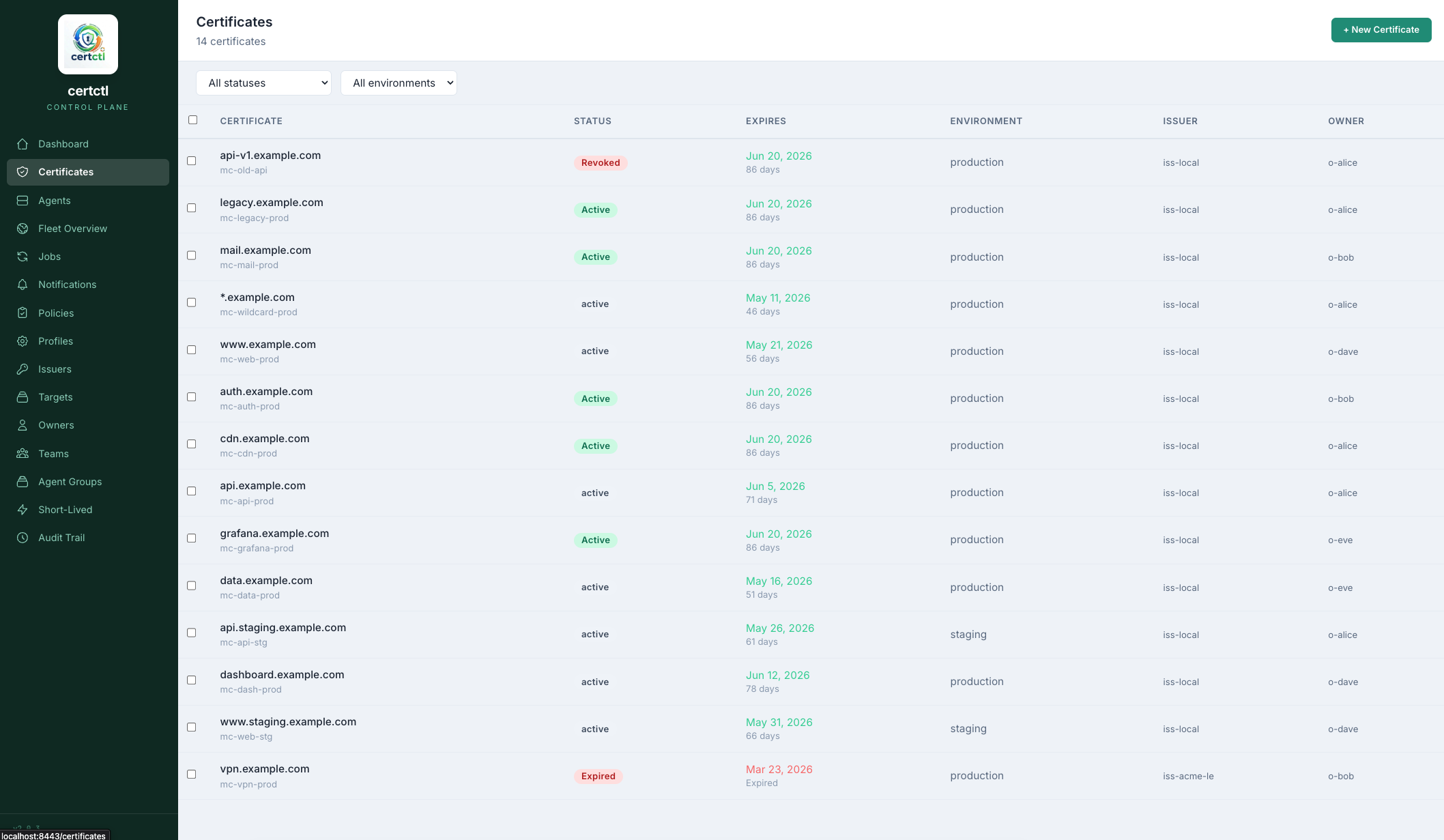 Certificates Inventory with status, owner, team filters |
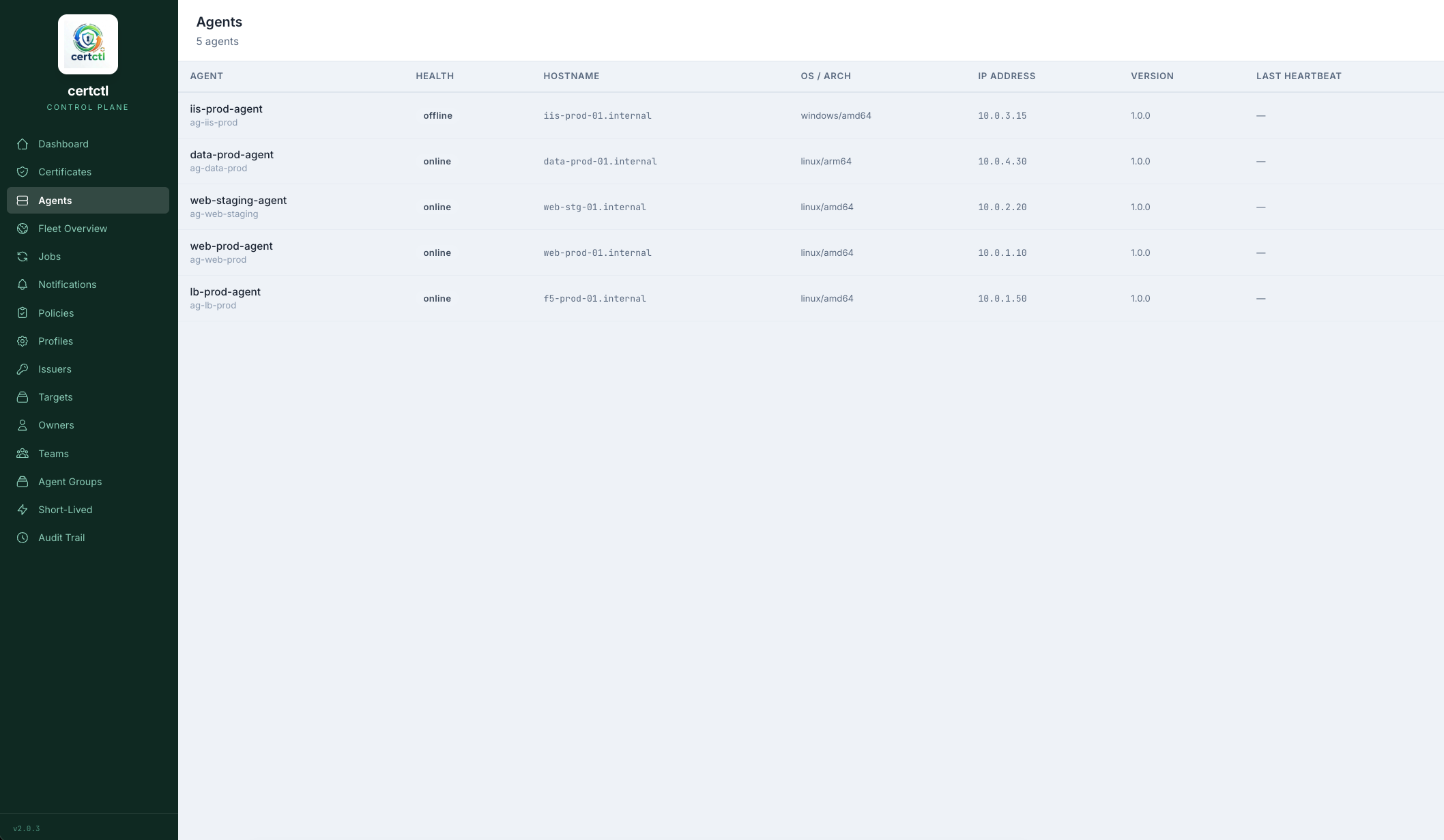 Agents Fleet health, OS/arch, IP, version |
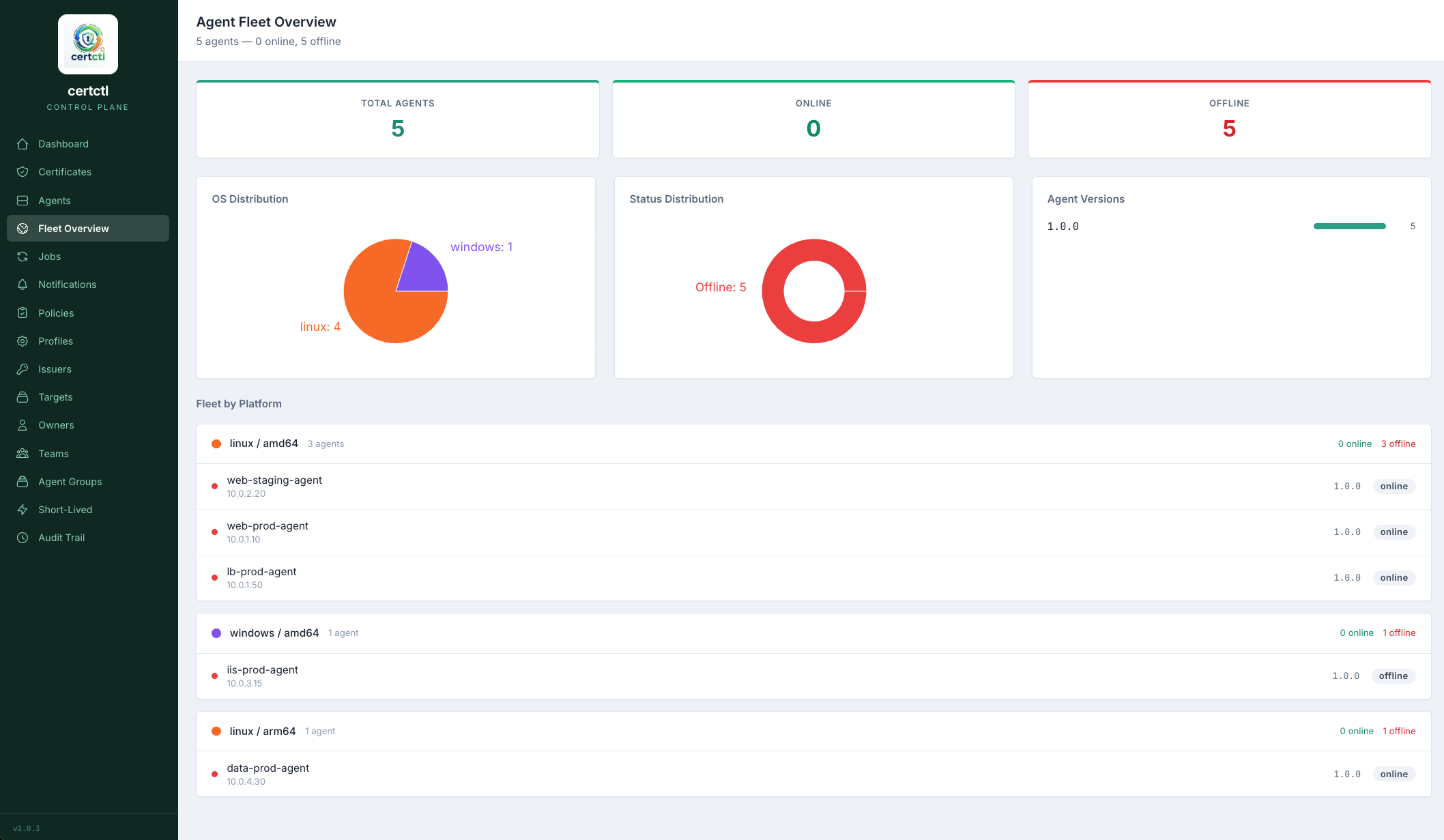 Fleet Overview OS distribution, status breakdown |
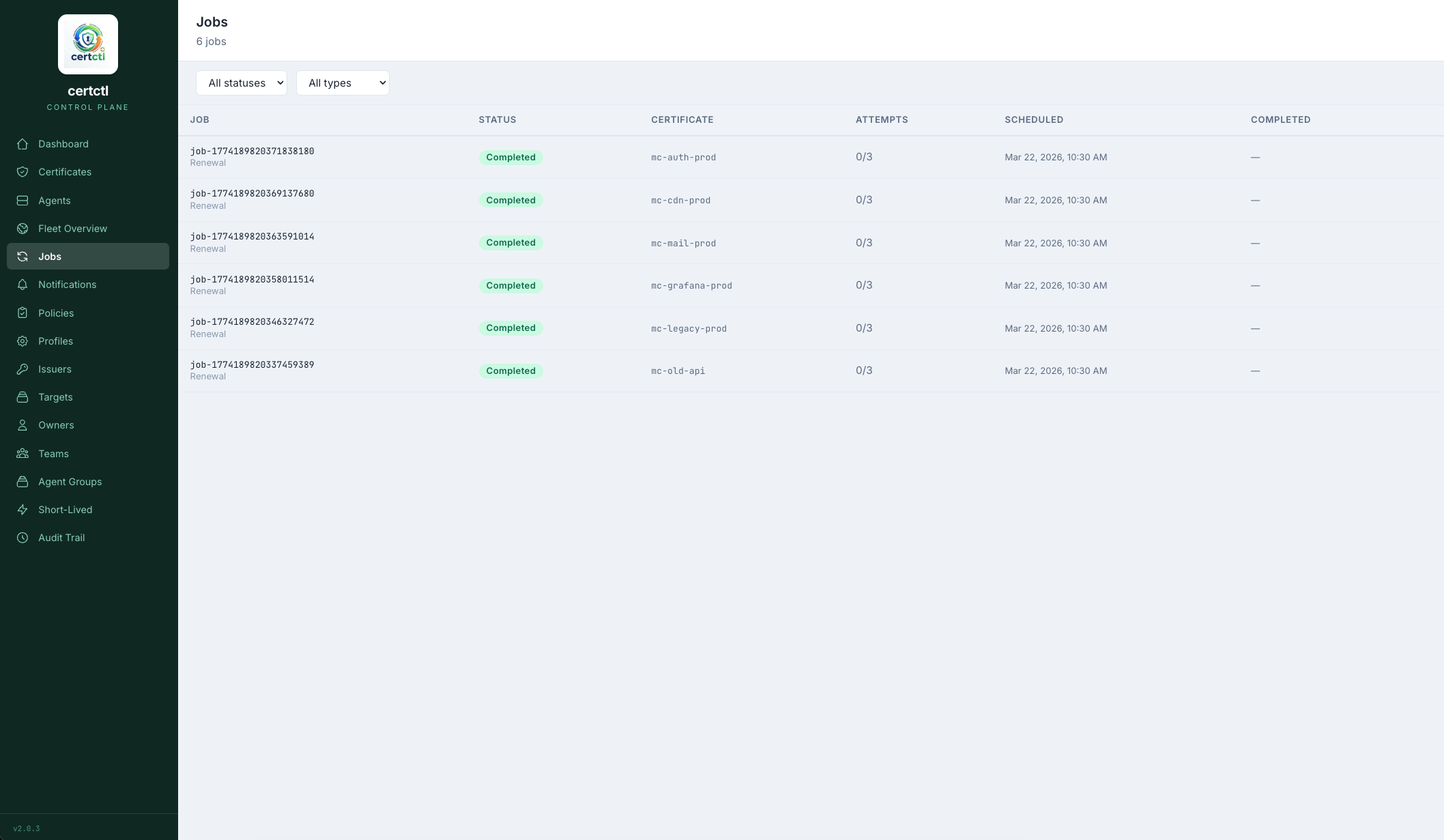 Jobs Issuance, renewal, deployment queue |
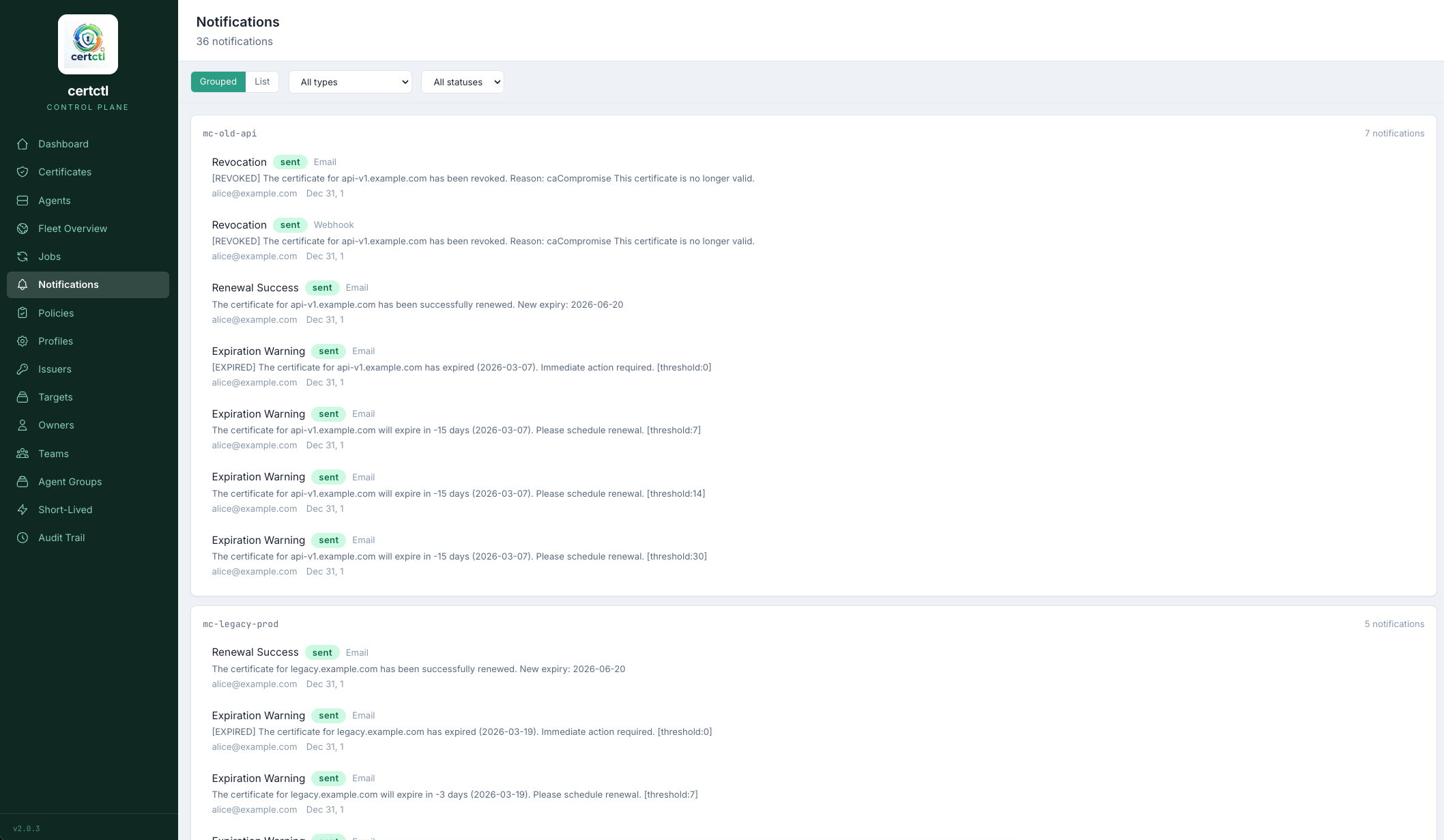 Notifications Expiration warnings, renewal results |
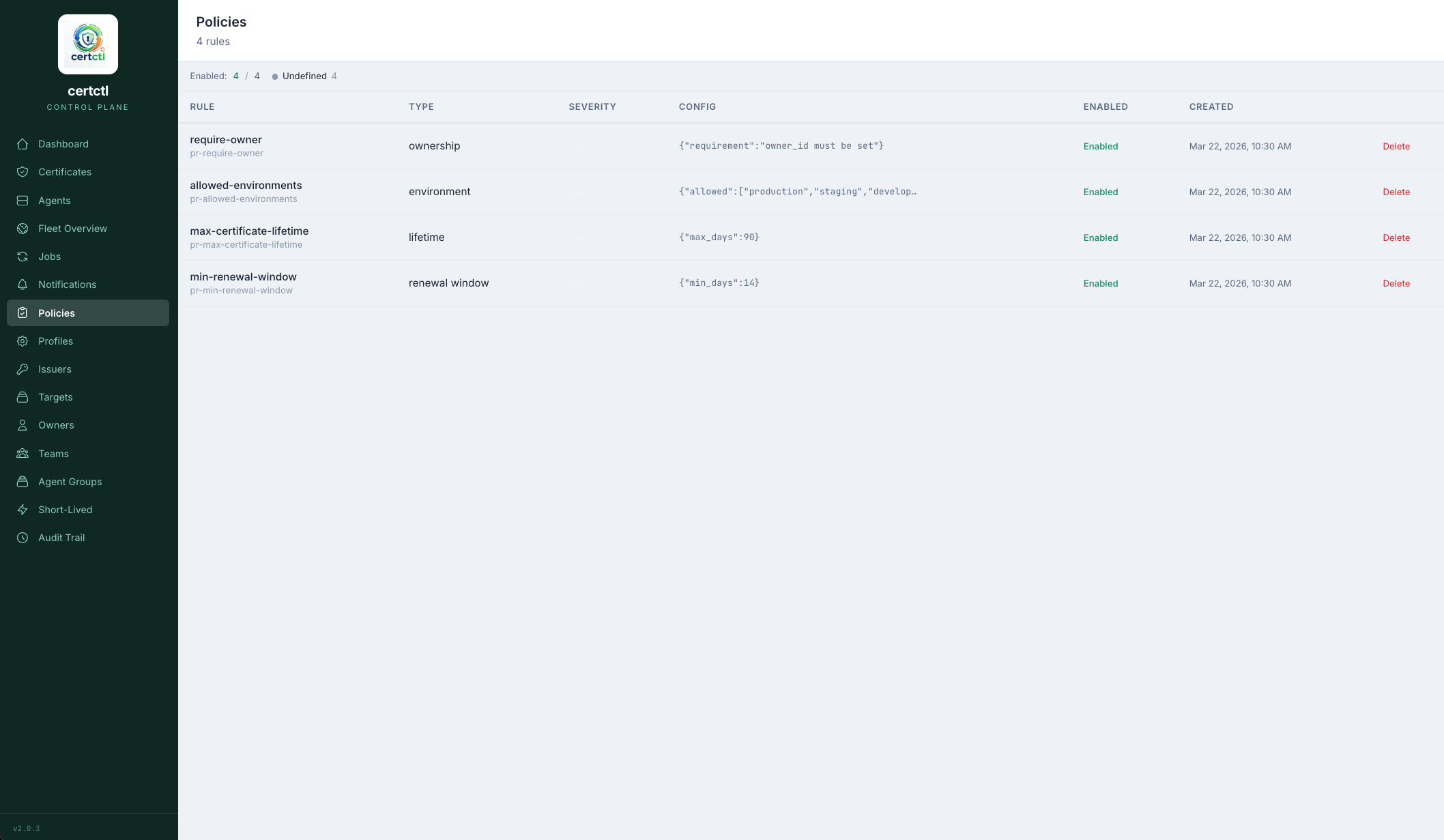 Policies Ownership, lifetime, renewal rules |
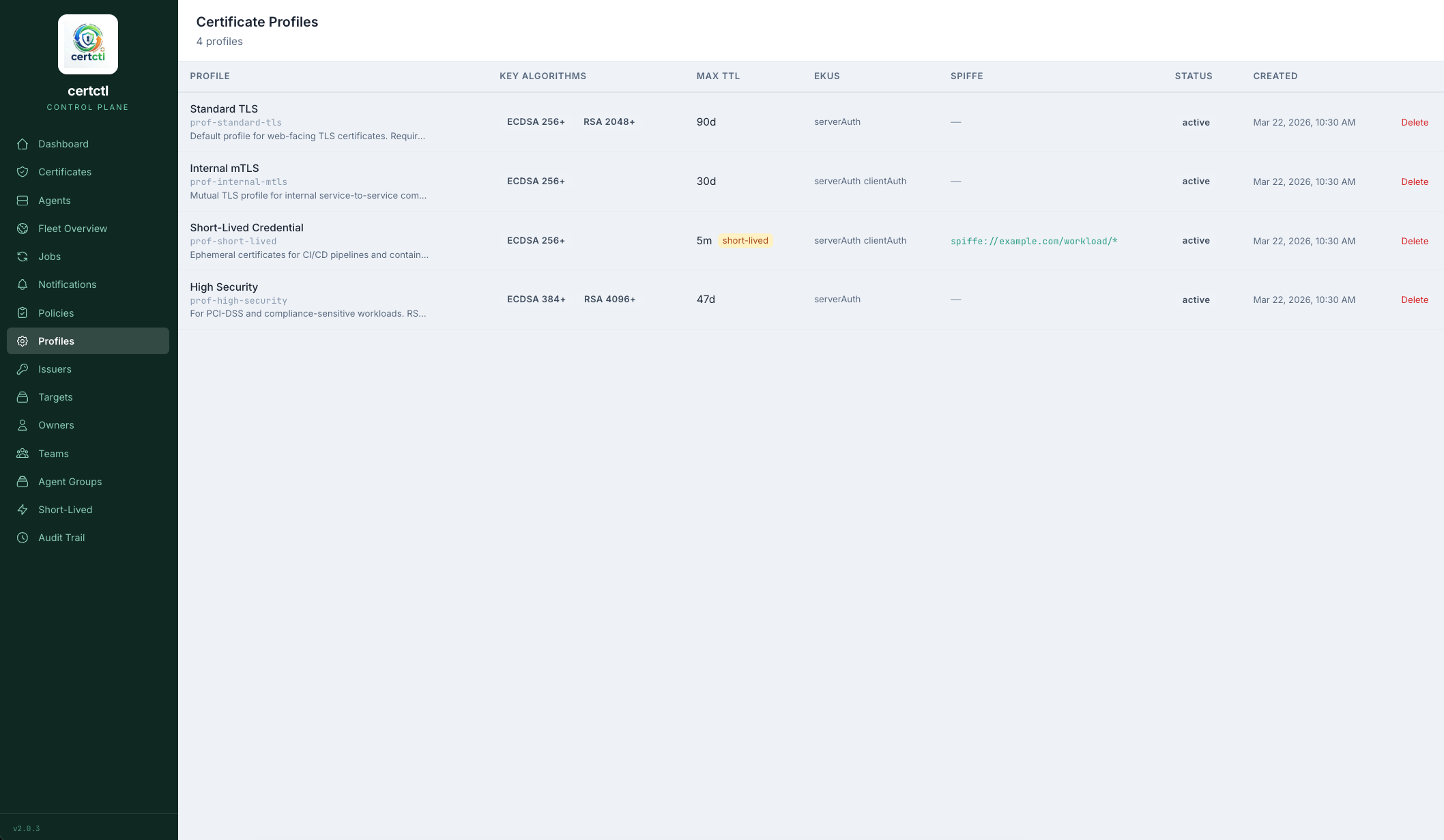 Profiles Key types, max TTL, crypto constraints |
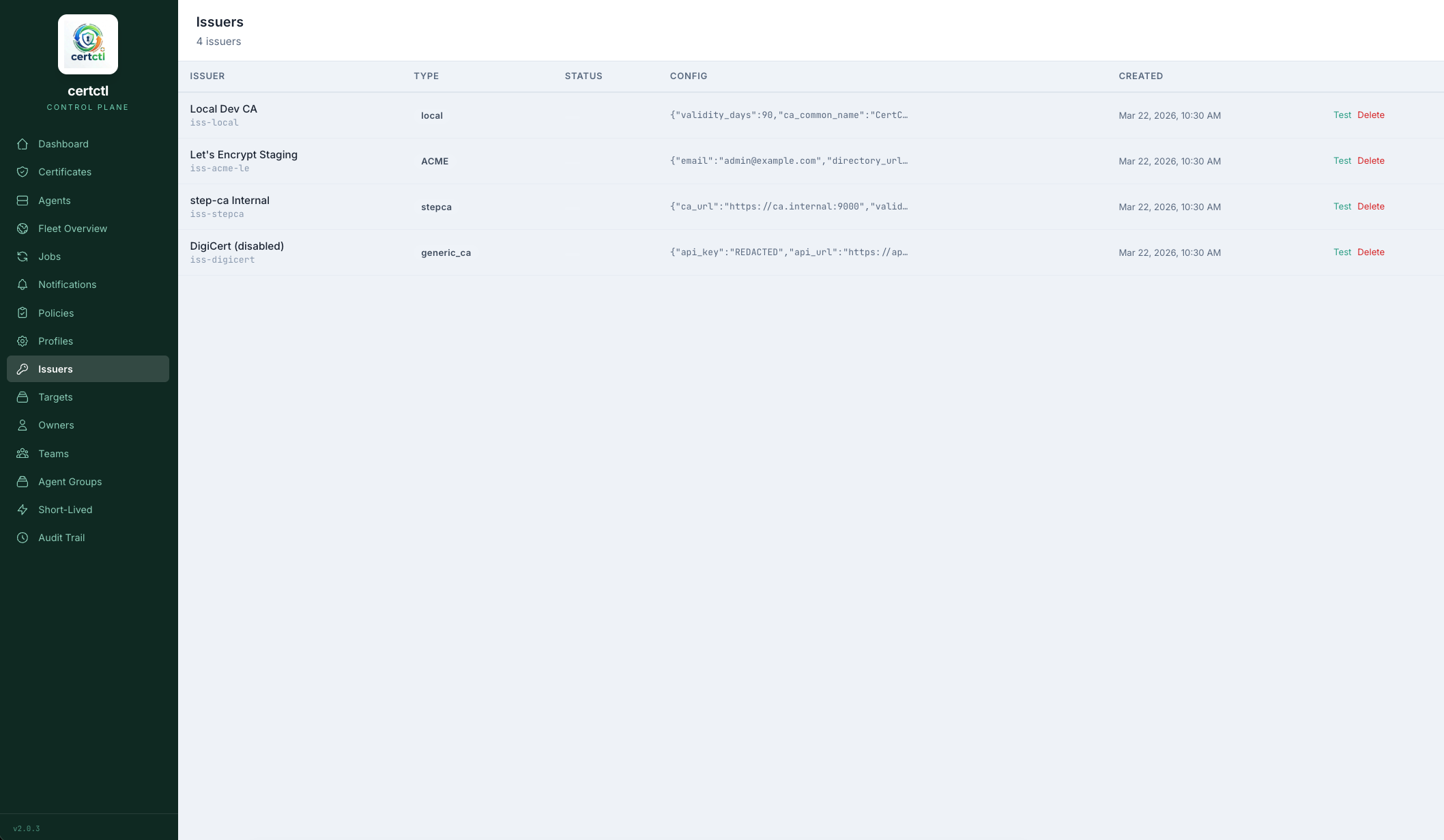 Issuers Local CA, ACME, step-ca connectors |
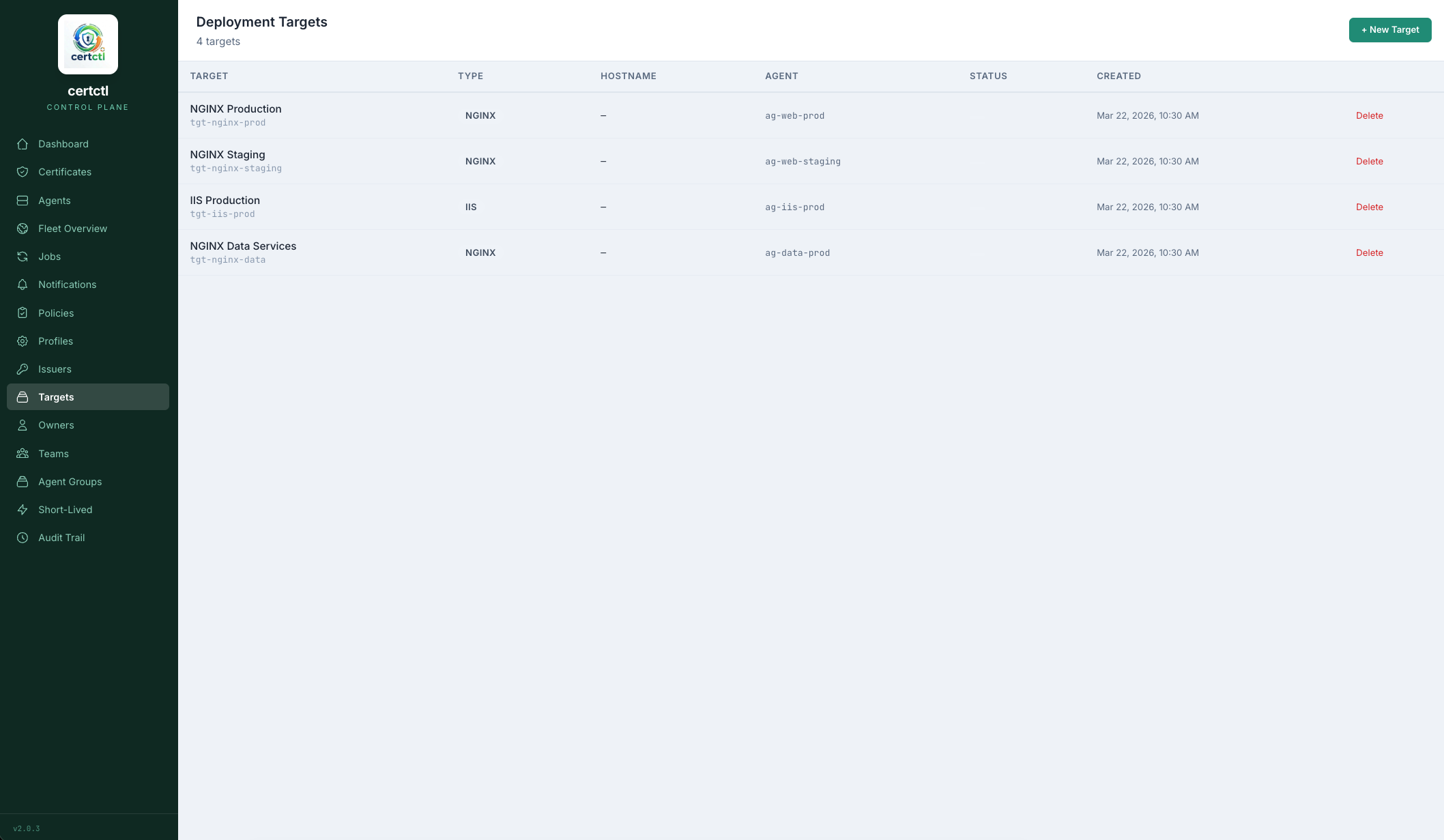 Targets NGINX, Apache, HAProxy deployment |
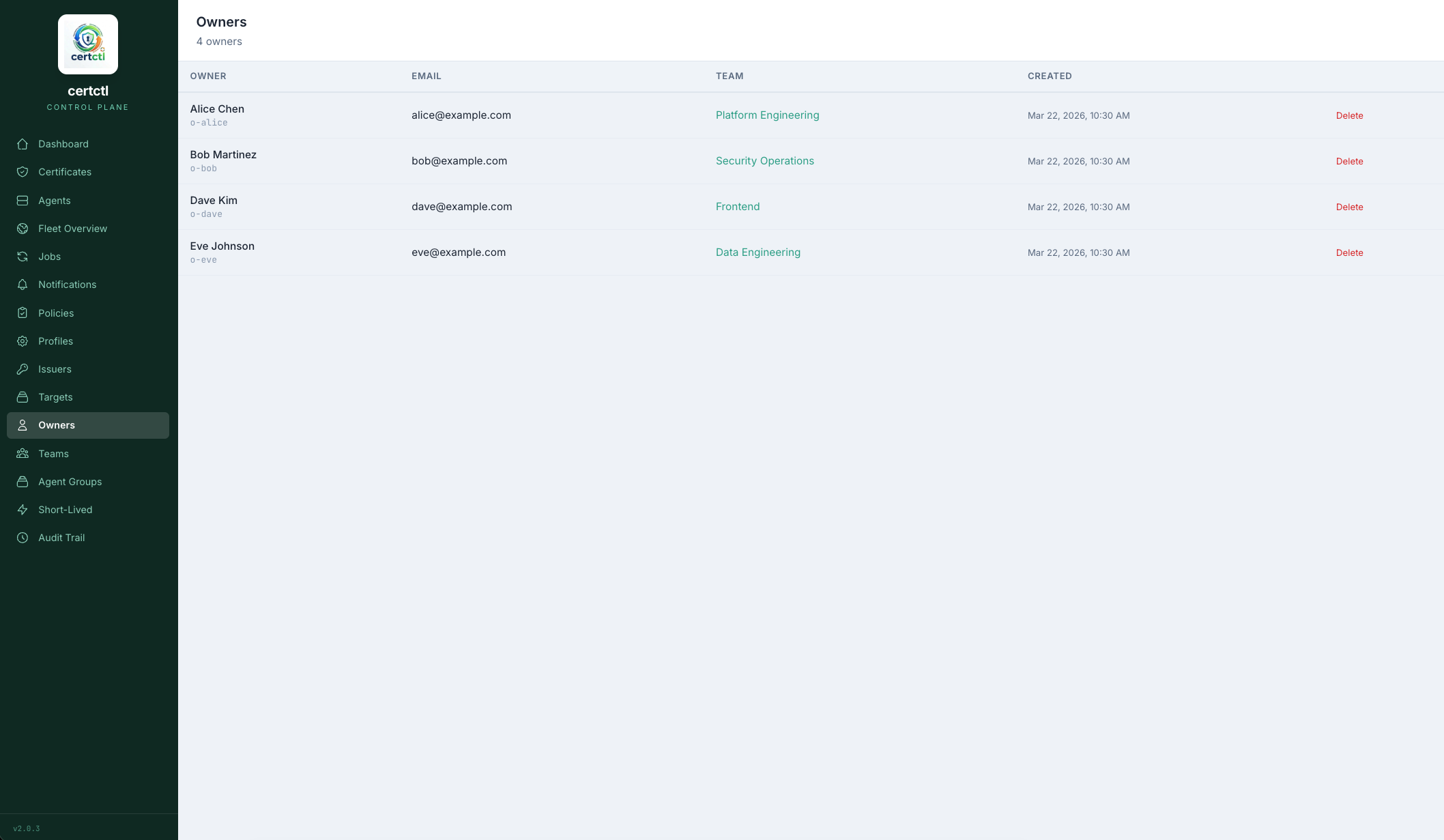 Owners Cert ownership with team assignment |
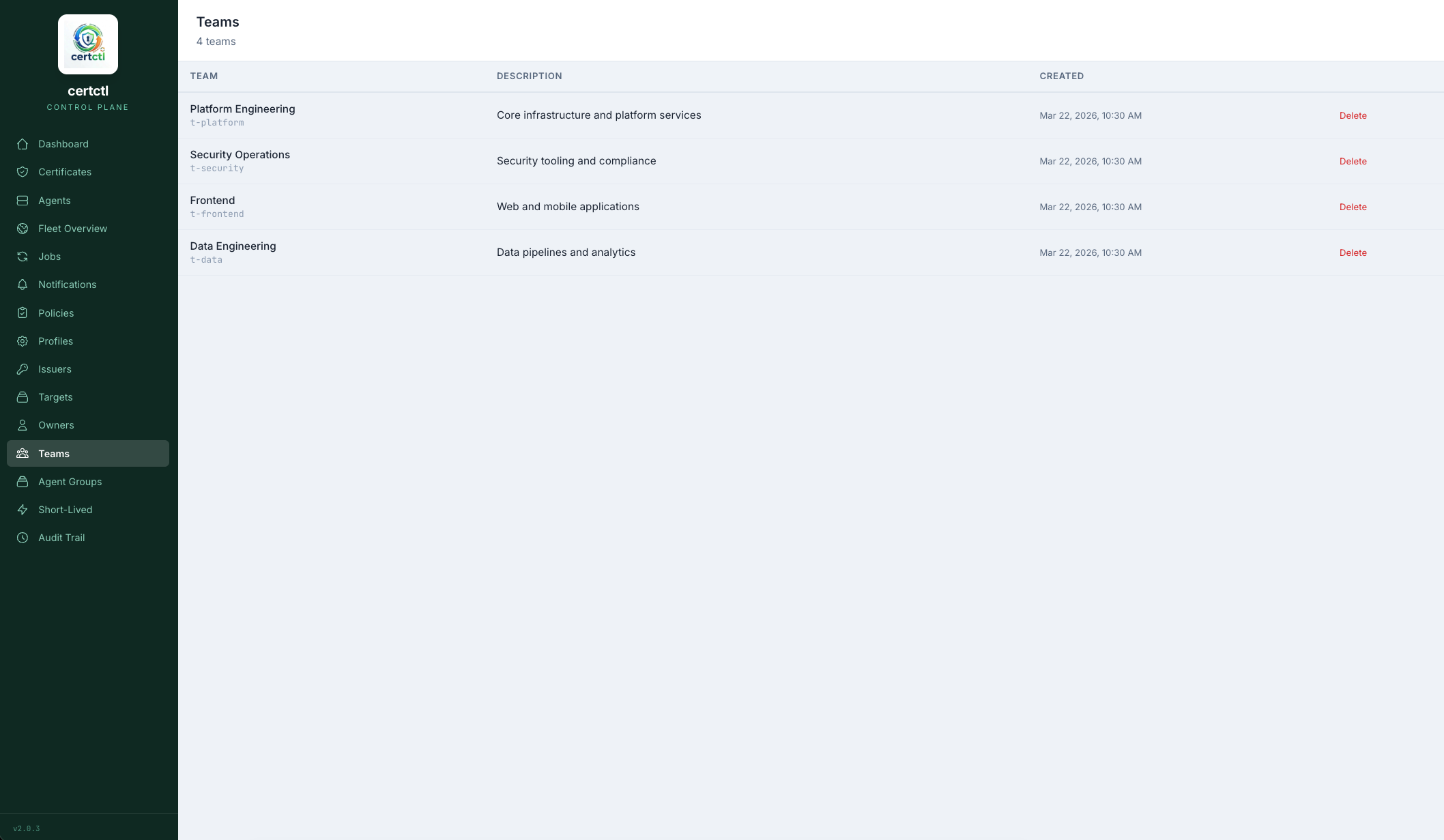 Teams Org grouping for notification routing |
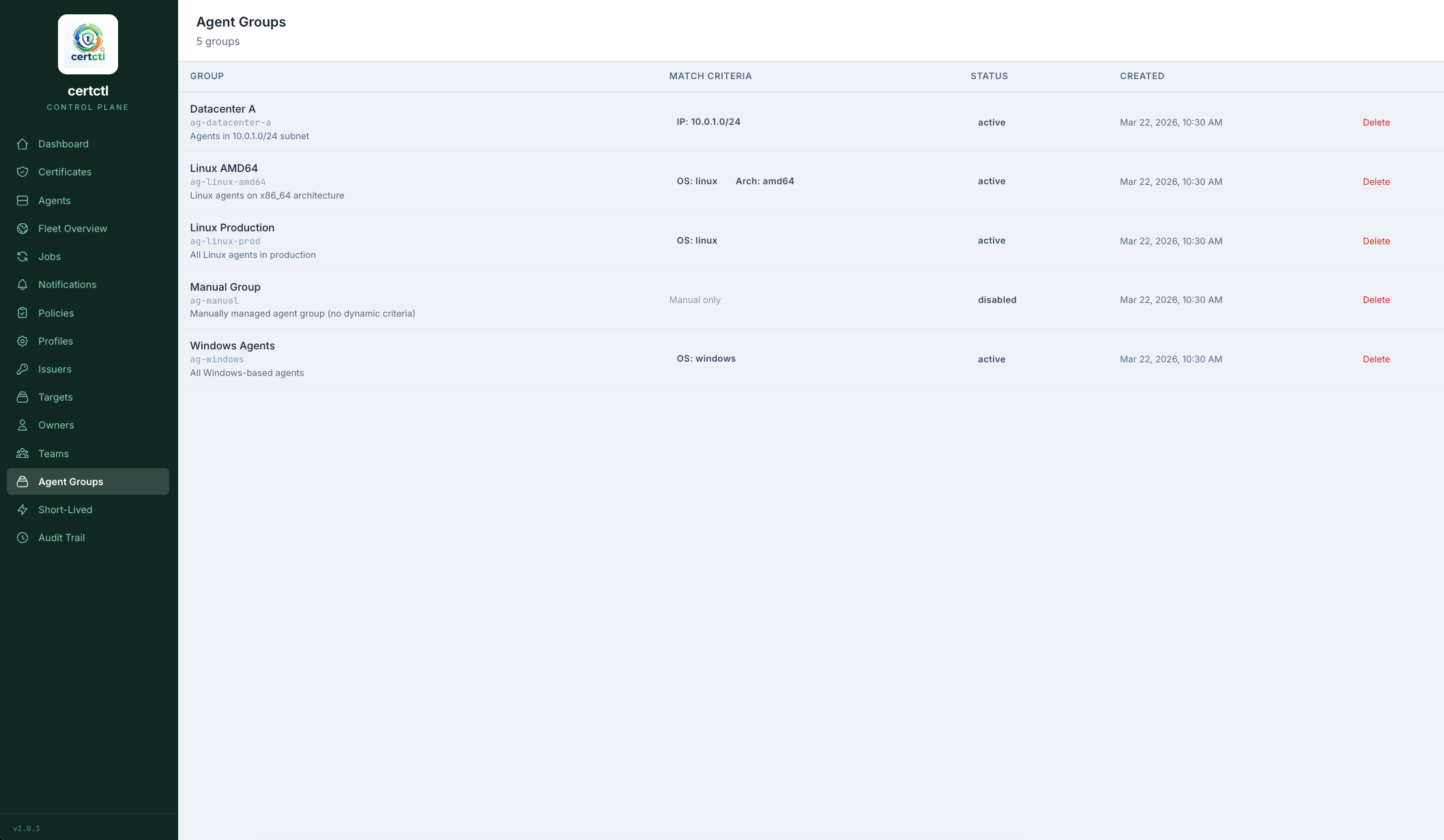 Agent Groups Dynamic grouping by OS, arch, CIDR |
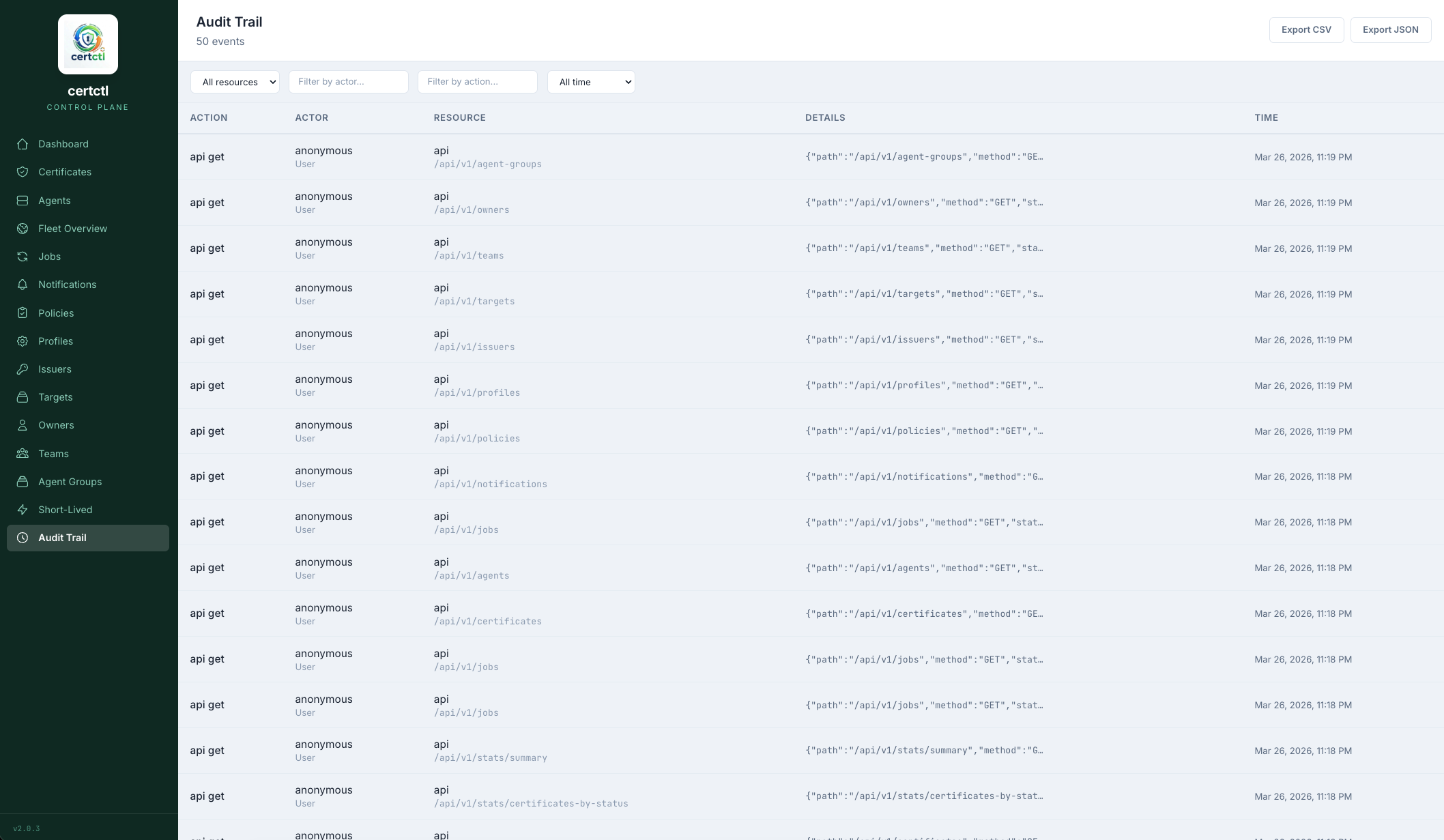 Audit Trail Immutable log, CSV/JSON export |
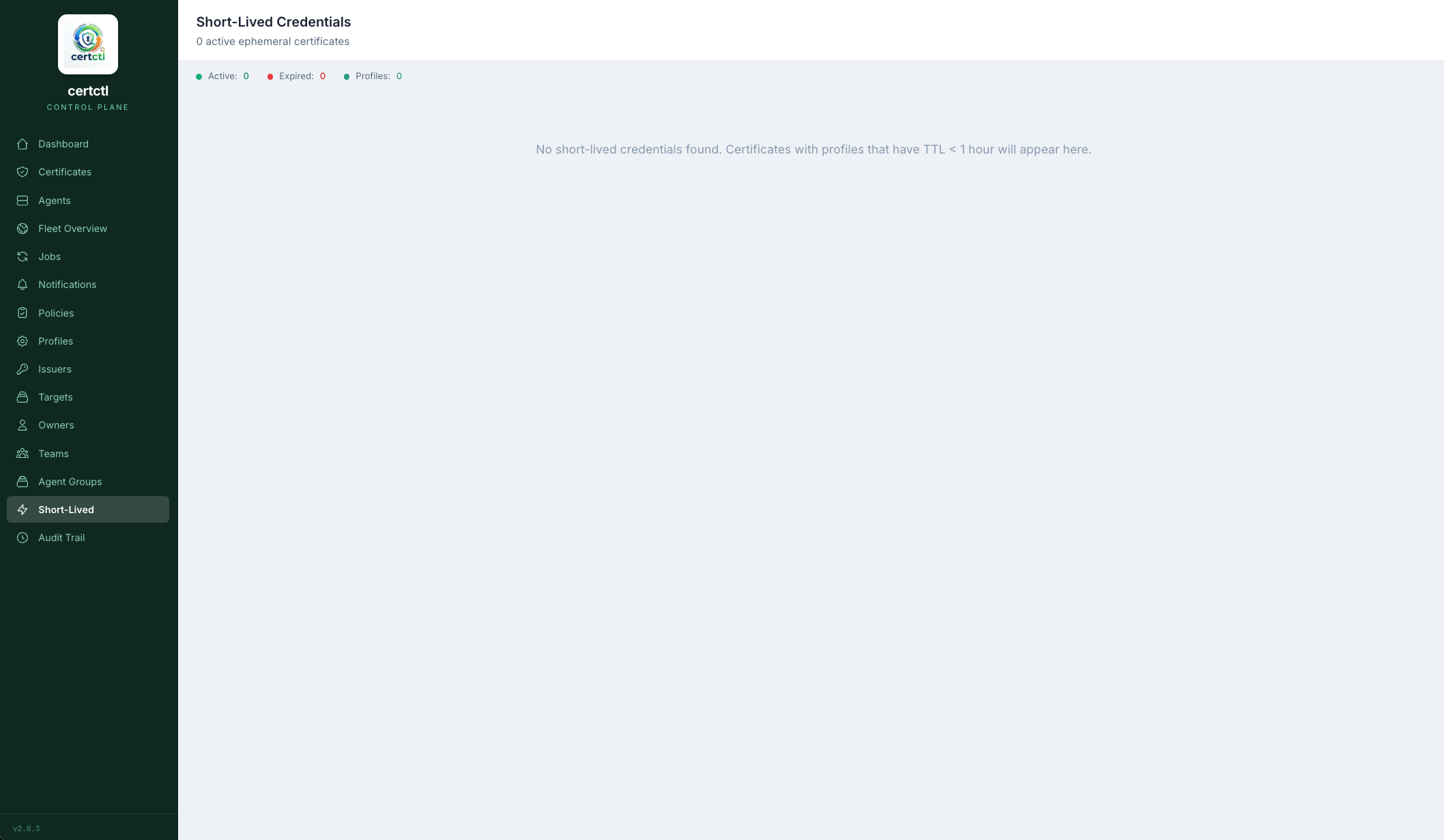 Short-Lived Creds Ephemeral certs with live TTL countdown |