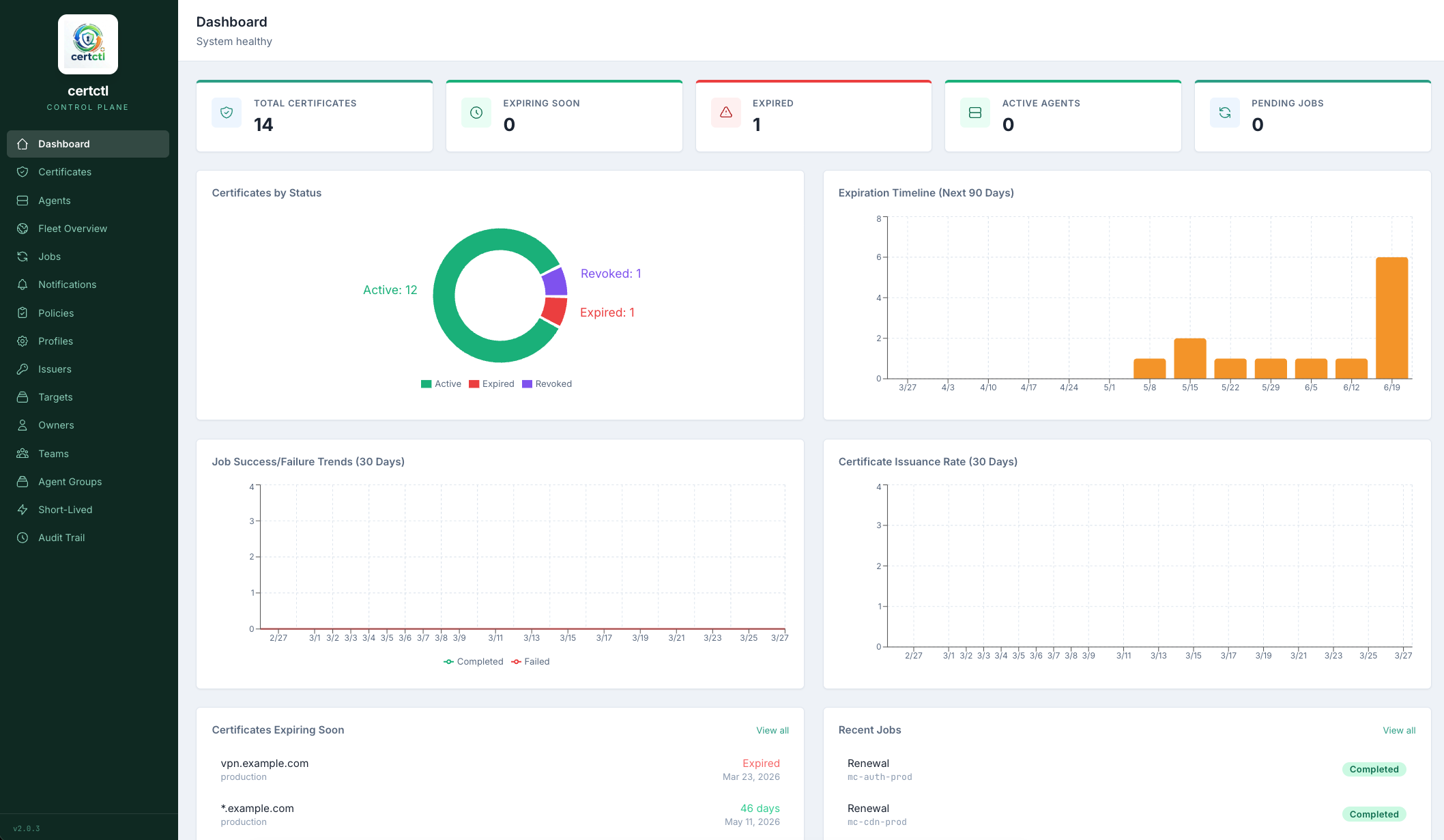
Dashboard
Stats, expiration heatmap, renewal trends |
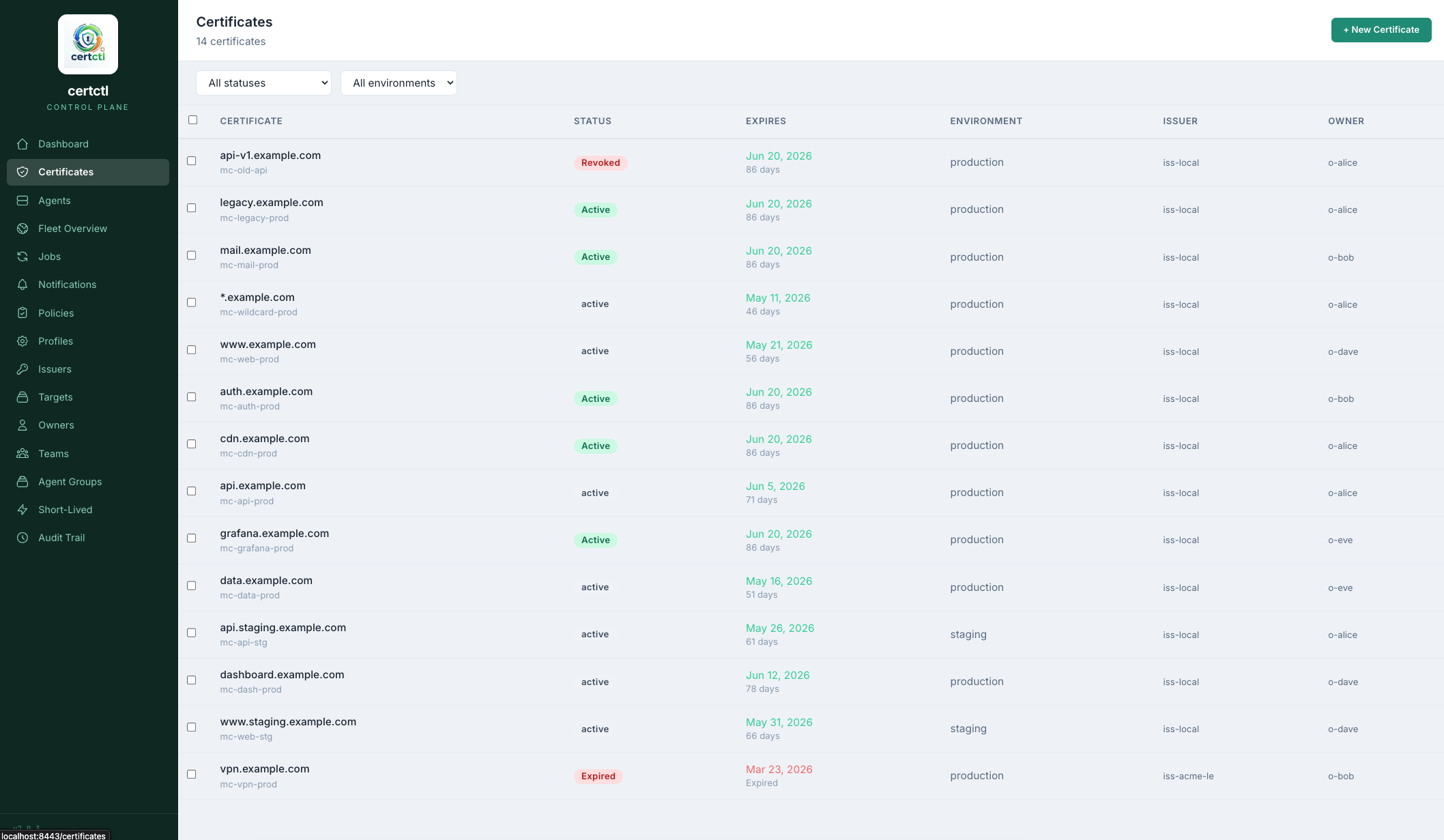
Certificates
Inventory with status, owner, team filters |
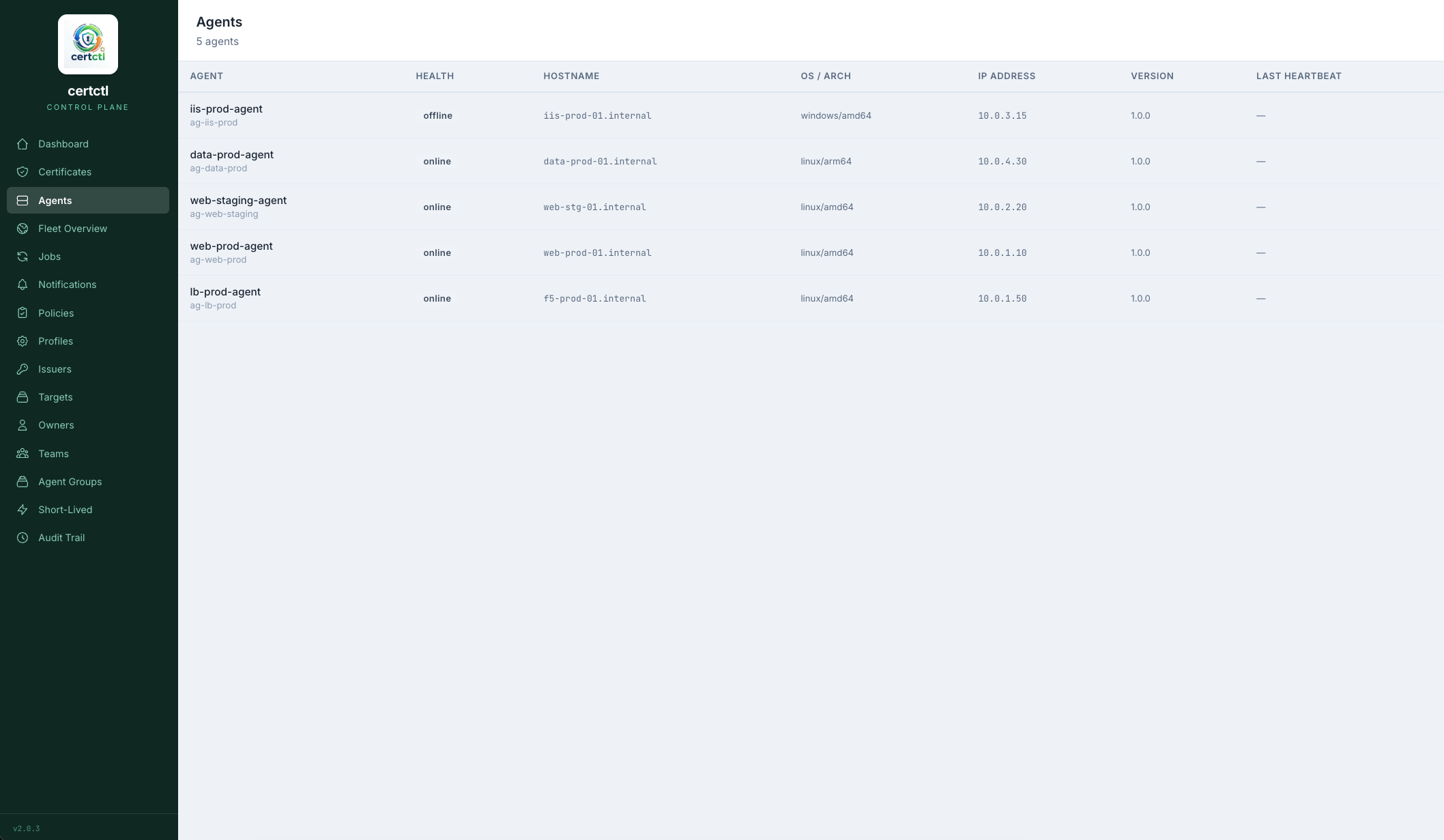
Agents
Fleet health, OS/arch, IP, version |
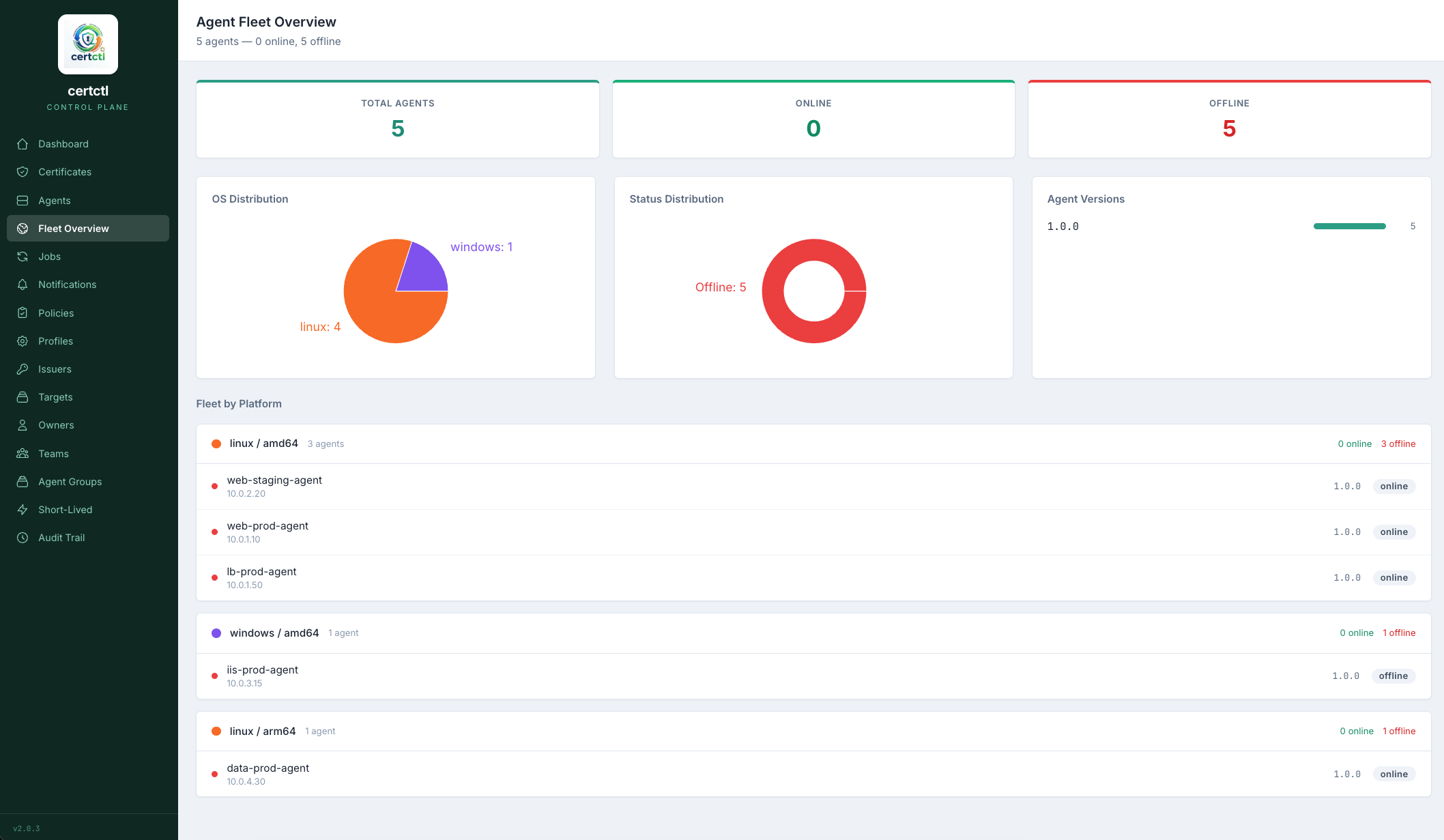
Fleet Overview
OS distribution, status breakdown |
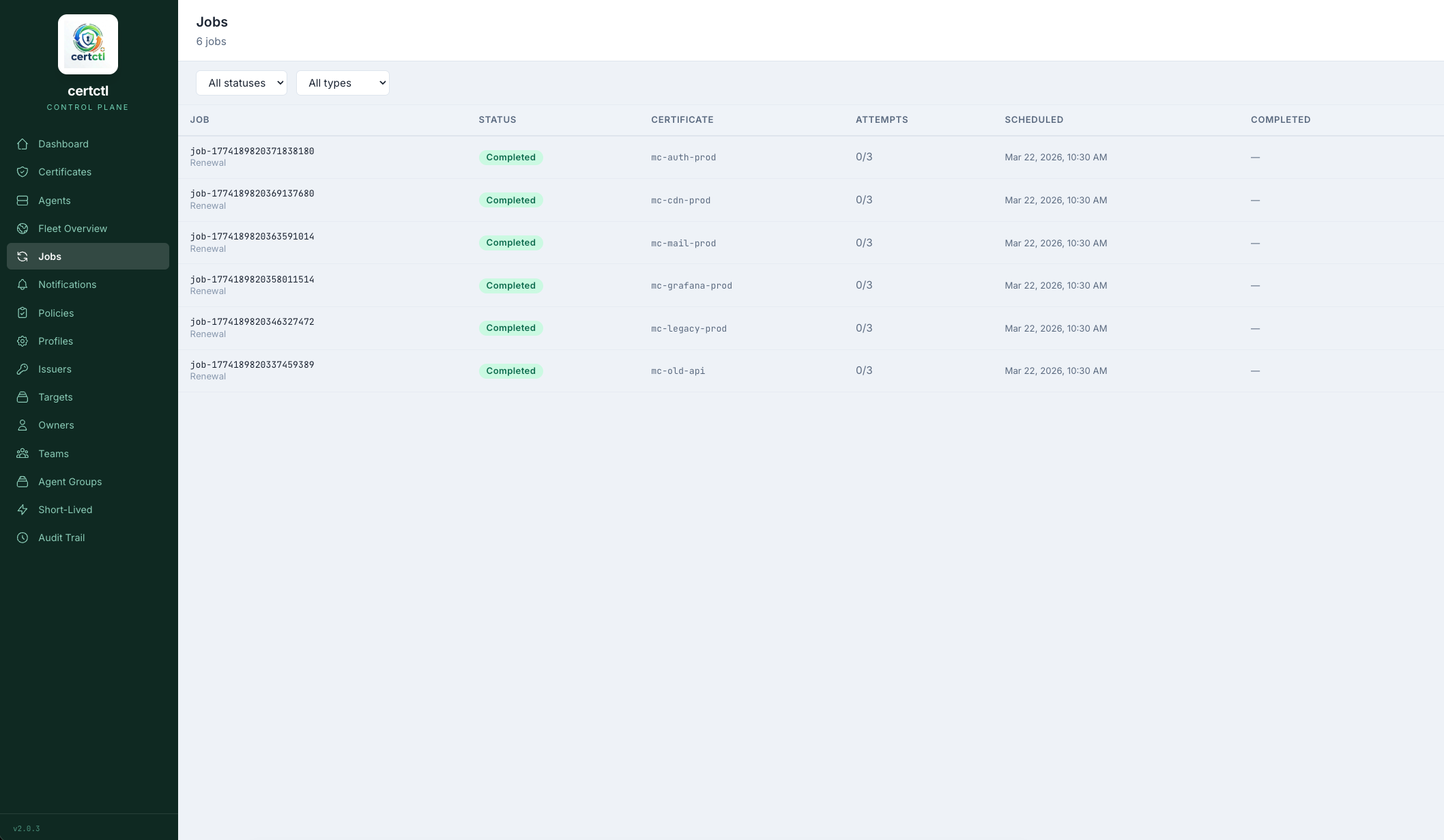
Jobs
Issuance, renewal, deployment queue |
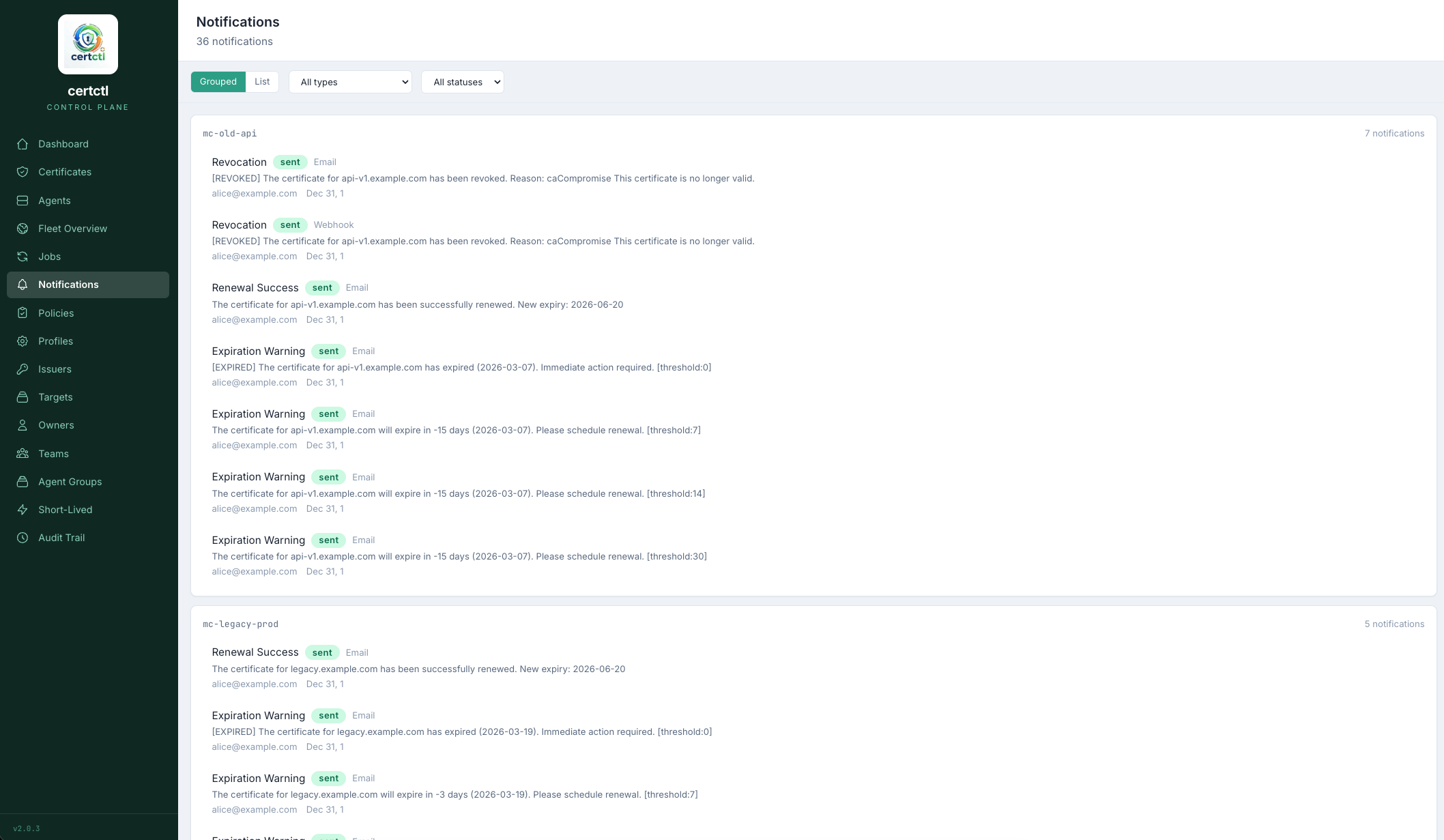
Notifications
Expiration warnings, renewal results |
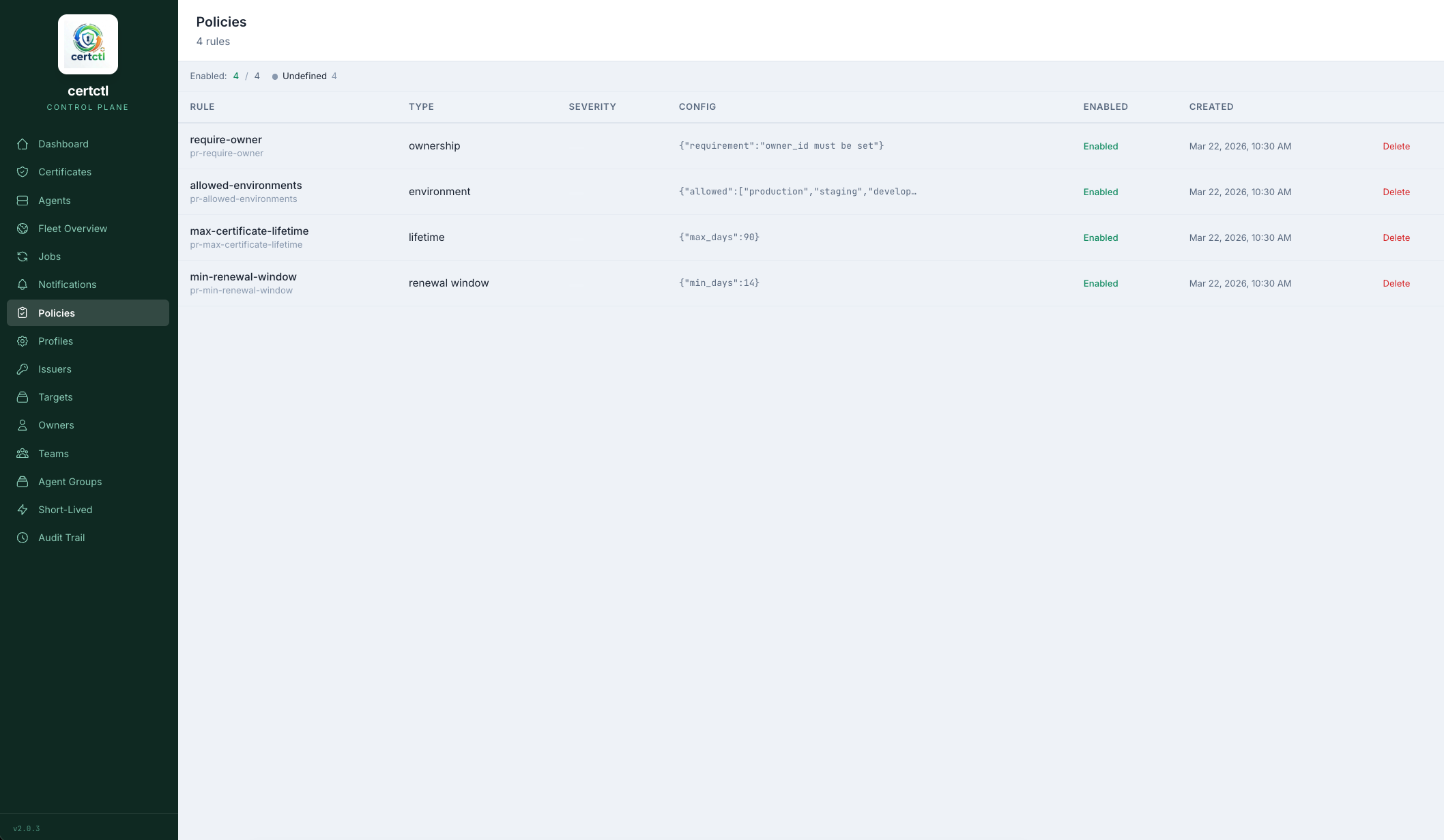
Policies
Ownership, lifetime, renewal rules |
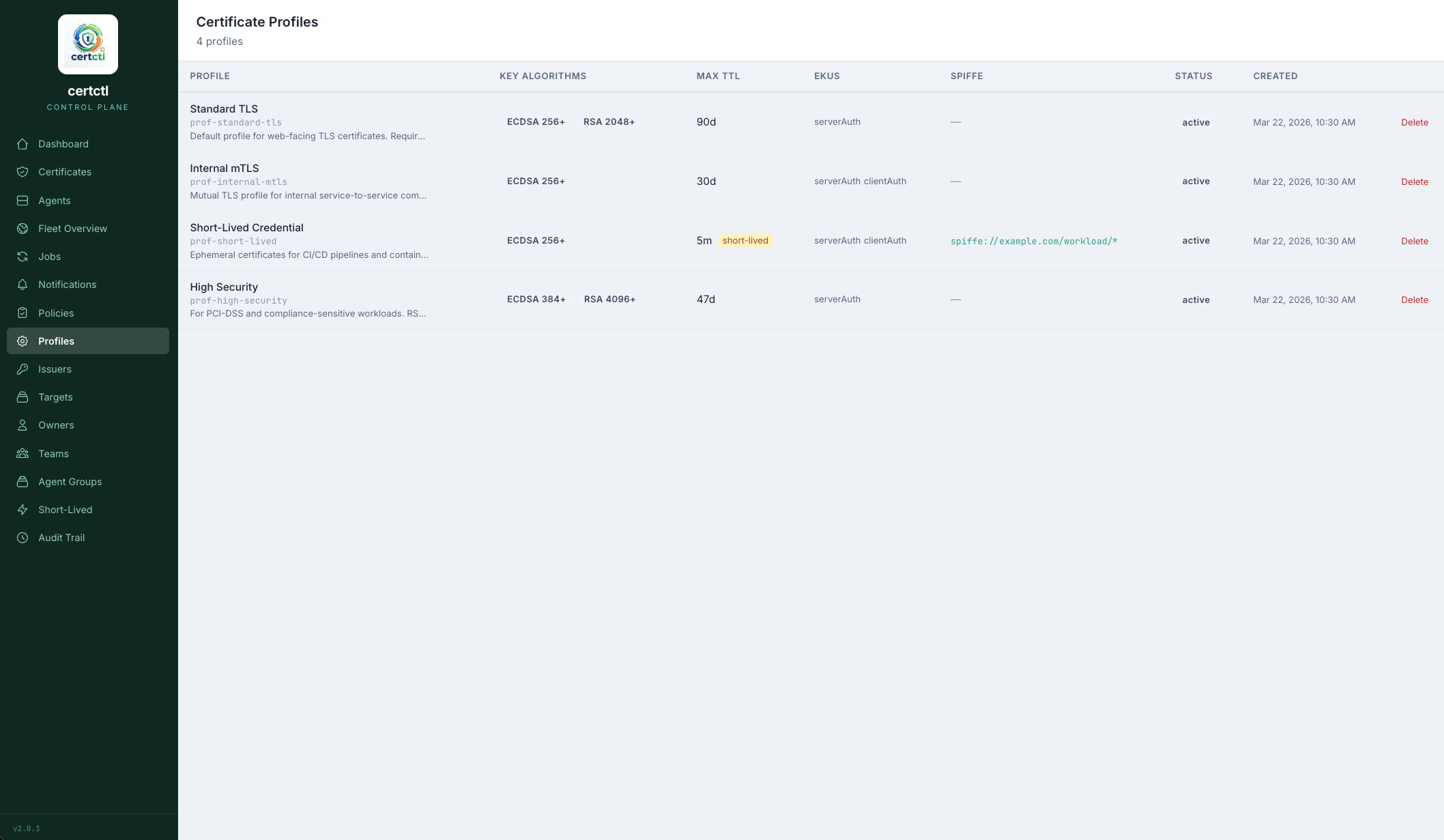
Profiles
Key types, max TTL, crypto constraints |
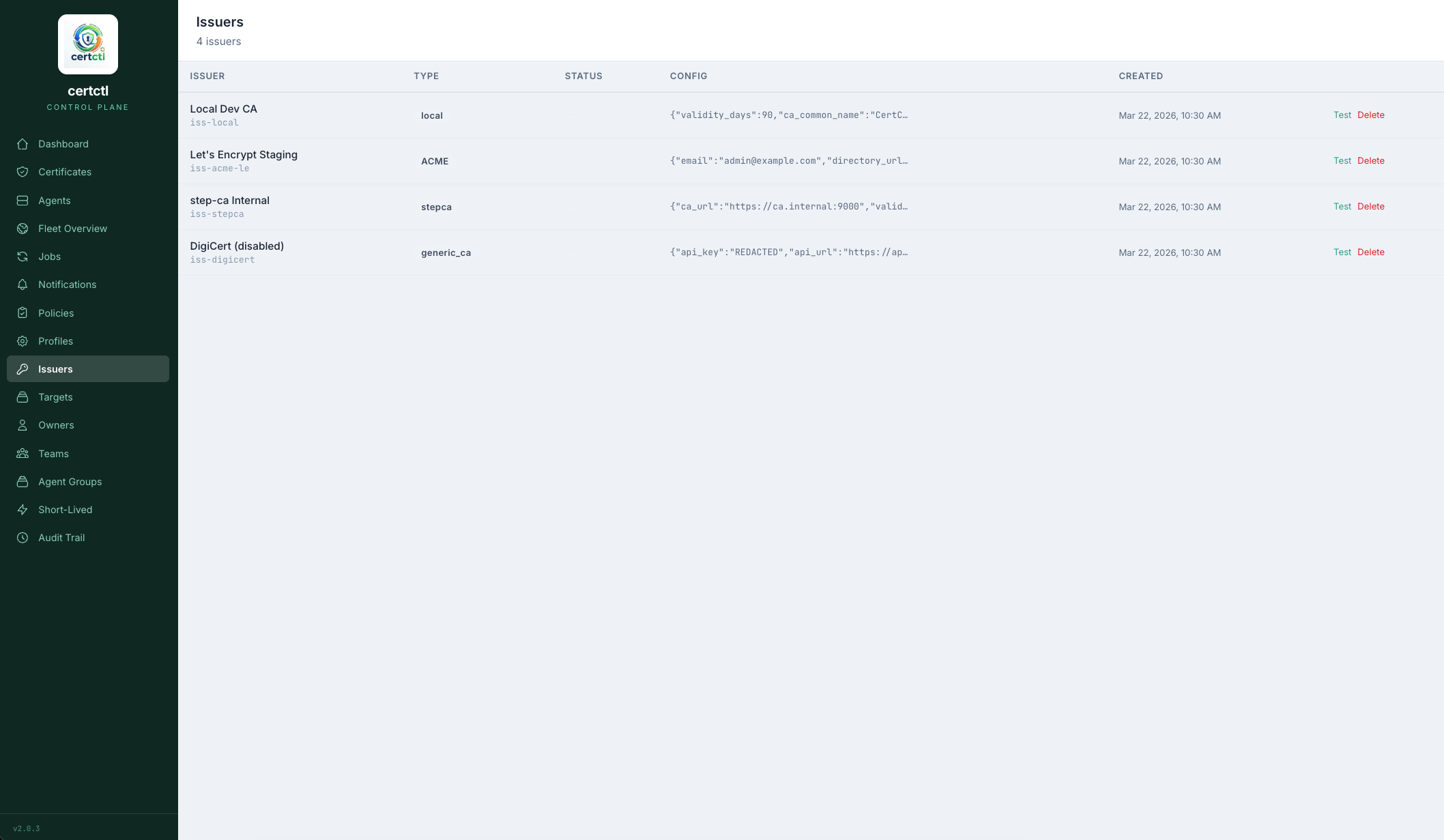
Issuers
Local CA, ACME, step-ca connectors |
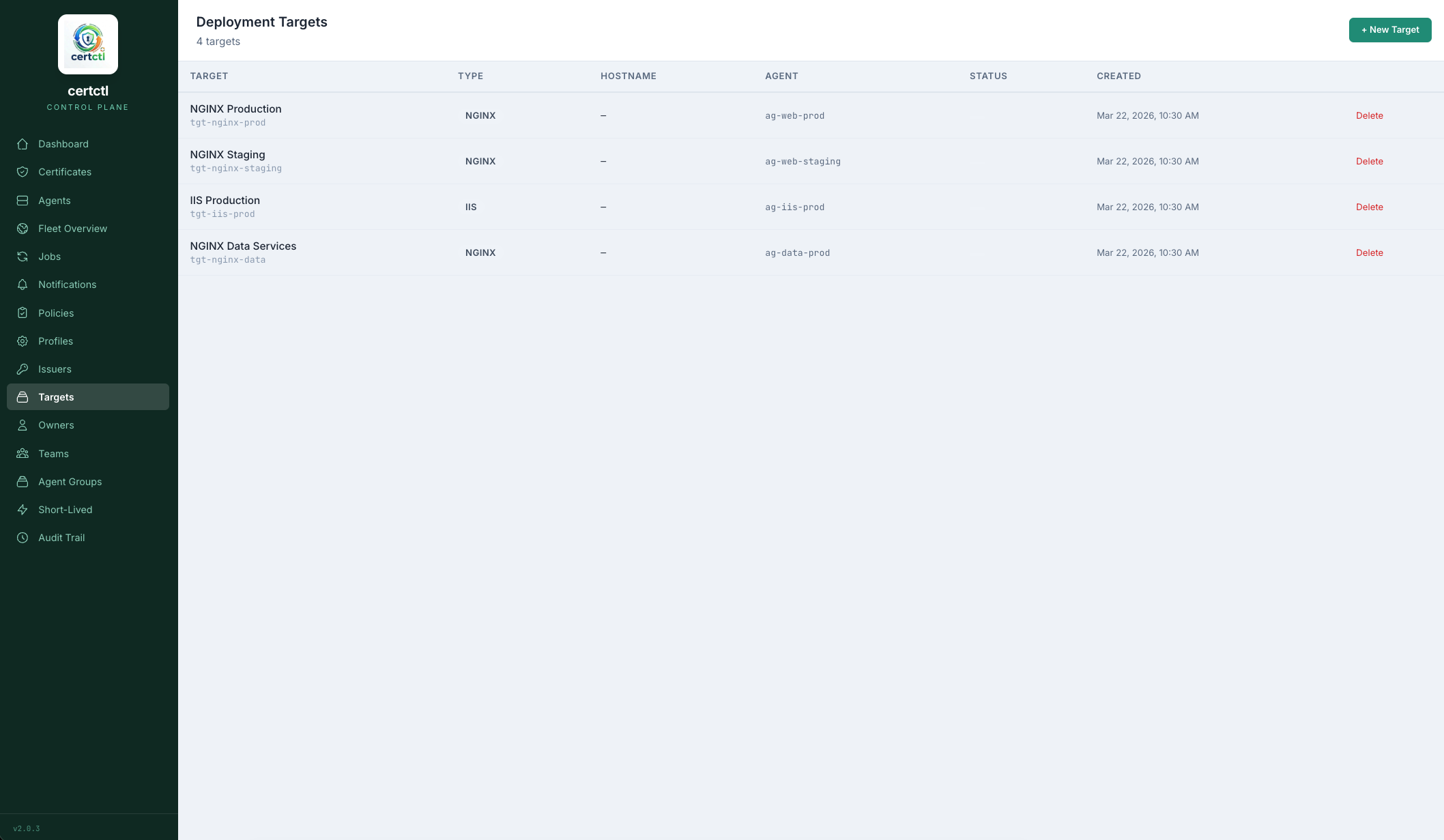
Targets
NGINX, Apache, HAProxy, Traefik, Caddy deployment |
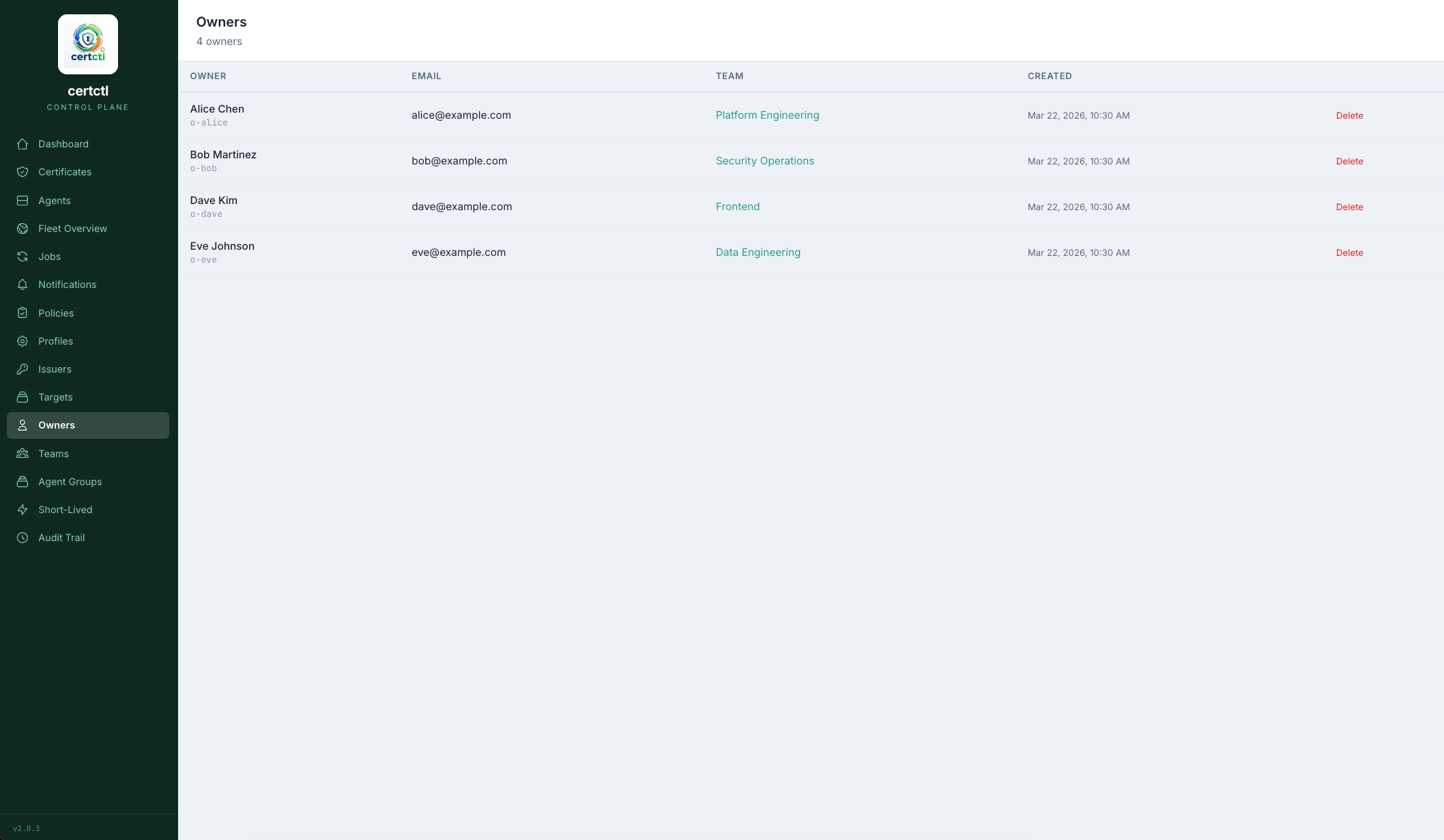
Owners
Cert ownership with team assignment |
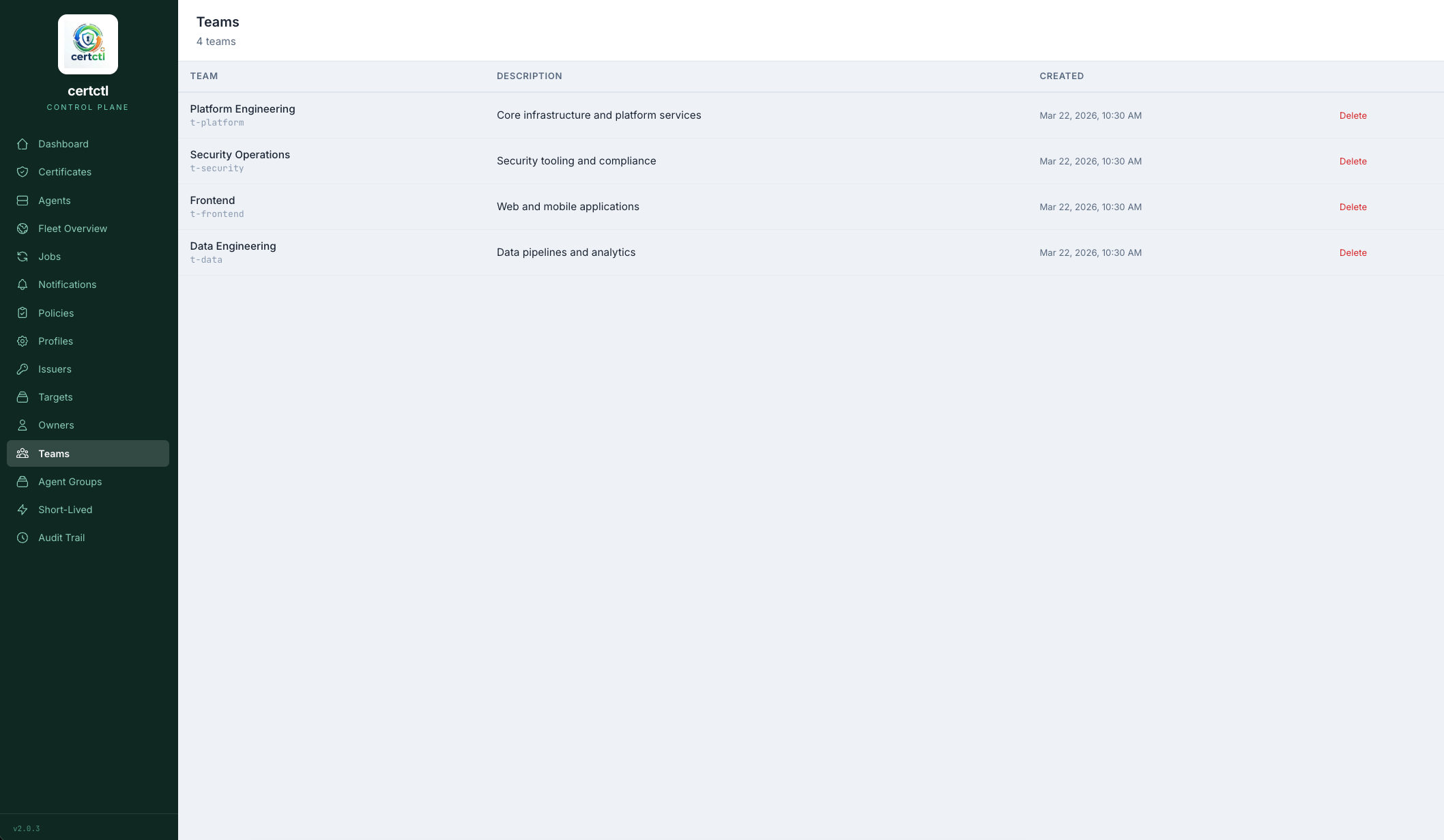
Teams
Org grouping for notification routing |
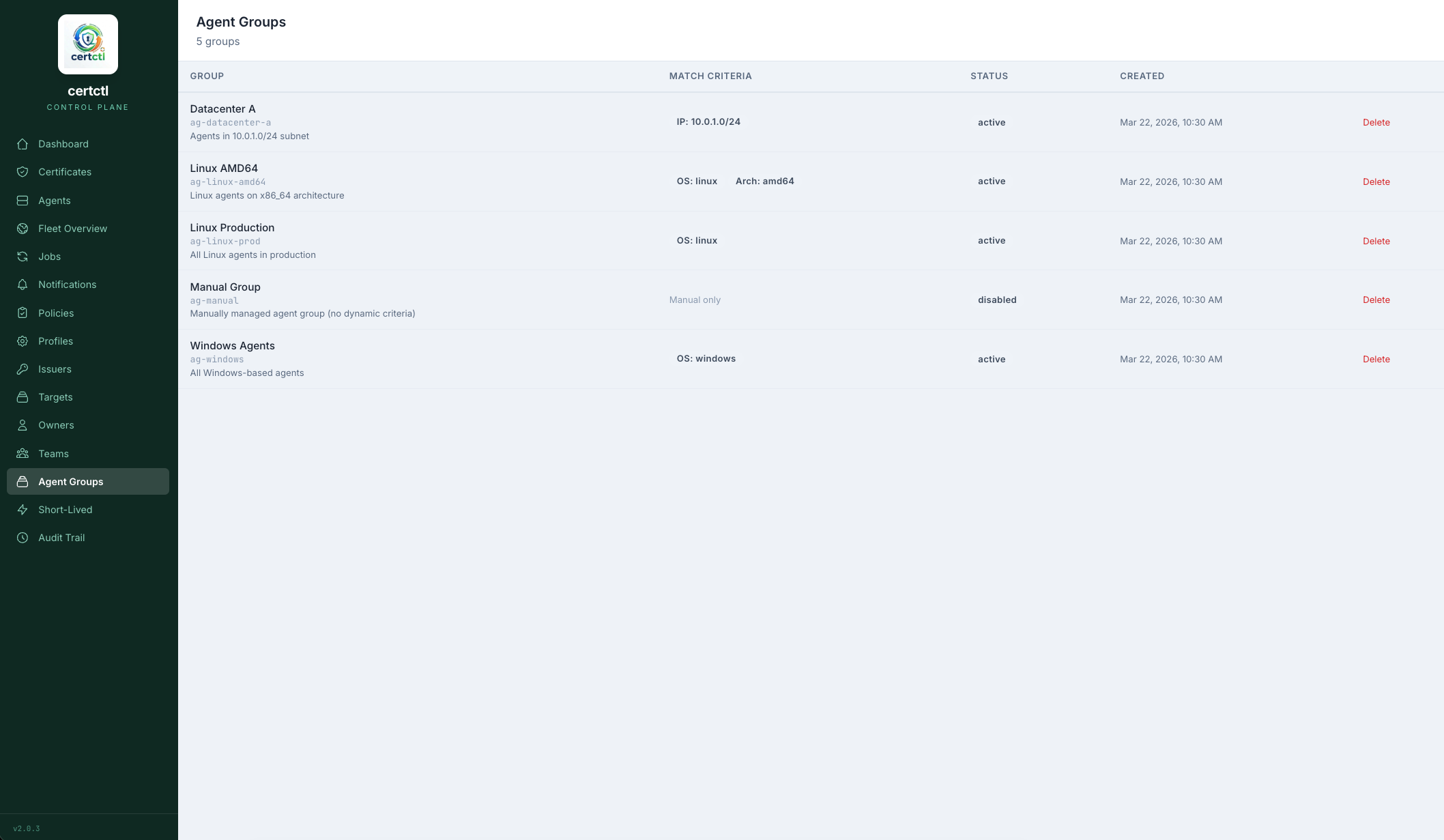
Agent Groups
Dynamic grouping by OS, arch, CIDR |
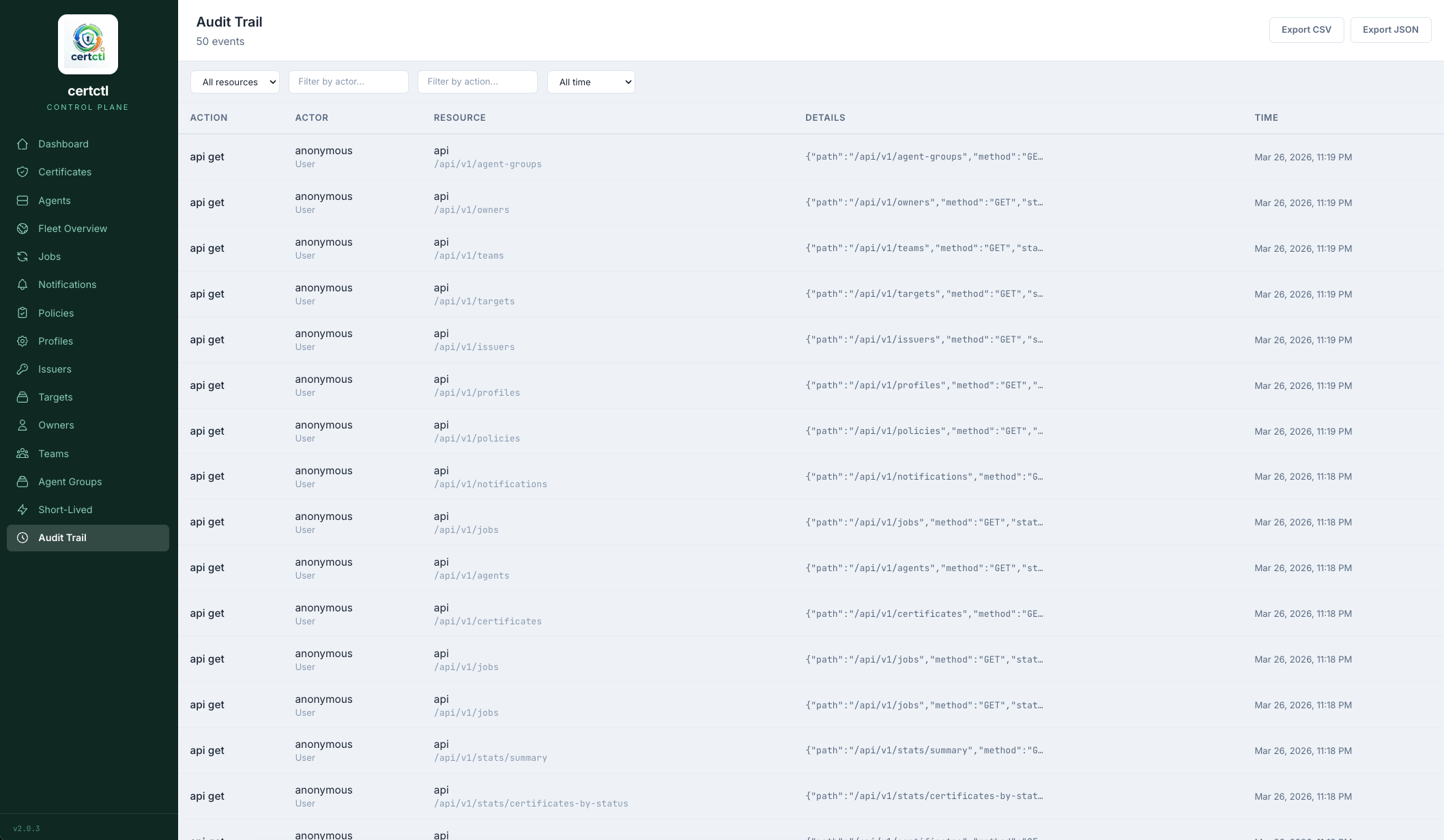
Audit Trail
Immutable log, CSV/JSON export |
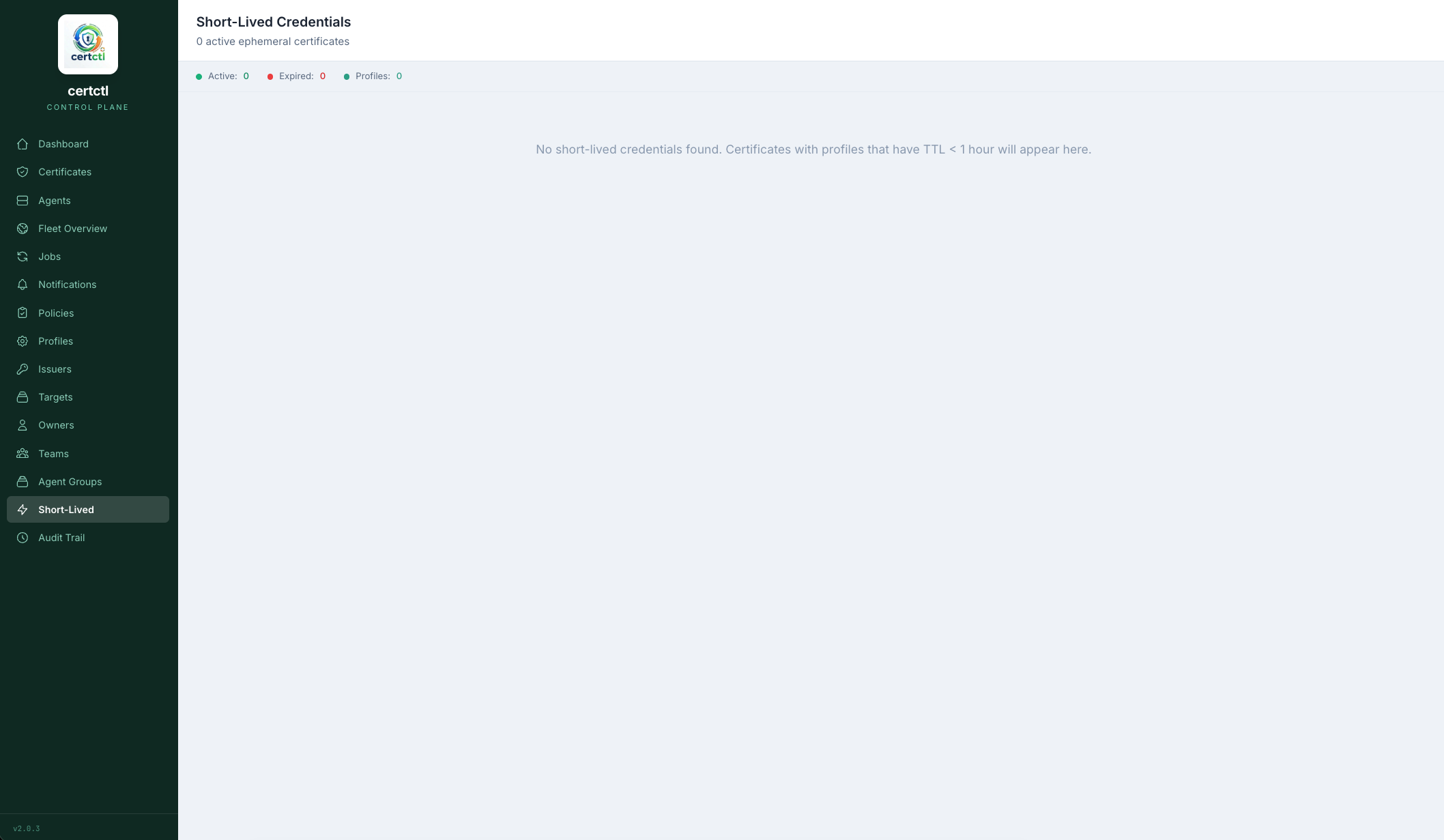
Short-Lived Creds
Ephemeral certs with live TTL countdown |
## Quick Start
### Docker Pull
```bash
docker pull shankar0123.docker.scarf.sh/certctl-server
docker pull shankar0123.docker.scarf.sh/certctl-agent
```
### Docker Compose (Recommended)
```bash
git clone https://github.com/shankar0123/certctl.git
cd certctl
docker compose -f deploy/docker-compose.yml up -d --build
```
Wait ~30 seconds, then open **http://localhost:8443** in your browser.
The dashboard comes pre-loaded with 15 demo certificates, 5 agents, policy rules, audit events, and notifications — a realistic snapshot of a certificate inventory so you can explore immediately.
Verify the API:
```bash
curl http://localhost:8443/health
# {"status":"healthy"}
curl -s http://localhost:8443/api/v1/certificates | jq '.total'
# 15
```
### Manual Build
```bash
# Prerequisites: Go 1.25+, PostgreSQL 16+
go mod download
make build
# Set up database
export CERTCTL_DATABASE_URL="postgres://certctl:certctl@localhost:5432/certctl?sslmode=disable"
export CERTCTL_AUTH_TYPE=none
make migrate-up
# Start server
./bin/server
# Start agent (separate terminal)
export CERTCTL_SERVER_URL=http://localhost:8443
export CERTCTL_API_KEY=change-me-in-production
export CERTCTL_AGENT_NAME=local-agent
export CERTCTL_AGENT_ID=agent-local-01
./bin/agent --agent-id=agent-local-01
```
## Architecture
**Control plane** (Go 1.25 net/http) → **PostgreSQL 16** (21 tables, TEXT primary keys) → **Agents** (key generation, CSR submission, cert deployment). Background scheduler runs 6 loops: renewal checks (1h), job processing (30s), agent health (2m), notifications (1m), short-lived cert expiry (30s), network scanning (6h). See [Architecture Guide](docs/architecture.md) for full system diagrams and data flow.
### Key Design Decisions
- **Private keys isolated from the control plane.** Agents generate ECDSA P-256 keys locally and submit CSRs (public key only). The server signs the CSR and returns the certificate — private keys never touch the control plane. Server-side keygen is available via `CERTCTL_KEYGEN_MODE=server` for demo/development only.
- **TEXT primary keys, not UUIDs.** IDs are human-readable prefixed strings (`mc-api-prod`, `t-platform`, `o-alice`) so you can identify resource types at a glance in logs and queries.
- **Handler → Service → Repository layering.** Handlers define their own service interfaces for clean dependency inversion. No global service singletons.
- **Idempotent migrations.** All schema uses `IF NOT EXISTS` and seed data uses `ON CONFLICT (id) DO NOTHING`, safe for repeated execution.
PostgreSQL 16 with 21 tables covering certificates, versions, policies, issuers, targets, agents, jobs, teams, owners, profiles, agent groups, revocations, discovery, network scans, and audit events. See the [Architecture Guide](docs/architecture.md) for the full schema.
## Configuration
All environment variables use the `CERTCTL_` prefix. Full reference below (39 variables across server, agent, and connector config).
### Server — Core
| Variable | Default | Description |
|----------|---------|-------------|
| `CERTCTL_SERVER_HOST` | `127.0.0.1` | Server bind address |
| `CERTCTL_SERVER_PORT` | `8080` | Server listen port (1–65535) |
| `CERTCTL_DATABASE_URL` | `postgres://localhost/certctl` | PostgreSQL connection string (required) |
| `CERTCTL_DATABASE_MAX_CONNS` | `25` | PostgreSQL connection pool size (min 1) |
| `CERTCTL_DATABASE_MIGRATIONS_PATH` | `./migrations` | Path to migration SQL files |
| `CERTCTL_MAX_BODY_SIZE` | `1048576` | Max HTTP request body in bytes (default 1MB) |
| `CERTCTL_LOG_LEVEL` | `info` | Log verbosity: `debug`, `info`, `warn`, `error` |
| `CERTCTL_LOG_FORMAT` | `json` | Log format: `json` (structured) or `text` (human-readable) |
### Server — Auth, CORS, Rate Limiting
| Variable | Default | Description |
|----------|---------|-------------|
| `CERTCTL_AUTH_TYPE` | `api-key` | Auth mode: `api-key`, `jwt`, or `none` (demo only) |
| `CERTCTL_AUTH_SECRET` | — | Required for `api-key` and `jwt` auth types |
| `CERTCTL_CORS_ORIGINS` | *(empty = deny all)* | Comma-separated allowed origins, or `*` for dev |
| `CERTCTL_RATE_LIMIT_ENABLED` | `true` | Enable token bucket rate limiting |
| `CERTCTL_RATE_LIMIT_RPS` | `50` | Requests per second per client |
| `CERTCTL_RATE_LIMIT_BURST` | `100` | Max burst size |
| `CERTCTL_KEYGEN_MODE` | `agent` | Key generation: `agent` (production) or `server` (demo only) |
### Server — Scheduler
| Variable | Default | Description |
|----------|---------|-------------|
| `CERTCTL_SCHEDULER_RENEWAL_CHECK_INTERVAL` | `1h` | How often to check expiring certs (min 1m) |
| `CERTCTL_SCHEDULER_JOB_PROCESSOR_INTERVAL` | `30s` | How often to process pending jobs (min 1s) |
| `CERTCTL_SCHEDULER_AGENT_HEALTH_CHECK_INTERVAL` | `2m` | Agent heartbeat check frequency (min 1s) |
| `CERTCTL_SCHEDULER_NOTIFICATION_PROCESS_INTERVAL` | `1m` | Notification send frequency (min 1s) |
### Server — Sub-CA Mode
| Variable | Default | Description |
|----------|---------|-------------|
| `CERTCTL_CA_CERT_PATH` | — | PEM-encoded CA certificate for sub-CA mode |
| `CERTCTL_CA_KEY_PATH` | — | PEM-encoded CA private key (RSA, ECDSA, PKCS#8) |
### Server — Feature Flags
| Variable | Default | Description |
|----------|---------|-------------|
| `CERTCTL_EST_ENABLED` | `false` | Enable RFC 7030 EST enrollment endpoints |
| `CERTCTL_EST_ISSUER_ID` | `iss-local` | Which issuer processes EST enrollments |
| `CERTCTL_EST_PROFILE_ID` | — | Constrain EST to a specific certificate profile |
| `CERTCTL_NETWORK_SCAN_ENABLED` | `false` | Enable server-side TLS network scanning |
| `CERTCTL_NETWORK_SCAN_INTERVAL` | `6h` | How often scheduled scans run |
| `CERTCTL_VERIFY_DEPLOYMENT` | `true` | TLS verification after certificate deployment |
| `CERTCTL_VERIFY_TIMEOUT` | `10s` | TLS probe timeout |
| `CERTCTL_VERIFY_DELAY` | `2s` | Delay before verification probe |
### Server — Notification Connectors
| Variable | Default | Description |
|----------|---------|-------------|
| `CERTCTL_SLACK_WEBHOOK_URL` | — | Slack incoming webhook URL (enables Slack) |
| `CERTCTL_SLACK_CHANNEL` | — | Override default webhook channel |
| `CERTCTL_SLACK_USERNAME` | `certctl` | Bot display name |
| `CERTCTL_TEAMS_WEBHOOK_URL` | — | Microsoft Teams webhook URL (enables Teams) |
| `CERTCTL_PAGERDUTY_ROUTING_KEY` | — | PagerDuty Events API v2 key (enables PagerDuty) |
| `CERTCTL_PAGERDUTY_SEVERITY` | `warning` | Event severity: `info`, `warning`, `error`, `critical` |
| `CERTCTL_OPSGENIE_API_KEY` | — | OpsGenie Alert API key (enables OpsGenie) |
| `CERTCTL_OPSGENIE_PRIORITY` | `P3` | Alert priority: `P1`–`P5` |
### Agent
| Variable | Default | Description |
|----------|---------|-------------|
| `CERTCTL_SERVER_URL` | `http://localhost:8080` | Control plane URL |
| `CERTCTL_API_KEY` | — | Agent API key for authentication |
| `CERTCTL_AGENT_ID` | — | Registered agent ID (required) |
| `CERTCTL_KEY_DIR` | `/var/lib/certctl/keys` | Private key storage directory (0600 perms) |
| `CERTCTL_DISCOVERY_DIRS` | — | Directories to scan for existing certs (comma-separated) |
Docker Compose overrides for the demo stack are in `deploy/docker-compose.yml`.
## Development
```bash
# Install dev tools (golangci-lint, migrate CLI, air)
make install-tools
# Run tests
make test
# Run tests with race detection (same as CI)
go test -race ./internal/service/... ./internal/api/handler/... ./internal/api/middleware/... ./internal/scheduler/... ./internal/connector/... ./internal/domain/... ./internal/validation/...
# Run with coverage
make test-coverage
# Lint (runs golangci-lint with project config)
make lint
# Vulnerability scan
govulncheck ./...
# Format
make fmt
```
### CI Pipeline
Every push and PR runs: `go vet`, `go test -race` (race detection), `golangci-lint` (11 linters including gosec and bodyclose), `govulncheck` (dependency CVE scanning), and per-layer coverage thresholds (service 60%, handler 60%, domain 40%, middleware 50%). Frontend CI runs TypeScript type checking, Vitest tests, and Vite production build. See `.github/workflows/ci.yml` for details.
### Docker Compose
```bash
make docker-up # Start stack (server + postgres + agent)
make docker-down # Stop stack
make docker-logs-server # Server logs
make docker-logs-agent # Agent logs
make docker-clean # Stop + remove volumes
```
## Security
### Private Key Management
- **Agent keygen mode (default)**: Agents generate ECDSA P-256 keys locally and store them with 0600 permissions in `CERTCTL_KEY_DIR` (default `/var/lib/certctl/keys`). Only the CSR (public key) is sent to the control plane. Private keys never leave agent infrastructure.
- **Server keygen mode (demo only)**: Set `CERTCTL_KEYGEN_MODE=server` for development/demo with Local CA. The control plane generates RSA-2048 keys server-side. A log warning is emitted at startup.
### Authentication
- Agent-to-server: API key (registered at agent creation)
- API key and JWT auth types supported; `none` for demo/development
- Auth type and secret configured via `CERTCTL_AUTH_TYPE` and `CERTCTL_AUTH_SECRET`
### CORS
- **Deny-by-default**: Empty `CERTCTL_CORS_ORIGINS` blocks all cross-origin requests. Operators must explicitly list allowed origins (comma-separated) or set `*` for development.
### Input Validation
- Shell command injection prevention on all connector scripts (strict character whitelist, no metacharacters)
- RFC 1123 domain name validation, base64url ACME token validation
- SSRF protection in network scanner (loopback, link-local, multicast, broadcast ranges filtered)
### Concurrency Safety
- Scheduler loops protected by `sync/atomic.Bool` idempotency guards — duplicate ticks are skipped
- Graceful shutdown waits up to 30 seconds for in-flight work before database close
### Audit Trail
- Immutable append-only log in PostgreSQL (`audit_events` table)
- Every lifecycle action attributed to an actor with timestamp and resource reference
- No update or delete operations on audit records
- Every API call recorded to audit trail with method, path, actor, SHA-256 body hash, response status, and latency
## API Overview
95 endpoints under `/api/v1/` + `/.well-known/est/`, all returning JSON. List endpoints support pagination, sparse field selection (`?fields=`), sort (`?sort=-notAfter`), time-range filters, and cursor-based pagination. Full request/response schemas in the [OpenAPI 3.1 spec](api/openapi.yaml).
### Key Endpoints
```
# Certificate lifecycle
GET /api/v1/certificates List (filter, sort, cursor, sparse fields)
POST /api/v1/certificates/{id}/renew Trigger renewal → 202 Accepted
POST /api/v1/certificates/{id}/revoke Revoke with RFC 5280 reason code
GET /api/v1/certificates/{id}/export/pem Export PEM (JSON or file download)
POST /api/v1/certificates/{id}/export/pkcs12 Export PKCS#12 bundle (no private key)
GET /api/v1/crl/{issuer_id} DER-encoded X.509 CRL
GET /api/v1/ocsp/{issuer_id}/{serial} OCSP responder (good/revoked/unknown)
# Agent operations
POST /api/v1/agents/{id}/csr Submit CSR for issuance
GET /api/v1/agents/{id}/work Poll for pending deployment jobs
POST /api/v1/agents/{id}/discoveries Submit certificate discovery scan results
# Discovery & network scanning
GET /api/v1/discovered-certificates List discovered certs (?agent_id, ?status)
POST /api/v1/discovered-certificates/{id}/claim Link to managed cert
POST /api/v1/network-scan-targets/{id}/scan Trigger immediate TLS scan
# Jobs & approval
POST /api/v1/jobs/{id}/approve Approve interactive renewal
POST /api/v1/jobs/{id}/reject Reject interactive renewal
# Post-deployment verification
POST /api/v1/jobs/{id}/verify Submit TLS verification result
GET /api/v1/jobs/{id}/verification Get verification status
# Observability
GET /api/v1/metrics/prometheus Prometheus exposition format
GET /api/v1/stats/summary Dashboard summary
# EST enrollment (RFC 7030)
POST /.well-known/est/simpleenroll Device certificate enrollment
GET /.well-known/est/cacerts CA certificate chain (PKCS#7)
```
Full CRUD is available for certificates, agents, issuers, targets, teams, owners, policies, profiles, agent groups, notifications, and audit events. See the [OpenAPI spec](api/openapi.yaml) or [Feature Inventory](docs/features.md) for the complete endpoint reference.
## CLI
```bash
# Install
go install github.com/shankar0123/certctl/cmd/cli@latest
# Configure
export CERTCTL_SERVER_URL=http://localhost:8443
export CERTCTL_API_KEY=your-api-key
# Certificate commands
certctl-cli certs list # List all certificates
certctl-cli certs get mc-api-prod # Get certificate details
certctl-cli certs renew mc-api-prod # Trigger renewal
certctl-cli certs revoke mc-api-prod --reason keyCompromise
# Agent and job commands
certctl-cli agents list # List registered agents
certctl-cli jobs list # List jobs
certctl-cli jobs cancel job-123 # Cancel a pending job
# Operations
certctl-cli status # Server health + summary stats
certctl-cli import certs.pem # Bulk import from PEM file
# Output formats
certctl-cli certs list --format json # JSON output (default: table)
```
## MCP Server (AI Integration)
certctl ships a standalone MCP (Model Context Protocol) server that exposes all 78 API endpoints as tools for AI assistants — Claude, Cursor, Windsurf, OpenClaw, VS Code Copilot, and any MCP-compatible client.
```bash
# Install
go install github.com/shankar0123/certctl/cmd/mcp-server@latest
# Configure
export CERTCTL_SERVER_URL=http://localhost:8443
export CERTCTL_API_KEY=your-api-key
# Run (stdio transport — add to your AI client config)
mcp-server
```
**Claude Desktop** (`claude_desktop_config.json`):
```json
{
"mcpServers": {
"certctl": {
"command": "mcp-server",
"env": {
"CERTCTL_SERVER_URL": "http://localhost:8443",
"CERTCTL_API_KEY": "your-api-key"
}
}
}
}
```
## Roadmap
### V1 (v1.0.0)
Core lifecycle management — Local CA + ACME v2 issuers, NGINX target connector, agent-side key generation, API auth + rate limiting, React dashboard, CI pipeline with coverage gates, Docker images on GHCR.
### V2: Operational Maturity
21 milestones complete, 1100+ tests. See the [Feature Inventory](docs/features.md) for details on every capability.
**What shipped (all ✅):**
- **Issuers** — Sub-CA mode (enterprise root chains), ACME DNS-01 + DNS-PERSIST-01 (wildcard certs, any DNS provider), step-ca (native /sign API), OpenSSL/Custom CA (script-based signing)
- **Revocation** — RFC 5280 reason codes, DER-encoded X.509 CRL, embedded OCSP responder, short-lived cert exemption
- **Profiles + Ownership** — certificate profiles (key types, max TTL, crypto constraints), ownership tracking (owners + teams), dynamic agent groups, interactive renewal approval
- **GUI Operations** — bulk renew/revoke/reassign, deployment timeline, inline policy editor, target wizard, audit export (CSV/JSON), short-lived credentials view
- **Discovery** — filesystem scanning (PEM/DER) + network TLS scanning (CIDR ranges), triage workflow (claim/dismiss), network scan target management
- **Observability** — Prometheus + JSON metrics, 5 stats API endpoints, dashboard charts (heatmap, trends, distribution), agent fleet overview, structured logging
- **EST Server** (RFC 7030) — device/WiFi certificate enrollment, PKCS#7 wire format, configurable issuer + profile binding
- **MCP Server** — 78 API operations as AI tools for Claude, Cursor, and any MCP-compatible client
- **CLI** — 12 subcommands (list/get/renew/revoke certs, agents, jobs, import, status), JSON/table output
- **Notifications** — Slack, Microsoft Teams, PagerDuty, OpsGenie connectors
- **API Enhancements** — sparse fields, sort, time-range filters, cursor pagination, immutable API audit logging
- **Compliance Mapping** — SOC 2 Type II, PCI-DSS 4.0, NIST SP 800-57 alignment guides
- **Post-Deployment TLS Verification** — agent-side TLS probe confirms the target is serving the correct certificate by SHA-256 fingerprint match
- **Traefik + Caddy Targets** — Traefik (file provider, auto-reload) and Caddy (Admin API hot-reload or file-based)
- **Certificate Export** — PEM (JSON or file download) and PKCS#12 formats, private keys never included (agent-side only), audit trail
- **S/MIME Support** — EKU-aware issuance (emailProtection, codeSigning, timeStamping), adaptive KeyUsage flags, email SAN routing
### V3: certctl Pro
Team access controls, identity provider integration, enterprise deployment targets, compliance and risk scoring, advanced fleet operations, event-driven architecture, advanced search, real-time operational views, and premium CA integrations.
### V4+: Cloud, Scale & Passive Discovery
Passive network discovery (TLS listener), Kubernetes integration (cert-manager external issuer, Secrets target), cloud infrastructure targets (AWS ALB/ACM, Azure Key Vault), extended CA support (Vault PKI, Google CAS, EJBCA), and platform-scale features (Terraform provider, multi-tenancy, HSM support).
## License
Certctl is licensed under the [Business Source License 1.1](LICENSE). The source code is publicly available and free to use, modify, and self-host. The one restriction: you may not offer certctl as a managed/hosted certificate management service to third parties.
For licensing inquiries: certctl@proton.me

 # certctl — Self-Hosted Certificate Lifecycle Platform
```mermaid
timeline
title TLS Certificate Maximum Lifespan (CA/Browser Forum Ballot SC-081v3)
2015 : 5 years
2018 : 825 days
2020 : 398 days
March 2026 : 200 days
March 2027 : 100 days
March 2029 : 47 days
```
TLS certificate lifespans are shrinking fast. The CA/Browser Forum passed [Ballot SC-081v3](https://cabforum.org/2025/04/11/ballot-sc081v3-introduce-schedule-of-reducing-validity-and-data-reuse-periods/) unanimously in April 2025, setting a phased reduction: **200 days** by March 2026, **100 days** by March 2027, and **47 days** by March 2029. Organizations managing dozens or hundreds of certificates can no longer rely on spreadsheets, calendar reminders, or manual renewal workflows. The math doesn't work — at 47-day lifespans, a team managing 100 certificates is processing 7+ renewals per week, every week, forever.
certctl is a self-hosted platform that automates the entire certificate lifecycle — from issuance through renewal to deployment — with zero human intervention. It works with any certificate authority, deploys to any server, and keeps private keys on your infrastructure where they belong.
[](LICENSE)
[](https://goreportcard.com/report/github.com/shankar0123/certctl)
[](https://github.com/shankar0123/certctl/releases)
## Documentation
| Guide | Description |
|-------|-------------|
| [Why certctl?](docs/why-certctl.md) | Competitive positioning — how certctl compares to open-source and enterprise certificate management platforms |
| [Concepts](docs/concepts.md) | TLS certificates explained from scratch — for beginners who know nothing about certs |
| [Quick Start](docs/quickstart.md) | Get running in 5 minutes — dashboard, API, CLI, discovery, stakeholder demo flow |
| [Advanced Demo](docs/demo-advanced.md) | Issue a certificate end-to-end with technical deep-dives |
| [Architecture](docs/architecture.md) | System design, data flow diagrams, security model |
| [Feature Inventory](docs/features.md) | Complete reference of all V2 capabilities, API endpoints, and configuration |
| [Connectors](docs/connectors.md) | Build custom issuer, target, and notifier connectors |
| [Compliance Mapping](docs/compliance.md) | SOC 2 Type II, PCI-DSS 4.0, NIST SP 800-57 alignment guides |
## Why certctl Exists
Certificate lifecycle tooling today falls into two camps: expensive enterprise platforms (Venafi, Keyfactor, Sectigo) that cost six figures and take months to deploy, or single-purpose tools (cert-manager, certbot) that handle one slice of the problem. If you run a mixed infrastructure — some NGINX, some Apache, a few HAProxy nodes, maybe an F5 — and you need to manage certificates from multiple CAs, there's nothing self-hosted that covers the full lifecycle without vendor lock-in.
certctl fills that gap. It's **CA-agnostic** — the issuer connector interface means you can plug in any certificate authority: a self-signed local CA for dev, Let's Encrypt via ACME for public certs, Smallstep step-ca for your private PKI, your enterprise ADCS via sub-CA mode, or any custom CA through a shell script adapter. You're never locked to a single CA vendor, and you can run multiple issuers simultaneously for different certificate types.
It's also **target-agnostic**. Agents deploy certificates to NGINX, Apache, HAProxy, Traefik, and Caddy — all using the same pluggable connector model for any server that accepts cert files. The control plane never initiates outbound connections — agents poll for work, which means certctl works behind firewalls, across network zones, and in air-gapped environments.
For a detailed comparison with CertKit, KeyTalk, and enterprise platforms (Venafi, Keyfactor), see [Why certctl?](docs/why-certctl.md)
## What It Does
certctl gives you a single pane of glass for every TLS certificate in your organization:
- **Web dashboard** — full certificate inventory with status, ownership, expiration heatmaps, and bulk operations
- **REST API** — 95 endpoints under `/api/v1/` + `/.well-known/est/` for complete automation
- **Agents** — generate private keys locally, discover existing certs on disk, submit CSRs (private keys never leave your servers)
- **Network scanner** — discovers certificates on TLS endpoints across CIDR ranges without requiring agents
- **EST server** (RFC 7030) — device and WiFi certificate enrollment via industry-standard protocol
- **Approval workflows** — require human sign-off on renewals before deployment
- **Background scheduler** — watches expiration dates and triggers renewals automatically, handling constant rotation at 47-day lifespans without human involvement
For the full capability breakdown — revocation infrastructure, policy engine, observability, EST enrollment, and more — see the [Feature Inventory](docs/features.md).
## Supported Integrations
### Certificate Issuers
| Issuer | Status | Type |
|--------|--------|------|
| Local CA (self-signed + sub-CA) | Implemented | `GenericCA` |
| ACME v2 (Let's Encrypt, Sectigo) | Implemented (HTTP-01 + DNS-01 + DNS-PERSIST-01) | `ACME` |
| ACME EAB (ZeroSSL, Google Trust) | Implemented (auto-fetch EAB from ZeroSSL) | `ACME` |
| step-ca | Implemented | `StepCA` |
| OpenSSL / Custom CA | Implemented | `OpenSSL` |
| Vault PKI | Future | — |
| DigiCert | Future | — |
**Note:** ADCS integration is handled via the Local CA's sub-CA mode — certctl operates as a subordinate CA with its signing certificate issued by ADCS. Any CA with a shell-accessible signing interface can be integrated today via the OpenSSL/Custom CA connector.
### Deployment Targets
| Target | Status | Type |
|--------|--------|------|
| NGINX | Implemented | `NGINX` |
| Apache httpd | Implemented | `Apache` |
| HAProxy | Implemented | `HAProxy` |
| Traefik | Implemented | `Traefik` |
| Caddy | Implemented | `Caddy` |
| F5 BIG-IP | Interface only | `F5` |
| Microsoft IIS | Interface only | `IIS` |
### Notifiers
| Notifier | Status | Type |
|----------|--------|------|
| Email (SMTP) | Implemented | `Email` |
| Webhooks | Implemented | `Webhook` |
| Slack | Implemented | `Slack` |
| Microsoft Teams | Implemented | `Teams` |
| PagerDuty | Implemented | `PagerDuty` |
| OpsGenie | Implemented | `OpsGenie` |
All connectors are pluggable — build your own by implementing the [connector interface](docs/connectors.md).
### Screenshots
# certctl — Self-Hosted Certificate Lifecycle Platform
```mermaid
timeline
title TLS Certificate Maximum Lifespan (CA/Browser Forum Ballot SC-081v3)
2015 : 5 years
2018 : 825 days
2020 : 398 days
March 2026 : 200 days
March 2027 : 100 days
March 2029 : 47 days
```
TLS certificate lifespans are shrinking fast. The CA/Browser Forum passed [Ballot SC-081v3](https://cabforum.org/2025/04/11/ballot-sc081v3-introduce-schedule-of-reducing-validity-and-data-reuse-periods/) unanimously in April 2025, setting a phased reduction: **200 days** by March 2026, **100 days** by March 2027, and **47 days** by March 2029. Organizations managing dozens or hundreds of certificates can no longer rely on spreadsheets, calendar reminders, or manual renewal workflows. The math doesn't work — at 47-day lifespans, a team managing 100 certificates is processing 7+ renewals per week, every week, forever.
certctl is a self-hosted platform that automates the entire certificate lifecycle — from issuance through renewal to deployment — with zero human intervention. It works with any certificate authority, deploys to any server, and keeps private keys on your infrastructure where they belong.
[](LICENSE)
[](https://goreportcard.com/report/github.com/shankar0123/certctl)
[](https://github.com/shankar0123/certctl/releases)
## Documentation
| Guide | Description |
|-------|-------------|
| [Why certctl?](docs/why-certctl.md) | Competitive positioning — how certctl compares to open-source and enterprise certificate management platforms |
| [Concepts](docs/concepts.md) | TLS certificates explained from scratch — for beginners who know nothing about certs |
| [Quick Start](docs/quickstart.md) | Get running in 5 minutes — dashboard, API, CLI, discovery, stakeholder demo flow |
| [Advanced Demo](docs/demo-advanced.md) | Issue a certificate end-to-end with technical deep-dives |
| [Architecture](docs/architecture.md) | System design, data flow diagrams, security model |
| [Feature Inventory](docs/features.md) | Complete reference of all V2 capabilities, API endpoints, and configuration |
| [Connectors](docs/connectors.md) | Build custom issuer, target, and notifier connectors |
| [Compliance Mapping](docs/compliance.md) | SOC 2 Type II, PCI-DSS 4.0, NIST SP 800-57 alignment guides |
## Why certctl Exists
Certificate lifecycle tooling today falls into two camps: expensive enterprise platforms (Venafi, Keyfactor, Sectigo) that cost six figures and take months to deploy, or single-purpose tools (cert-manager, certbot) that handle one slice of the problem. If you run a mixed infrastructure — some NGINX, some Apache, a few HAProxy nodes, maybe an F5 — and you need to manage certificates from multiple CAs, there's nothing self-hosted that covers the full lifecycle without vendor lock-in.
certctl fills that gap. It's **CA-agnostic** — the issuer connector interface means you can plug in any certificate authority: a self-signed local CA for dev, Let's Encrypt via ACME for public certs, Smallstep step-ca for your private PKI, your enterprise ADCS via sub-CA mode, or any custom CA through a shell script adapter. You're never locked to a single CA vendor, and you can run multiple issuers simultaneously for different certificate types.
It's also **target-agnostic**. Agents deploy certificates to NGINX, Apache, HAProxy, Traefik, and Caddy — all using the same pluggable connector model for any server that accepts cert files. The control plane never initiates outbound connections — agents poll for work, which means certctl works behind firewalls, across network zones, and in air-gapped environments.
For a detailed comparison with CertKit, KeyTalk, and enterprise platforms (Venafi, Keyfactor), see [Why certctl?](docs/why-certctl.md)
## What It Does
certctl gives you a single pane of glass for every TLS certificate in your organization:
- **Web dashboard** — full certificate inventory with status, ownership, expiration heatmaps, and bulk operations
- **REST API** — 95 endpoints under `/api/v1/` + `/.well-known/est/` for complete automation
- **Agents** — generate private keys locally, discover existing certs on disk, submit CSRs (private keys never leave your servers)
- **Network scanner** — discovers certificates on TLS endpoints across CIDR ranges without requiring agents
- **EST server** (RFC 7030) — device and WiFi certificate enrollment via industry-standard protocol
- **Approval workflows** — require human sign-off on renewals before deployment
- **Background scheduler** — watches expiration dates and triggers renewals automatically, handling constant rotation at 47-day lifespans without human involvement
For the full capability breakdown — revocation infrastructure, policy engine, observability, EST enrollment, and more — see the [Feature Inventory](docs/features.md).
## Supported Integrations
### Certificate Issuers
| Issuer | Status | Type |
|--------|--------|------|
| Local CA (self-signed + sub-CA) | Implemented | `GenericCA` |
| ACME v2 (Let's Encrypt, Sectigo) | Implemented (HTTP-01 + DNS-01 + DNS-PERSIST-01) | `ACME` |
| ACME EAB (ZeroSSL, Google Trust) | Implemented (auto-fetch EAB from ZeroSSL) | `ACME` |
| step-ca | Implemented | `StepCA` |
| OpenSSL / Custom CA | Implemented | `OpenSSL` |
| Vault PKI | Future | — |
| DigiCert | Future | — |
**Note:** ADCS integration is handled via the Local CA's sub-CA mode — certctl operates as a subordinate CA with its signing certificate issued by ADCS. Any CA with a shell-accessible signing interface can be integrated today via the OpenSSL/Custom CA connector.
### Deployment Targets
| Target | Status | Type |
|--------|--------|------|
| NGINX | Implemented | `NGINX` |
| Apache httpd | Implemented | `Apache` |
| HAProxy | Implemented | `HAProxy` |
| Traefik | Implemented | `Traefik` |
| Caddy | Implemented | `Caddy` |
| F5 BIG-IP | Interface only | `F5` |
| Microsoft IIS | Interface only | `IIS` |
### Notifiers
| Notifier | Status | Type |
|----------|--------|------|
| Email (SMTP) | Implemented | `Email` |
| Webhooks | Implemented | `Webhook` |
| Slack | Implemented | `Slack` |
| Microsoft Teams | Implemented | `Teams` |
| PagerDuty | Implemented | `PagerDuty` |
| OpsGenie | Implemented | `OpsGenie` |
All connectors are pluggable — build your own by implementing the [connector interface](docs/connectors.md).
### Screenshots